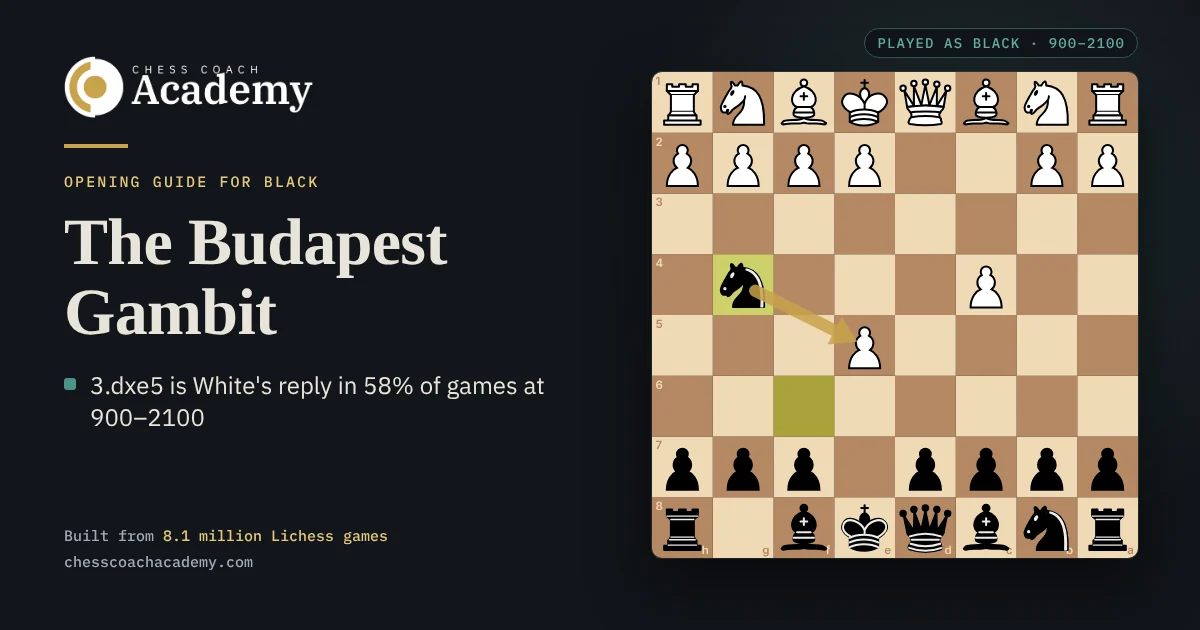
The Budapest Gambit: How It Really Plays Out at 900 to 2100
TL;DR: the data
Built from 8.1 million Lichess games played by 900 to 2100 rated players You play Black, 14 practice lines, every move of yours checked by Stockfish Most common line 1. d4 Nf6 2. c4 e5 3. dxe5 Ng4 4. Nf3 Bc5 5. e3 Nc6 6. Nc3 O-O 7. Be2 Re8 8. O-O Ngxe5 Replies to 5...Nc6 6. Nc3 29% · 6. Be2 22% · 6. Qd5 16% Worth knowing After 4.Bf4 Nc6 5.Nf3 Bb4+ 6.Nbd2 Qe7 7.a3 Ngxe5, 42% of White players take the bishop with 8.axb4?? and Black wins 99% of those games thanks to 8...Nd3#.
The Budapest Gambit is 1.d4 Nf6 2.c4 e5. Instead of a slow setup, you offer a pawn on move two. White usually takes it, and your knight jumps to g4 to attack it straight back. Then you pile up on e5 with ...Bc5 or ...Bb4+, ...Nc6 and ...Qe7, and in most lines the pawn falls within a few moves.
This guide is built from 8.1 million Lichess games played by 900 to 2100 rated players. The honest summary: with perfect play Stockfish still gives White a small edge, but at this level White has to find several accurate moves in a row, and the data shows how often that doesn't happen. The best example is a trap in the 4.Bf4 line that catches 42% of White players.
1. d4 Nf6 2. c4 e5
Practice the Budapest Gambit free →Who it's for
Players rated roughly 900 to 2100 who want an active answer to 1.d4 2.c4 and like having a clear target. Your plan in almost every line is the same: attack e5 until it drops, then play a normal game with active pieces.
It's a good fit if you like positions where knowing the tricks matters more than White's small theoretical edge. It's less suited to players who want a sound, long-term answer to 1.d4, and you'll need something else against White players who don't play 2.c4.
Why it works at 900 to 2100
- A simple plan. Attack e5 with your knights, bishop, queen and sometimes a rook until it falls, and in almost every line here it does.
- White has to be accurate from move three. A natural move like 5.Nc3? in the 4.Nf3 line drops a pawn, and grabbing your bishop in the 4.Bf4 line gets White mated.
- Declining helps you too. Against 3.d5, 3.Nc3 and 3.e3 you get an easy, active game with no risk.
- White keeps a small edge with best play. Stockfish gives White around half a pawn to three quarters of a pawn in the main lines, so this is a fighting choice, not a refutation of 1.d4.
- You don't always get the pawn back. In the 4.Bf4 line with 6.Nc3 and 7.Qd5 you stay a pawn down and play against White's doubled c-pawns instead.
- It only works after 2.c4. White plays 2.c4 in 41% of games in this data, so you need a different plan when White starts with 2.Nf3 or 2.Bf4.
What 900 to 2100 players actually play
This is the main line position, after 4.Nf3 Bc5 5.e3 Nc6. Your knight and bishop both hit e5, and White's replies are spread out. 6.Nc3 is the most common at 29%, then 6.Be2 (22%), 6.Qd5 (16%), 6.a3 (13%) and 6.h3 (10%). Most of them just develop and let the pawn go. Only 6.Qd5 adds a second defender, and your answer to that is ...Qe7.
Three numbers from the data tell you how this gambit plays out:
- After 1.d4 Nf6 2.c4 e5, White takes the pawn with 3.dxe5 in 58% of games at 900-2100. 3.d5 (20%) and 3.Nc3 (11%) are the most common ways to decline.
- After 3...Ng4, White defends with 4.Nf3 in 55% of games and 4.Bf4 in 19%; 4.e4, giving the pawn back, comes up in 7%.
- After 4.Bf4 Nc6 5.Nf3 Bb4+ 6.Nbd2 Qe7 7.a3 Ngxe5, 42% of White players take the bishop with 8.axb4?? and Black wins 99% of those games thanks to 8...Nd3#.
How to play the Budapest Gambit: move by move
Each board below is a position from the practice lines, shown from your side. The arrows show White's most common replies at 900 to 2100, labeled with how often each one is played in that exact position. Under every board you'll find why White plays the move and the answer you give.
After 1. d4 Nf6 2. c4 e5
About six White players in ten take the pawn. The rest decline, and every way of declining gives you a comfortable game.
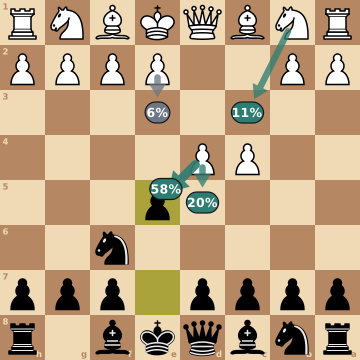
- 3. dxe5 (58%). White is a pawn up for now, but that pawn on e5 is hard to keep.
Your answer: 3...Ng4. Attack the e5 pawn at once. - 3. d5 (20%). d5? doesn't lose material, but it closes the center and leaves your e5 pawn safe.
Your answer: 3...Bb4+. Develop with check. - 3. Nc3 (11%). White ignores the gambit and develops Nc3.
Your answer: 3...exd4. Take the pawn in the center. - 3. e3 (6%). It holds the center but blocks White's c1 bishop.
Your answer: 3...exd4. Trade pawns in the center.
After 1. d4 Nf6 2. c4 e5 3. dxe5 Ng4
White has to defend e5 or give it back. 4.Nf3 and 4.Bf4 defend it, and your answers (...Bc5 and ...Nc6) add attackers until White runs out of defenders.
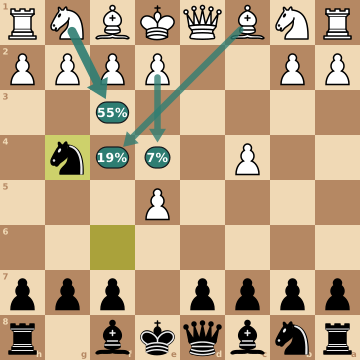
- 4. Nf3 (55%). It protects the pawn and develops a piece.
Your answer: 4...Bc5. Your bishop and knight now both aim at f2. - 4. Bf4 (19%). White defends e5 with the bishop.
Your answer: 4...Nc6. Another attacker on e5. - 4. e4 (7%). White doesn't try to hold e5 and plays for space instead.
Your answer: 4...Nxe5. Take the pawn back. Material is level.
After 1. d4 Nf6 2. c4 e5 3. dxe5 Ng4 4. Nf3 Bc5 5. e3 Nc6
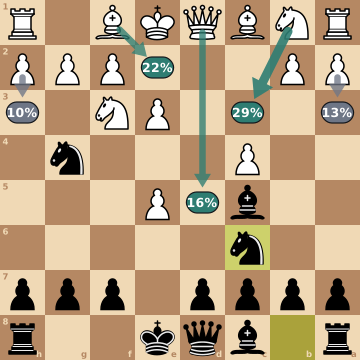
- 6. Nc3 (29%). White develops the last queenside knight instead of trying to hold e5.
Your answer: 6...O-O. Castle first. The e5 pawn isn't going anywhere. - 6. Be2 (22%). White isn't trying to hold e5 any more.
Your answer: 6...Ngxe5. Win the pawn back right away. - 6. Qd5 (16%). White's queen attacks your bishop on c5.
Your answer: 6...Qe7. Protects the bishop and adds another attacker on e5. - 6. a3 (13%). White plays a3, preparing b4.
Your answer: 6...a5. Stops b4 for good. - 6. h3 (10%). White kicks your knight with h3.
Your answer: 6...Ngxe5. The knight was attacked, so take the pawn.
After 1. d4 Nf6 2. c4 e5 3. dxe5 Ng4 4. Nf3 Bc5 5. e3 Nc6 6. Be2 Ngxe5
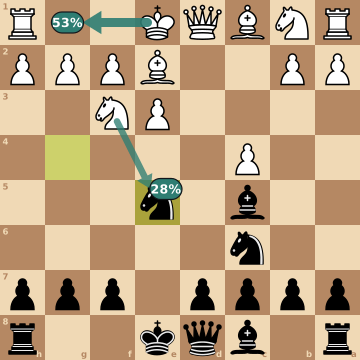
- 7. O-O (53%). White keeps the knights on the board.
Your answer: 7...O-O. Castle too, and your king is safe. - 7. Nxe5 (28%). White trades knights on e5.
Your answer: 7...Nxe5. Recapture, and your knight stands in the center.
After 1. d4 Nf6 2. c4 e5 3. dxe5 Ng4 4. Bf4 Nc6 5. Nf3 Bb4+
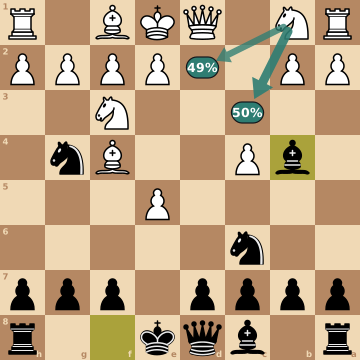
- 6. Nc3 (50%). Your bishop now pins that knight to White's king.
Your answer: 6...Qe7. A third attacker on e5. - 6. Nbd2 (49%). Remember that.
Your answer: 6...Qe7. Third attacker on e5, and your queen lines up with White's king.
After 1. d4 Nf6 2. c4 e5 3. dxe5 Ng4 4. Bf4 Nc6 5. Nf3 Bb4+ 6. Nbd2 Qe7
This is the trap position. White's king is boxed in on e1, and your queen looks straight down the e-file at e2. After 7.a3, ignore the attack on your bishop and take on e5.
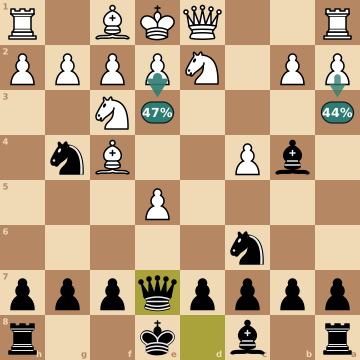
- 7. e3 (47%). It's White's most careful choice.
Your answer: 7...Ngxe5. Win the pawn back. - 7. a3 (44%). White attacks your bishop with a3.
Your answer: 7...Ngxe5. Ignore the attack on your bishop. It's a trap!
After 1. d4 Nf6 2. c4 e5 3. Nc3 exd4 4. Qxd4 Nc6 5. Qd1 Bb4
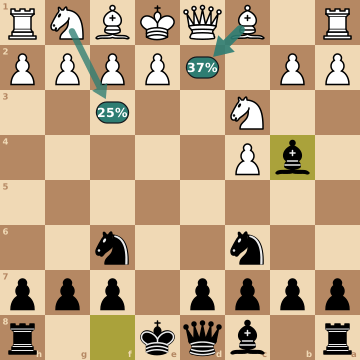
- 6. Bd2 (37%). If you take on c3, White recaptures with the bishop and keeps healthy pawns.
Your answer: 6...O-O. Castle, and you're fully comfortable. - 6. Nf3 (25%). Nf3?
Your answer: 6...Bxc3+. Double White's pawns.
Your plan after the opening
Against 4.Nf3: aim at f2, castle, then collect e5
4...Bc5 points your bishop at f2, which forces 5.e3. Add ...Nc6, castle and bring a rook to e8. The e5 pawn is then attacked three times and falls. After that, keep the bishop safe on b6 if a knight comes to e4 to hit it, and look for ...d6 and a queen on h4 or g5 against White's king.
If White plays 6.a3 to chase your bishop with b4, stop it with 6...a5. If White plays 6.Qd5, protect the bishop with 6...Qe7, which also hits e5 again.
1. d4 Nf6 2. c4 e5 3. dxe5 Ng4 4. Nf3 Bc5 5. e3 Nc6 6. Nc3 O-O 7. Be2 Re8 8. O-O Ngxe5
Against 4.Bf4: ...Nc6, ...Bb4+ and ...Qe7
Add ...Nc6, give a developing check with ...Bb4+, and bring your queen to e7. If White blocks with Nbd2, White's king is stuck, which is what makes the ...Nd3 trap possible. If White blocks with Nc3 and defends with 7.Qd5, give up your bishop with ...Bxc3+ to double White's pawns, then hit e5 with ...f6. You stay a pawn down, but Stockfish rates White only about half a pawn better.
1. d4 Nf6 2. c4 e5 3. dxe5 Ng4 4. Bf4 Nc6 5. Nf3 Bb4+ 6. Nc3 Qe7 7. Qd5 Bxc3+ 8. bxc3 f6 9. exf6 Nxf6
Against 4.e4: take back and fight the big center
White gives the pawn back to build a center. Take it with 4...Nxe5, and after 5.f4 retreat to c6. On g6 it could be chased again by h4-h5, but on c6 it's safe and it eyes d4. Then play ...Bc5, aiming at g1 to make castling awkward for White, followed by ...d6 and ...O-O. Stockfish gives White a real edge here, close to a pawn, so play it carefully.
1. d4 Nf6 2. c4 e5 3. dxe5 Ng4 4. e4 Nxe5 5. f4 Nec6
When White declines
Against 3.d5, give a check with 3...Bb4+. If White blocks with Nc3, take it and White has doubled c-pawns. Against 3.Nc3, trade with 3...exd4 and hit the queen with ...Nc6, then pin with ...Bb4. If White leaves the pin with 6.Nf3?, take on c3 and Stockfish rates you almost a pawn better.
1. d4 Nf6 2. c4 e5 3. Nc3 exd4 4. Qxd4 Nc6 5. Qd1 Bb4 6. Nf3 Bxc3+ 7. bxc3 O-O
Traps and common mistakes
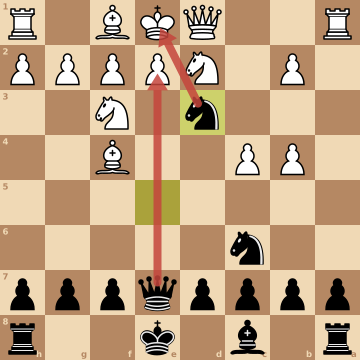
White's big mistake: 8.axb4?? Nd3#
1. d4 Nf6 2. c4 e5 3. dxe5 Ng4 4. Bf4 Nc6 5. Nf3 Bb4+ 6. Nbd2 Qe7 7. a3 Ngxe5 8. axb4?? Nd3#
This is the trap every Budapest player needs to know. After 7.a3 your bishop is attacked, but you ignore it and take on e5. If White grabs the bishop, 8...Nd3 is checkmate. The e2 pawn can't take the knight because your queen pins it, the queen on d1 is blocked by the knight on d2, and White's own pieces fill every escape square.
At this level, 42% of White players take the bishop with 8.axb4??, and Black wins 99% of those games. The trick still works one move later: after 8.Nxe5 Nxe5, 9.axb4?? walks into the same mate.
White forgets about f2: 5.Nc3? Bxf2+
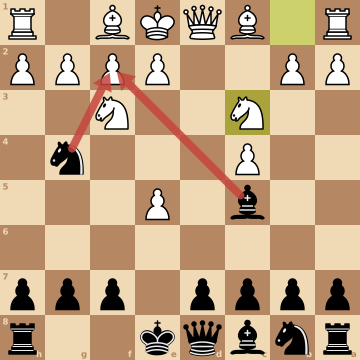
1. d4 Nf6 2. c4 e5 3. dxe5 Ng4 4. Nf3 Bc5 5. Nc3? Bxf2+ 6. Kd2
After 4.Nf3 Bc5, your bishop and knight both aim at f2, and only White's king guards it. White has to block with 5.e3, and nearly everyone does. If White plays a natural developing move instead, 5...Bxf2+ wins a pawn. Your knight on g4 protects the bishop, so the king can't take it and has to walk to d2.
Grabbing e5 too early
1. d4 Nf6 2. c4 e5 3. dxe5 Ng4 4. Nf3 Bc5 5. e3 Nc6 6. Nc3 O-O
After 6.Nc3 the pawn is attacked twice and defended once, so taking it looks obvious. But 6...Ngxe5 7.Nxe5 Nxe5 lets White kick your knight with f4, then chase your bishop with a3 and b4. Castle first, bring a rook to e8, and take the pawn a couple of moves later. It isn't going anywhere.
Letting White chase your bishop with a3 and b4
1. d4 Nf6 2. c4 e5 3. dxe5 Ng4 4. Nf3 Bc5 5. e3 Nc6 6. a3 a5
Your c5 bishop does a lot of work: it pins f2 and keeps White busy. When White plays 6.a3, answer 6...a5. Now if White pushes b4, you just take it, and your bishop stays on its good diagonal while e5 is still attacked twice.
Frequently asked questions
Is the Budapest Gambit good for beginners?
It's a good choice for players from about 900 up who like active play. The plan is simple (attack e5 until it falls) and the traps are easy to remember. The downside is that it only covers 2.c4, so you still need a second answer for other White setups.
Is the Budapest Gambit sound?
Not quite. With best play Stockfish gives White a small edge, around half a pawn to three quarters of a pawn. In practice at 900 to 2100 White has to find several precise moves, and the data shows many don't: 42% of White players fall for the ...Nd3 mate in the 4.Bf4 line.
What is the most common reply to the Budapest Gambit at club level?
At 900 to 2100 on Lichess, White takes the pawn with 3.dxe5 in 58% of games. 3.d5 (20%) and 3.Nc3 (11%) are the most common ways to decline. After 3...Ng4, White defends with 4.Nf3 in 55% of games and 4.Bf4 in 19%.
Do I always win the pawn back in the Budapest?
Almost always. Against 4.Nf3 you win it back within a few moves, often right after castling and ...Re8, and against the 4.Bf4 line with Nbd2 you take it on move seven. The exception is 4.Bf4 with 6.Nc3 and 7.Qd5, where you stay a pawn down but White has doubled c-pawns.
Why is it called the Budapest Gambit?
It's named after the city of Budapest in Hungary. The name is all you need to know: everything else in this guide is about how it's played today at 900 to 2100.
Keep learning
- All 36 opening guides: every opening on the site, grouped by what you play as White and Black.
- Is the Budapest Gambit sound?: Engine verdicts compared with how the gambit actually scores in practice.
- The best trap-heavy openings for blitz and bullet: Where the Budapest ranks among the trappiest openings at fast time controls.
The Coach plays 1.d4 and 2.c4 against you with the moves 900 to 2100 players actually choose, including the 4.Bf4 trap line, and explains every one of your moves in plain English. Progress tracking is free during the open beta.
Practice the Budapest Gambit free →