The Caro-Kann Advance for White: A Calm Setup Built From 900 to 1800 Games
TL;DR: the data
Built from 24 million Lichess games played by 900 to 1800 rated players You play White, 13 practice lines, every move of yours checked by Stockfish Most common line 1. e4 c6 2. d4 d5 3. e5 Bf5 4. Nf3 e6 5. Be2 c5 6. O-O Nc6 7. c3 cxd4 8. cxd4 Replies to 7.c3 7...cxd4 29% · 7...Qb6 29% · 7...Nge7 17% Worth knowing After 5...Nd7 6.O-O c5, only 12% of White players find 7.c4, but they win 69% of those games.
Against the Caro-Kann, 3.e5 is the calm, space-first answer. You push past Black's d5 pawn, take the f6 square away from Black's knight, and ask Black to prove the position is fine. Black's pieces have less room, and Black's only real target is your d4 pawn.
This guide is built from 24 million Lichess games played by 900 to 1800 rated players. At that level the main problem isn't theory. It's that several very natural Black moves are mistakes, and most White players don't punish them. The lines below show you which moves those are and the one pawn break, c4, that punishes two of them.
1. e4 c6 2. d4 d5 3. e5 Bf5 4. Nf3 e6 5. Be2
Practice the Caro-Kann Advance (White) free →Who it's for
Players rated roughly 900 to 1800 who want a principled answer to 1...c6 built on space and simple development. Against 3...Bf5 you use one setup: Nf3, Be2, castle and c3. There is very little to memorize.
It's especially natural if you already play the French Advance, because the pawn chain and the fight over d4 are the same. If you want sharp attacking lines against the Caro-Kann, this is not that repertoire: you win here by understanding the plans, not with a forced trick.
Why it works at 900 to 1800
- One calm setup (Nf3, Be2, O-O, c3) works against almost everything Black plays after 3...Bf5.
- Several common replies are real mistakes. 7...Qb6 and 7...Nge7 run into dxc5, and an early ...cxd4 lets your knight hit the f5 bishop.
- The data rewards you for knowing one break. When Black plays ...c5 with the king still on e8, c4 opens lines and White wins most of those games.
- Against correct play the main line is close to level. You need to know the middlegame plans, not just the moves.
- d4 is the base of your chain and Black's main target. If it falls, e5 usually falls with it.
- Black's f5 bishop is a good piece in this structure. You often have to spend time with Nh4 to trade it off.
What 900 to 1800 players actually play
Once your king is castled and c3 supports d4, Black has three main choices. 7...cxd4 and 7...Qb6 are tied at 29% each, and 7...Nge7 follows at 17%. Only the first is a good move. The queen on b6 can be hit by your pawn with dxc5, and the knight on e7 blocks Black's own f8 bishop, so again dxc5 wins time or a pawn. Together those two mistakes make up almost half the games.
Three numbers from the data worth remembering:
- After 3.e5, players rated 900-1800 on Lichess answer 3...Bf5 in 62% of games, 3...c5 in 24% and 3...e6 in 8%.
- After 5...Nd7 6.O-O c5, only 12% of White players find 7.c4, but they win 69% of those games.
- After 5...c5 6.O-O cxd4 7.Nxd4 Bg6, the strong 8.c4 scores 65% wins for White at this level.
How to play the Caro-Kann Advance (White): move by move
Each board below is a real decision point from the practice lines. The arrows show Black's most common replies at 900 to 1800, labeled with how often each is played in that exact position. Under each board you'll find why players choose the move and the answer the Coach teaches.
After 1. e4 c6 2. d4 d5 3. e5
Three replies cover almost every game. Against all three your next move is the same: Nf3, guarding both d4 and e5.
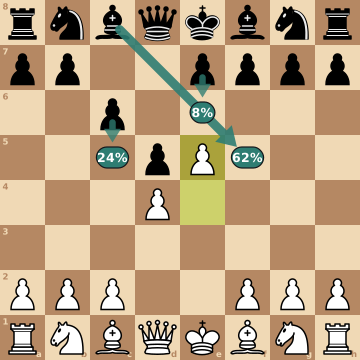
- 3...Bf5 (62%). e6 shuts it in.
Your answer: 4. Nf3. Develop a knight that guards both d4 and e5. - 3...c5 (24%). Black's c-pawn has moved twice, but the c8 bishop is still free to come out.
Your answer: 4. Nf3. Develop and protect both d4 and e5. - 3...e6 (8%). The light-squared bishop is now stuck behind Black's own pawns, which is exactly what the Caro-Kann normally avoids.
Your answer: 4. Nf3. Develop and protect d4 and e5.
After 1. e4 c6 2. d4 d5 3. e5 Bf5 4. Nf3 e6 5. Be2
Most White players at this level choose Bd3 here to trade off the f5 bishop. The Coach prefers Be2: you castle next move and keep more pieces on the board. Against almost every reply, castling is your next move.
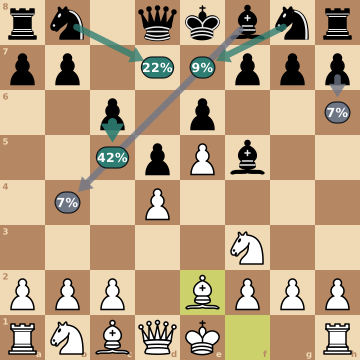
- 5...c5 (42%). d4 is the base of your pawn chain d4-e5, so Black attacks it to weaken e5 too.
Your answer: 6. O-O. Get your king safe before the center opens. - 5...Nd7 (22%). c5 and keeps an eye on e5.
Your answer: 6. O-O. Castle first, as usual. - 5...Ne7 (9%). Black develops the knight to e7.
Your answer: 6. O-O. Castle and keep things calm. - 5...h6 (7%). It doesn't develop anything.
Your answer: 6. O-O. Castle while Black spends time on pawn moves. - 5...Bb4+ (7%). It's not dangerous, but you need to block it.
Your answer: 6. c3. Block with a pawn and attack the bishop.
After 1. e4 c6 2. d4 d5 3. e5 Bf5 4. Nf3 e6 5. Be2 c5 6. O-O
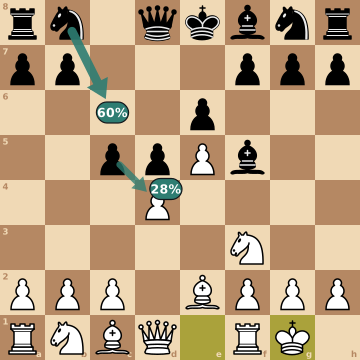
- 6...Nc6 (60%). Now d4 is attacked by the c5 pawn and the knight.
Your answer: 7. c3. Support d4 with a pawn. - 6...cxd4 (28%). cxd4? Black also opens the center while the king is still on e8.
Your answer: 7. Nxd4. Recapture with the knight and attack the f5 bishop.
After 1. e4 c6 2. d4 d5 3. e5 Bf5 4. Nf3 e6 5. Be2 c5 6. O-O Nc6 7. c3
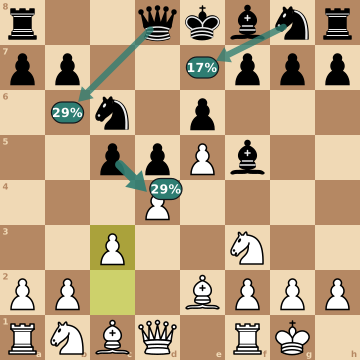
- 7...cxd4 (29%). It opens the c-file for both sides.
Your answer: 8. cxd4. Recapture with the pawn and keep your chain d4-e5. - 7...Qb6 (29%). Qb6? But a queen standing in front of Black's pawns can be hit by one of yours.
Your answer: 8. dxc5. Take the pawn, and your new c5 pawn attacks the queen. - 7...Nge7 (17%). Nge7?Ng6 to hit e5, but the knight now blocks the f8 bishop. If you take on c5, that bishop can't take back.
Your answer: 8. dxc5. Grab the pawn. Black's bishop can't recapture.
After 1. e4 c6 2. d4 d5 3. e5 Bf5 4. Nf3 e6 5. Be2 Nd7 6. O-O
The knight on d7 cuts Black's queen off from d5. Remember this: if Black now plays ...c5, the pawn on d5 has only one defender, and c4 attacks it.
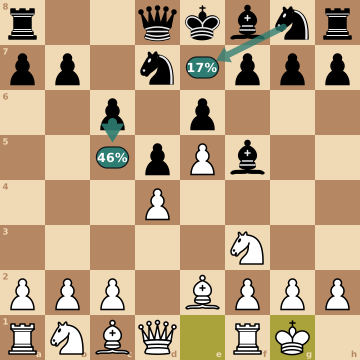
- 6...c5 (46%). c5? Only the e6 pawn protects it.
Your answer: 7. c4. Hit the d5 pawn while it's short of defenders. - 6...Ne7 (17%). c5. Black keeps things solid.
Your answer: 7. c3. Support d4 before Black attacks it.
After 1. e4 c6 2. d4 d5 3. e5 c5 4. Nf3
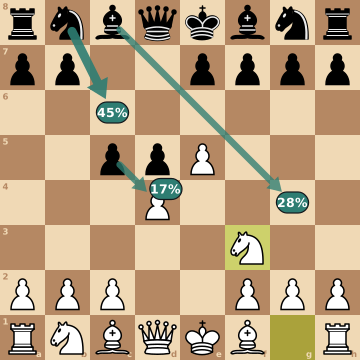
- 4...Nc6 (45%). The knight joins the c5 pawn in attacking d4.
Your answer: 5. Bb5. Pin the knight to Black's king. - 4...Bg4 (28%). That knight guards d4 and e5, so Black wants to trade it off.
Your answer: 5. dxc5. Take the pawn so there's nothing left on d4 to attack. - 4...cxd4 (17%). Black trades pawns on d4.
Your answer: 5. Nxd4. Recapture with the knight, strong in the center.
Your plan after the opening
The main line: keep d4, then chase the f5 bishop
After 7...cxd4 take back with the c-pawn, so your chain d4-e5 stays intact and c3 opens up for your queen's knight. Then develop with Nc3 and look for Nh4 to hunt the f5 bishop, or Be3 to support d4.
d4 is guarded by your knight and queen, so if Black plays ...Qb6 and ...Nxd4, check whether Nxd4 simply wins a piece. It often does.
1. e4 c6 2. d4 d5 3. e5 Bf5 4. Nf3 e6 5. Be2 c5 6. O-O Nc6 7. c3 cxd4 8. cxd4 Nge7 9. Nc3 Bg4 10. Nh4 Bxe2 11. Nxe2
Hunt the bishop pair with Nh4
Black's light-squared bishop is the piece that makes the Caro-Kann work. When Black wastes time, Nh4 attacks it, and if it retreats to g6, Nxg6 gives you both bishops against Black's one. After 5...Bb4+ 6.c3 Ba5 7.O-O Ne7 8.Nh4, for example, Stockfish rates you about a pawn better.
1. e4 c6 2. d4 d5 3. e5 Bf5 4. Nf3 e6 5. Be2 Bb4+ 6. c3 Ba5 7. O-O Ne7 8. Nh4
Against 3...c5: develop fast and use the pin
3...c5 attacks d4 at once. Play Nf3, and if Black adds 4...Nc6, pin the knight with 5.Bb5 so it can't add to the pressure. Against 4...Bg4 take on c5 so there is nothing left on d4 to attack. Against 4...cxd4 recapture with the knight and trade on c6 to split Black's pawns.
1. e4 c6 2. d4 d5 3. e5 c5 4. Nf3 Nc6 5. Bb5
Against 3...e6: it's a French with Black a move behind
Black has used two moves to get the c-pawn to c5 and has locked in the c8 bishop. Play exactly as in the French Advance: c3, Be2 or Bd3, and castle.
1. e4 c6 2. d4 d5 3. e5 e6 4. Nf3 c5 5. c3
Traps and common mistakes
Missing 7.c4 after 5...Nd7 and ...c5
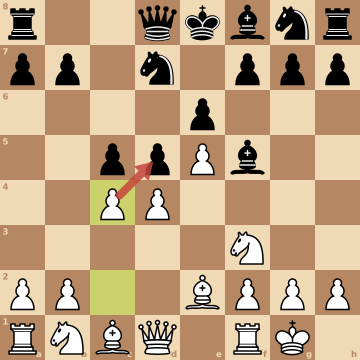
1. e4 c6 2. d4 d5 3. e5 Bf5 4. Nf3 e6 5. Be2 Nd7 6. O-O c5 7. c4!
With the knight on d7, Black's queen no longer guards d5. Only the e6 pawn does. 7.c4 hits it at once, while Black's king is still on e8 and the g8 knight and f8 bishop haven't moved.
Only 12% of White players find 7.c4 at this level, but they win 69% of those games. If Black answers 7...cxd4?, 8.cxd5 is even stronger.
Answering 7...Qb6 with a slow move
1. e4 c6 2. d4 d5 3. e5 Bf5 4. Nf3 e6 5. Be2 c5 6. O-O Nc6 7. c3 Qb6 8. dxc5! Bxc5 9. b4
7...Qb6 is one of the most popular moves here, and it's a mistake: a queen standing in front of Black's pawns can be hit by one of yours. 8.dxc5 attacks it, and after 8...Bxc5, 9.b4 chases the bishop too. Next b5 kicks the c6 knight.
Don't worry about 9...Bxb4: after 10.cxb4 Qxb4, Black has given a whole bishop for two pawns. Even against Black's best reply to 9.b4, Stockfish rates you about a pawn and a half ahead.
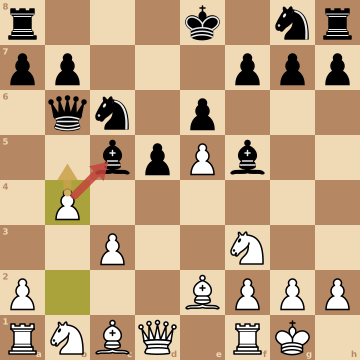
Not grabbing c5 after 7...Nge7
1. e4 c6 2. d4 d5 3. e5 Bf5 4. Nf3 e6 5. Be2 c5 6. O-O Nc6 7. c3 Nge7 8. dxc5! Ng6 9. b4
The knight on e7 wants to go to g6 and hit e5, but right now it blocks the f8 bishop. So 8.dxc5 wins a pawn that the bishop can't take back, and 9.b4 protects it. Black usually wins back e5, but your extra queenside pawns and Nd4 hitting the f5 bishop give you the better game.
Taking back slowly after an early ...cxd4
1. e4 c6 2. d4 d5 3. e5 Bf5 4. Nf3 e6 5. Be2 c5 6. O-O cxd4 7. Nxd4 Bg6 8. c4!
When Black trades on d4 before you've played c3, take back with the knight. 7.Nxd4 attacks the f5 bishop, so Black spends another move on it. Then 8.c4 opens the center while Black's king is still at home. At this level 8.c4 scores 65% wins for White.
Opening the long diagonal in the 3...c5 line
1. e4 c6 2. d4 d5 3. e5 c5 4. Nf3 Nc6 5. Bb5 cxd4 6. Nxd4 Bd7 7. Nxc6 Bxc6 8. Bxc6+ bxc6
After 7...Bxc6 it's tempting to keep your bishop with 8.Bd3. It's playable, but it hands Black an easy target: 8...d4 opens the long diagonal, and Black's bishop on c6 hits your g2 pawn with the rook on h1 behind it. The simpler way is to trade with 8.Bxc6+, castle, and use your space.
Frequently asked questions
Is the Caro-Kann Advance good for White beginners?
Yes. Against the main reply 3...Bf5 you play the same four moves (Nf3, Be2, O-O, c3) almost every game. And at 900 to 1800 several of Black's most common moves are mistakes, so knowing a couple of ideas like dxc5 and c4 wins a lot of games.
What is the most common reply to the Caro-Kann Advance?
At 900 to 1800 on Lichess, Black answers 3.e5 with 3...Bf5 in 62% of games, 3...c5 in 24% and 3...e6 in 8%. After 3...Bf5 4.Nf3, 4...e6 follows in 85% of games.
Should White play Bd3 or Be2 in the Caro-Kann Advance?
Bd3 is the most common move at this level because it offers to trade the f5 bishop. The Coach teaches Be2: it's simpler, you castle next move, and you keep more pieces on the board. Later, Nh4 is the calmer way to go after that bishop.
Does the Caro-Kann Advance give White an advantage?
Against perfect play it's close to level. In practice it scores well because Black has to find accurate moves: after 5...Nd7 6.O-O c5, White wins 69% of games with 7.c4, and after an early ...cxd4 and ...Bg6, 8.c4 scores 65% at this level.
What should White watch out for in the Advance Variation?
Your d4 pawn. It holds up e5, so if it falls, e5 usually goes too. Keep it defended with c3, Nf3 and your queen, and don't move pieces that guard it without counting attackers and defenders first.
Keep learning
- All 36 opening guides: every opening on the site, grouped by what you play as White and Black.
- How to Beat the Caro-Kann as White: The Short System, the ...Qxb2 grab and the 3...c5 line explained.
- Why Is the Caro-Kann So Solid?: What makes Black's position hard to crack, and where the cracks are.
- Which White Openings Are Right for 1200 to 1500 Elo: How the Caro-Kann Advance compares with other White openings at that rating.
The Coach plays the Caro-Kann against you with the moves 900 to 1800 players actually choose, including 7...Qb6 and 6...c5, and explains every move in plain English. Progress tracking is free during the open beta.
Practice the Caro-Kann Advance (White) free →