Which White Openings Are Right for 1200 to 1500 Elo (Based on Real Lichess Games)
TL;DR
- Five White openings whose recommended ranges fully cover 1200 to 1500, each built from what players at that opening's own rating range actually play on Lichess, with every White move checked by Stockfish.
- Caro-Kann Advance (White side): solid, 900 to 1800, about 24 million Lichess games. Black answers 3.e5 with 3...Bf5 in 62% of games and 3...c5 in 24%.
- Vienna Game: aggressive and flexible, 800 to 1800, about 64 million games. Against 2...Nf6, the Vienna Gambit 3.f4 scores 58% for White at this level on Lichess.
- English Opening: flexible, 1000 to 2400, about 147 million games, the largest dataset of the five.
- Trompowsky Attack: aggressive, 900 to 1800, about 4.2 million games. Only about 4% of players choose 2.Bg5, so few opponents are ready for it.
- Reti Opening: hypermodern and flexible, 1000 to 2000, about 4.8 million games. Black's replies to 1.Nf3 d5 2.c4 spread across five moves, led by 2...dxc4 (35%).
- Most percentages below are move frequencies: how often a move was played at that exact position, at that opening's rating range. Where the data states a result, we quote it with the rating band.
Why These Five, Specifically
Rating recommendations on this site aren't a guess. Each opening has an Elo range based on how sharp the resulting positions are and how much precise calculation they demand, and these five all have ranges that fully cover 1200 to 1500, not just brush against the edge of it. A few, like the London System, top out at 1400 and were left off this list for that reason. They're not bad, they just age out of this band sooner than the five below.
A note on the numbers: our trainers were rebuilt from Lichess data, so every opening now comes with the moves players at its level actually choose. Most figures here are move frequencies. A few are results, and those are quoted exactly as our data states them, always with the rating band.
Caro-Kann Advance (White Side)
Recommended range: 900 to 1800 Elo · Lichess games behind this repertoire: about 24 million · Style: Solid, positional
The Advance Variation is the most direct way to meet the Caro-Kann as White, and it hands Black two common replies at move three, plus a rarer third.
1. e4 c6 2. d4 d5 3. e5
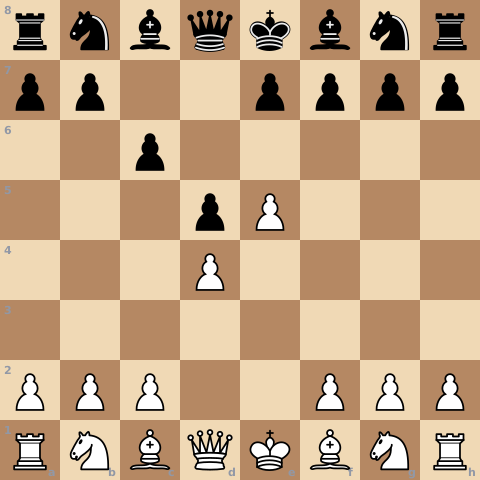
At 900 to 1800 on Lichess, the split looks like this:
- 3...Bf5 (developing the bishop to f5 before ...e6 can shut it in), 62% of games.
- 3...c5 (pushing the c-pawn to challenge White's center), 24% of games.
- 3...e6, locking the bishop in, 8% of games.
At 1200 to 1500, this matters more than it looks. A well-known problem in the French Defense, a structurally similar opening, is a light-squared bishop trapped behind its own pawns. The Caro-Kann's whole point is dodging that, and most opponents at this level know it. Against 3...Bf5 our repertoire uses one calm setup: Nf3, Be2, castle and c3.
There's also a chance to punish a common slip. After 5...Nd7 6.O-O c5, only 12% of White players find 7.c4, but they win 69% of those games at this level on Lichess.
Practice the Caro-Kann Advance interactively →
Vienna Game
Recommended range: 800 to 1800 Elo · Lichess games behind this repertoire: about 64 million · Style: Aggressive, flexible
1. e4 e5 2. Nc3
At 800 to 1800 on Lichess, Black's two main tries are almost level:
- 2...Nc6 (developing the knight toward the center), 33% of games. Our repertoire meets it with the calm 3.Bc4.
- 2...Nf6 (developing the knight to attack the e4 pawn), 32% of games.
- 2...d6 and 2...Bc5, about 10% each.
Against 2...Nf6, White has a sharp option:
3. f4
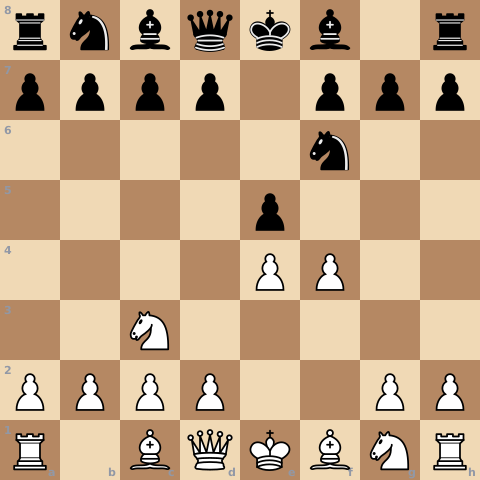
White pushes the f-pawn two squares and offers a pawn. At this level on Lichess, the Vienna Gambit 3.f4 scores 58% for White, compared with 49% for 3.Nf3. Black takes with 3...exf4 in 43.7% of games, and after 4. e5 the knight has nowhere good to go: 58% of players retreat it to g8.
About a quarter of players answer 4.e5 with the mistake 4...Qe7 instead, and White wins 72% of games after 5.Qe2. At 1200 to 1500, a line where one natural-looking move is a known error is exactly what makes an opening worth learning.
Practice the Vienna Game interactively →
English Opening
Recommended range: 1000 to 2400 Elo · Lichess games behind this repertoire: about 147 million · Style: Flexible, positional
The English is the largest dataset among these five, and it's also the most transposition-heavy, meaning the same position can be reached from several different move orders.
1. c4
At 1000 to 2400 on Lichess, Black's most common replies:
- 1...e5 (pushing the pawn two squares), a Sicilian Defense with the colors reversed, the main choice at 34%.
- 1...Nf6 (developing the knight), a flexible reply that can transpose into many structures, 17%.
- 1...c5 (the Symmetrical English), 11%, and 1...e6, 10%.
Against 1...e5, our repertoire plays 2.Nc3 and then fianchettoes with g3 and Bg2:
2. Nc3 Nf6 3. g3 d5
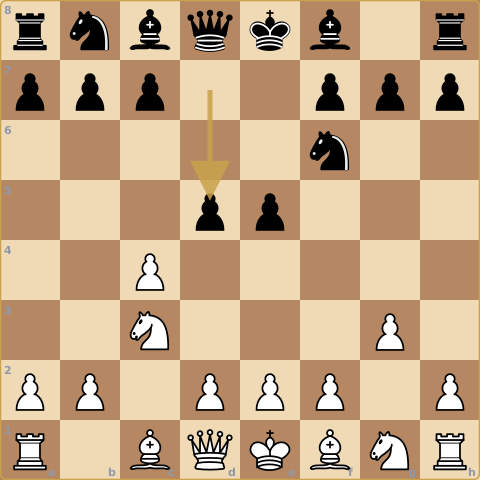
That central strike, 3...d5, is played in 22.8% of games at this point, the most common continuation, ahead of 3...Bc5 (18.7%) and 3...Bb4 (16.7%). After 3...Bc5 4.Bg2, 12% of players try 4...Ng4, and White wins 61% of those games.
For a 1200 to 1500 player, the English's flexibility cuts both ways. It rewards understanding structures over memorizing lines, which is exactly the skill this rating band is usually still building.
Practice the English Opening interactively →
Trompowsky Attack
Recommended range: 900 to 1800 Elo · Lichess games behind this repertoire: about 4.2 million · Style: Aggressive, low-theory
1. d4 Nf6 2. Bg5
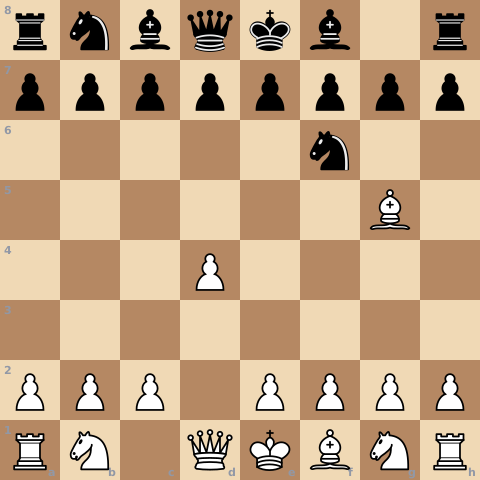
Only about 4% of players at 900 to 1800 on Lichess choose 2.Bg5 after 1.d4 Nf6, so most opponents are on their own from move two. Black's most common replies:
- 2...e6 (pushing the e-pawn one square), 29%. White grabs the center with 3.e4, using the pin on the f6 knight.
- 2...d5 (pushing the d-pawn two squares), 18%.
- 2...g6 (preparing a fianchetto), 17%.
- 2...Ne4 (the knight jumps to e4, attacking the bishop), 12%.
Against 2...d5, 2...g6 and most other replies, White simply takes on f6, gives Black doubled pawns and plays a calm e3 setup. Against 2...Ne4 the bishop retreats:
3. Bf4
The plans repeat from line to line, which is the Trompowsky's whole appeal at 1200 to 1500: less to prepare, and more room to think once a real choice appears.
Practice the Trompowsky Attack interactively →
Reti Opening
Recommended range: 1000 to 2000 Elo · Lichess games behind this repertoire: about 4.8 million · Style: Hypermodern, flexible
1. Nf3 d5 2. c4
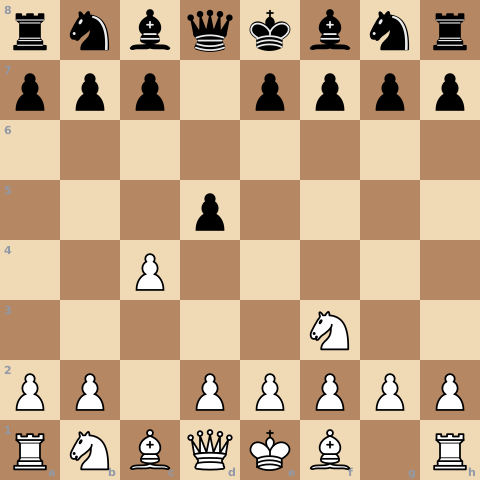
White strikes at d5 from the side. At 1000 to 2000 on Lichess, Black's replies:
- 2...dxc4 (taking the pawn), the most common at 35%. White plays 3.e3 so the bishop can win the pawn back with Bxc4, and White wins 58% of games after 3.e3 at this level.
- 2...d4 (pushing the d-pawn one more square to gain space), 20%.
- 2...c6 (supporting d5 with the c-pawn), 14%.
- 2...e6, 12%, and 2...Nf6, 11%.
Against most of these, White uses the same setup:
3. g3 Nf6 4. Bg2
That's the path after 2...c6 or 2...e6, where Black plays 3...Nf6 in 45.1% and 48.2% of games. The same g3, Bg2 and castling setup works against almost everything, with 2...dxc4 and 2...Nf6 as the two exceptions to learn.
Practice the Reti Opening interactively →
Keep reading
For both colors and the full 1200 to 1800 range:
- The Best Chess Openings for Intermediate Players (1200 to 1800): White and Black repertoires for club players, backed by our move data.
Start Practicing These for Free
All five openings above, along with the full 36-opening library, are completely unlocked during this site's open beta. No card, no limit, no account required to start, just move-by-move practice lines built from the same Lichess data cited in this article, with your progress tracked for free if you create an account.
Every line checked the same way, against real game data, not against what sounds right.
Browse all 36 openings free →