The Vienna Game and Vienna Gambit: What 800 to 1800 Players Actually Play
TL;DR: the data
Built from 64 million Lichess games played by 800 to 1800 rated players You play White, 12 practice lines, every move of yours checked by Stockfish Most common line 1. e4 e5 2. Nc3 Nc6 3. Bc4 Replies to 3.f4 3...exf4 44% · 3...d6 20% · 3...Nc6 16% Worth knowing After 3.f4 exf4 4.e5, about a quarter of players answer with the mistake 4...Qe7, and White wins 72% of games after 5.Qe2.
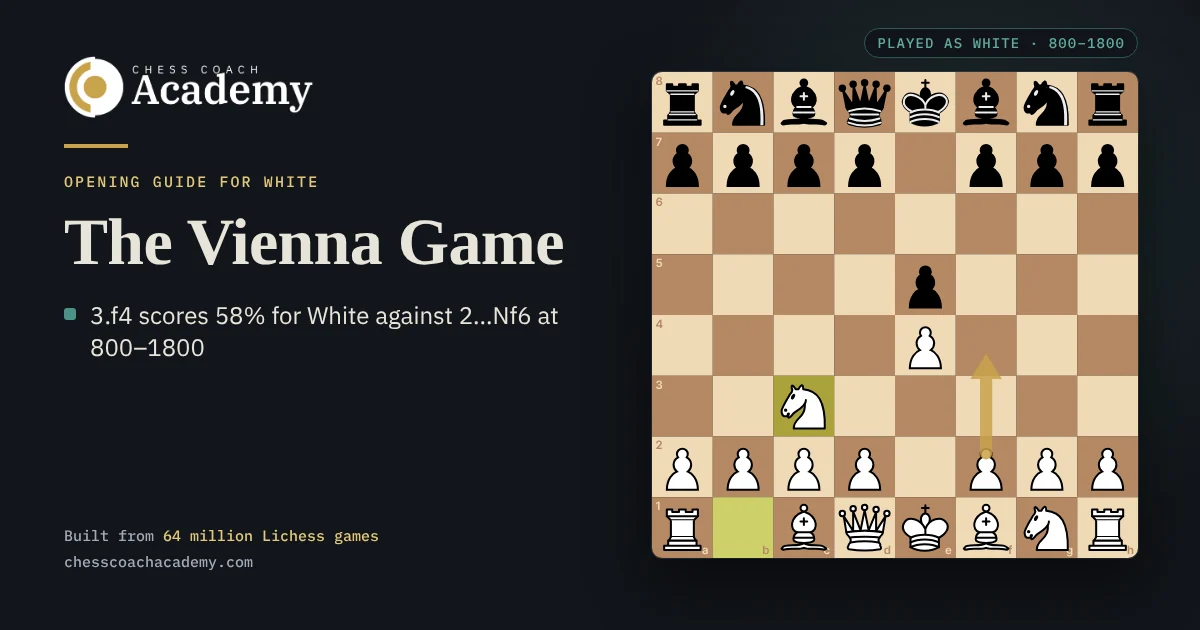
The Vienna Game starts 1.e4 e5 2.Nc3. Instead of the usual 2.Nf3, you bring out the queen's knight first. It protects e4 and, just as important, it keeps your f-pawn free. Against most replies you follow up with f4 and attack e5 with a pawn. Against 2...Nf6 that push is the Vienna Gambit.
Most guides teach the Vienna from games between masters. This one is built from 64 million Lichess games played by 800 to 1800 rated players. At this level Black's two favorite answers are almost tied, 2...Nc6 at 33% and 2...Nf6 at 32%, and the gambit line hides two very common mistakes that you'll learn to punish.
1. e4 e5 2. Nc3 Nf6 3. f4
Practice the Vienna Game free →Who it's for
Players rated roughly 800 to 1800 who enjoy open, attacking chess and want something a little different from the heavily studied 2.Nf3 lines. There's one main idea to learn, the f4 push, and a handful of tricks to watch for.
It also suits players who like choosing the tempo of the game. Against 2...Nc6 you play calmly with Bc4 and d3. Against everything else you go for f4. If you'd rather avoid any risk to your own king, a quieter opening like the Italian with d3 may suit you better.
Why it works at 800 to 1800
- The Vienna Gambit works well at this level. Against 2...Nf6, 3.f4 scores 58% for White, and two popular replies (3...Nc6 and 4...Qe7) are real mistakes.
- You dodge the Petrov and the long theory of 2.Nf3 openings. Your opponents are often out of their comfort zone by move three.
- The ideas repeat. Nf3 to cover h4, d4 to support e5, and Bxf4 to win back the pawn come up again and again.
- Pushing f4 opens lines toward your own king. Watch for ...Qh4+ in every line where your f-pawn has moved and your knight isn't on f3 yet.
- Against 2...Bc5 the bishop looks straight at g1, so you can't castle kingside until it's traded or blocked.
- Against Black's best answer to the gambit, 3...d5, you only get a level position.
What 800 to 1800 players actually play
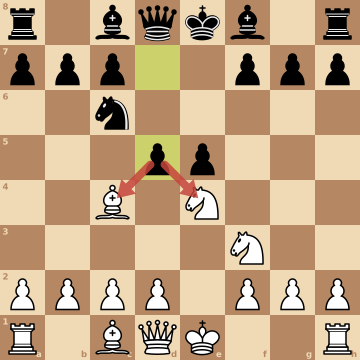
This is the heart of the Vienna Gambit. The most common reply is to grab the pawn with 3...exf4 (44%), which runs into 4.e5, kicking the knight. The solid 3...d6 comes next at 20%. Then comes 3...Nc6 at 16%, which is a mistake because fxe5 attacks the knight. The strongest answer, 3...d5, is played in only 10% of games here.
Three numbers from the data are worth remembering:
- After 1.e4 e5 2.Nc3, the most common replies at 800-1800 are 2...Nc6 (33%) and 2...Nf6 (32%), followed by 2...d6 and 2...Bc5 (10% each).
- Against 2...Nf6, the Vienna Gambit 3.f4 scores 58% for White at this level, compared with 49% for 3.Nf3.
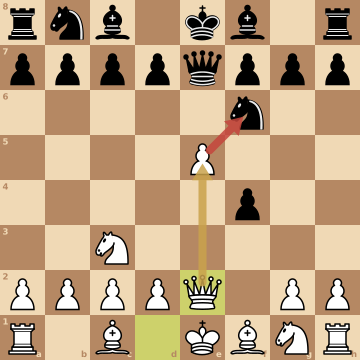
- After 3.f4 exf4 4.e5, about a quarter of players answer with the mistake 4...Qe7, and White wins 72% of games after 5.Qe2.
How to play the Vienna Game: move by move
Every board below is a decision point from the practice lines. The arrows show Black's most common replies at 800 to 1800, labeled with how often each one is played in that exact position. Under each board you'll find why players choose the move and the answer you play.
After 1. e4 e5 2. Nc3
The first fork in the road. Against 2...Nc6 you play calmly with 3.Bc4. Against the other three common replies you push 3.f4.
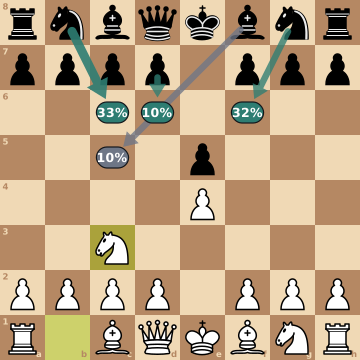
- 2...Nc6 (33%). Nc6 protects e5 and develops.Nf6.
Your answer: 3. Bc4. Develop the bishop and aim it at f7. - 2...Nf6 (32%). It develops and puts pressure on e4, which your knight on c3 protects.
Your answer: 3. f4. The Vienna Gambit. Attack e5 with a pawn. - 2...d6 (10%). d6 is solid but a bit passive: it blocks Black's f8 bishop.
Your answer: 3. f4. Attack e5 while Black is passive. - 2...Bc5 (10%). Bc5 aims at your f2 pawn and the g1 square.
Your answer: 3. f4. Attack e5, but know what the c5 bishop can do.
After 1. e4 e5 2. Nc3 Nf6 3. f4
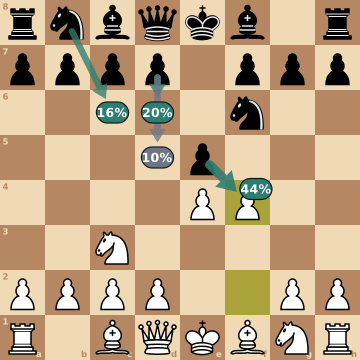
- 3...exf4 (44%). It wins a pawn for now, but it leaves the knight on f6 open to your e-pawn.
Your answer: 4. e5. Kick the knight away from f6. - 3...d6 (20%). d6 keeps a pawn on e5 so your f-pawn can't win it. It's solid, but it blocks Black's f8 bishop.
Your answer: 4. Nf3. Develop, add pressure on e5 and cover h4. - 3...Nc6 (16%). Nc6? doesn't deal with f4xe5, which also attacks the knight on f6.
Your answer: 4. fxe5. Take the pawn and attack the knight on f6. - 3...d5 (10%). d5 opens the center before you can.
Your answer: 4. fxe5. Take on e5 and attack the knight on f6.
After 1. e4 e5 2. Nc3 Nf6 3. f4 exf4 4. e5
Your pawn attacks the knight, and it has no comfortable square. Watch what Black does here: one of the two common answers is a big mistake.
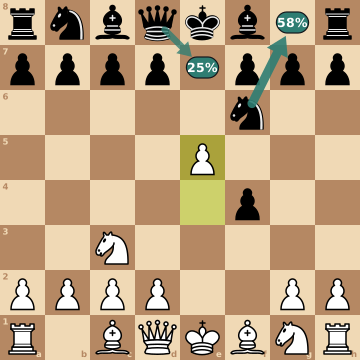
- 4...Ng8 (58%). It's safe, but Black has now used two moves to put the knight back where it started.
Your answer: 5. Nf3. Qh4+ at the same time. - 4...Qe7 (25%). Qe7? stops exf6 for now, because your e5 pawn is pinned to your king. But the queen blocks Black's own f8 bishop, and you can break the pin at once.
Your answer: 5. Qe2. Break the pin. Now exf6 is threatened.
After 1. e4 e5 2. Nc3 Nf6 3. f4 exf4 4. e5 Ng8 5. Nf3
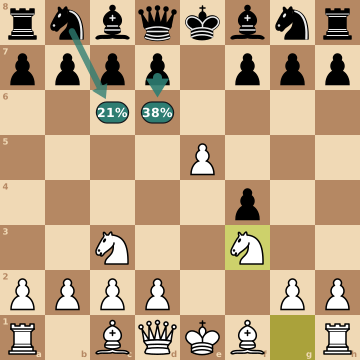
- 5...d6 (38%). It hits e5 and opens a diagonal for the c8 bishop.
Your answer: 6. d4. Support e5 and open your dark-squared bishop toward f4. - 5...Nc6 (21%). It develops, but the knight can be pushed around by your pawns later.
Your answer: 6. d4. Protect e5 and open the way for Bxf4.
After 1. e4 e5 2. Nc3 Nf6 3. f4 d6 4. Nf3
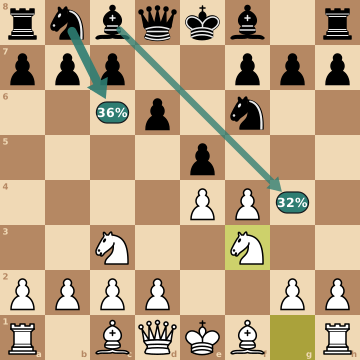
- 4...Nc6 (36%). Now e5 is protected twice.
Your answer: 5. d4. A third attack on e5, and a big center. - 4...Bg4 (32%). The knight on f3 can still move, but then your queen on d1 would be hit.
Your answer: 5. d4. Ignore the pin and build your center.
After 1. e4 e5 2. Nc3 d6 3. f4
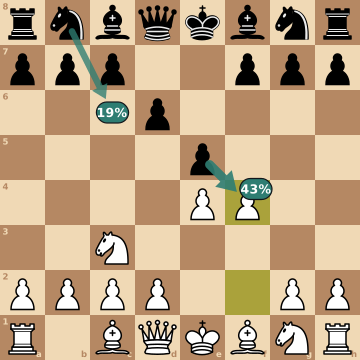
- 3...exf4 (43%). It wins a pawn for now and gives up the center.
Your answer: 4. Qf3. Go straight after the f4 pawn. - 3...Nc6 (19%). Nc6 keeps a pawn on e5 and develops.
Your answer: 4. Nf3. Develop and add pressure on e5.
After 1. e4 e5 2. Nc3 Bc5 3. f4
Remember that the bishop on c5 now looks at g1. Until it's traded off or blocked, don't castle kingside.
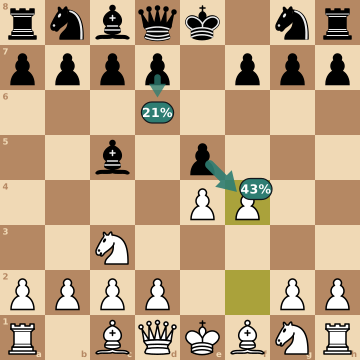
- 3...exf4 (43%). Qh4+.
Your answer: 4. Nf3. Develop and take h4 away from Black's queen. - 3...d6 (21%). d6 keeps a pawn on e5 and keeps the c5 bishop's diagonal open.
Your answer: 4. Nf3. Develop and add pressure on e5.
Your plan after the opening
Against 2...Nc6: develop calmly with Bc4 and d3
Bring the bishop to c4 to aim at f7, then play d3, a knight to f3 or e2, and castle. Stockfish rates it about equal, but it's an easy position to play. If Black chases your bishop with ...Na5, drop it back to b3.
Against the common 3...Nf6, protect e4 with 4.d3 before you play Nf3. Why that order matters is explained in the mistakes section below.
1. e4 e5 2. Nc3 Nc6 3. Bc4 Nf6 4. d3
In the Vienna Gambit: Nf3, d4, then win back f4
After 3...exf4 4.e5 Ng8 the plan is simple. Nf3 develops and covers h4, d4 supports your e5 pawn, and the c1 bishop takes back on f4 later. Black's knight on g8 can't return to f6 while your pawn is on e5.
If Black hits e5 with 5...d6 6.d4 dxe5, give a check with 7.Bb5+. After 7...c6 8.Bc4 your bishop aims at f7. Stockfish rates you slightly better even though Black is two pawns up for the moment. Against 5...Nc6 6.d4, you're about a pawn better.
1. e4 e5 2. Nc3 Nf6 3. f4 exf4 4. e5 Ng8 5. Nf3 d6 6. d4 dxe5 7. Bb5+ c6 8. Bc4
Against 3...d5: take on e5, then Nf3
After 4.fxe5 almost every player (90%) jumps into e4 with the knight. Answer with 5.Nf3 to cover h4, then play d4, Bd3 or Be2, and castle. The position is level. Avoid 5.Nxe4: after 5...dxe4 Black's pawn on e4 cramps your pieces.
1. e4 e5 2. Nc3 Nf6 3. f4 d5 4. fxe5 Nxe4 5. Nf3
Against 2...Bc5: f4 anyway, but trade that bishop
After 3.f4 exf4 4.Nf3 your king can't castle short while the c5 bishop controls g1. Develop with Bc4, then jump Na4 to trade off the bishop. Once it's gone, castle and aim for d4 and Bxf4 to win back the pawn. Stockfish rates you slightly better.
1. e4 e5 2. Nc3 Bc5 3. f4 exf4 4. Nf3
Traps and common mistakes
The 4...Qe7 pin that backfires
1. e4 e5 2. Nc3 Nf6 3. f4 exf4 4. e5 Qe7 5. Qe2 Ng8 6. d4
After 4.e5, about a quarter of players (25%) try to save the knight with 4...Qe7, pinning your e5 pawn to your king. It works for exactly one move. 5.Qe2 steps in front of your king, the pin is gone, and exf6 is threatened again.
Black usually retreats with 5...Ng8 (71%). Now no black minor piece is developed, and the queen on e7 blocks the f8 bishop. After 6.d4 Stockfish rates you about two pawns better. After 5.Qe2, White wins 72% of games at this level.
Leaving e5 to be taken: 3...Nc6?
1. e4 e5 2. Nc3 Nf6 3. f4 Nc6 4. fxe5 Nxe5 5. d4 Ng6 6. e5 Ng8
16% of players answer the gambit with 3...Nc6, which develops but does nothing about fxe5. Take with 4.fxe5, attacking the f6 knight. If Black grabs your e4 pawn with the f6 knight, Nxe4 wins a piece. After 4...Nxe5 5.d4 your pawns chase both knights back home. Stockfish rates you about a pawn and a half better.
The fork trick after 2...Nc6 3.Bc4 Nf6
1. e4 e5 2. Nc3 Nc6 3. Bc4 Nf6 4. Nf3 Nxe4! 5. Nxe4 d5
4.Nf3 looks like the most natural move, but it leaves e4 without a pawn guard and hands Black an easy way to equalize. Black takes it with the knight, and after 5.Nxe4 d5 the pawn forks your bishop and knight, so Black wins the piece back. Stockfish rates the game dead level, and Black has an easy position.
Play 4.d3 first. Your e4 pawn is safe, and Nf3 can come next.
Forgetting about ...Qh4+
1. e4 e5 2. Nc3 d6 3. f4 exf4 4. Qf3 Qh4+ 5. g3 fxg3 6. hxg3
Once your f-pawn has moved, Black's queen can check on h4. In most lines Nf3 covers that square. Against 2...d6 3.f4 exf4 you go after the pawn with 4.Qf3 instead, so know the answer to the check: 5.g3. If 5...fxg3 6.hxg3, your rook on h1 attacks the queen.
In the same line, after 4...Nc6 5.Qxf4 Nd4, protect c2 with 6.Bd3. Otherwise ...Nxc2+ forks your king and rook.
Frequently asked questions
Is the Vienna Game good for beginners?
Yes. The moves are natural, there's one main idea (the f4 push), and at 800 to 1800 two of the most common replies to the Vienna Gambit are mistakes. You do need to respect ...Qh4+ once your f-pawn has moved.
What is the Vienna Gambit?
It's 1.e4 e5 2.Nc3 Nf6 3.f4. You offer your f-pawn to open lines and kick the f6 knight with e5. Against 2...Nf6, the Vienna Gambit 3.f4 scores 58% for White at this level, compared with 49% for 3.Nf3.
What is the most common reply to the Vienna Game at club level?
At 800 to 1800 on Lichess it's 2...Nc6 (33%), just ahead of 2...Nf6 (32%). Then come 2...d6 and 2...Bc5 at 10% each. This guide covers all four.
What is the best reply to the Vienna Gambit for Black?
3...d5 is Black's strongest answer, opening the center before White can. Only 10% of players at this level choose it. After 4.fxe5 Nxe4 5.Nf3 the game is level.
Why play 2.Nc3 instead of 2.Nf3?
The knight on c3 protects e4 without blocking your f-pawn, so f4 is ready next move. You also avoid the Petrov and the long theory of 2.Nf3 openings. The price is that your kingside gets a bit looser once f4 is played.
Keep learning
- All 36 opening guides: every opening on the site, grouped by what you play as White and Black.
- Is the Vienna Game Good for Beginners?: The calm 2...Nc6 setup, the gambit and the rating range we recommend.
- The best trap-heavy openings for blitz: How the Vienna compares with other trap-rich openings when the clock is short.
- Which White openings are right for 1200 to 1500: Five White openings that fit this rating range, with move data for each.
The Coach plays the Vienna Game against you with the moves 800 to 1800 players actually choose, including the 4...Qe7 and 3...Nc6 mistakes, and explains every move in plain English. Progress tracking is free during the open beta.
Practice the Vienna Game free →