What Is Transposition in Chess, and How Can I Use Move Orders to Trick My Opponent?
TL;DR
Short answer Transposition is reaching the same position through a different order of moves. You can use it to steer into positions you know, to dodge your opponent's favorite line, or to keep your options open for a move longer. Games behind this article About 564 million Lichess games, each opening at its own rating range: Queen's Gambit Declined (177 million), English (147 million), Bishop's Opening (143 million), London System (35 million), French Advance (30 million), Alapin (27 million), Reti (4.8 million) and Catalan (about 939,000) Same position, two routes London: 1. d4 d5 2. Bf4 Nf6 3. e3 and 1. d4 Nf6 2. Bf4 d5 3. e3 are both in our trainer, and they're the same position One opening into another 1. e4 c5 2. c3 e6 3. d4 d5 4. e5 is exactly a French Advance position Flexible first moves English: 18 lines, 1000 to 2400 Elo. Reti: 19 lines, 1000 to 2000 Elo
What transposition means
Chess positions don't remember how they were reached. If two different move orders lead to the same pieces on the same squares with the same side to move, it's the same position, and the same theory applies.
A simple example comes from the King's Gambit. A game can start with 1.f4, then 2.e4:
That's move for move the same position as the usual order:
It's the same opening, so the same theory applies, whichever order the moves came in. The Budapest Gambit works the same way: 1.c4 Nf6 2.d4 e5 reaches the same position as 1.d4 Nf6 2.c4 e5.
Small transpositions: same opening, different order
Most transpositions are quiet swaps inside one opening. The London shows it well. Black can start with the pawn or the knight:
Both reach the identical position, and both are in our London trainer. Among 400 to 1400 rated players on Lichess, 54.9% answer 1.d4 with 1...d5 and 10.0% with 1...Nf6. After 2.Bf4 the other piece follows in 19.7% and 23.7% of those games. For a London player that's great news: you don't need two sets of preparation.
Big transpositions: one opening turns into another
The more interesting cases are when you start in one opening and end up in a completely different one. Our Alapin data has a clean example. After 2.c3, Black plays 2...e6 in 14.3% of games at 900 to 2200 on Lichess, and then:
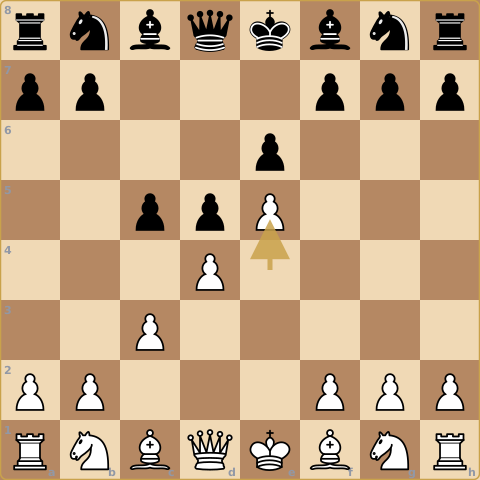
Compare it with the French Advance main line:
Same position, same side to move, and it's a position our French Advance trainer reaches after 4.c3. A Sicilian player has walked into a French. Our Alapin repertoire prefers 4.exd5 here, which opens the position instead, but if you already play the French Advance as White, 4.e5 takes you straight into familiar territory.
The English does the same thing with 1.d4 openings. Here's a line straight from our English repertoire:
That's the Queen's Gambit Declined, reached as if the game had gone 1.d4 d5 2.c4 e6 3.Nc3, which is the main line of our Queen's Gambit Declined trainer. White started with a flank pawn and arrived at one of the most classical positions in chess.
The Reti and the Catalan
The Reti is built around this kind of flexibility. Our guide calls 2...e6 the reply that heads into Catalan-style structures, and our Reti line against it stops at 4.Bg2 with that structure in place. Carry on a few natural moves and one pawn push makes it an exact Catalan:
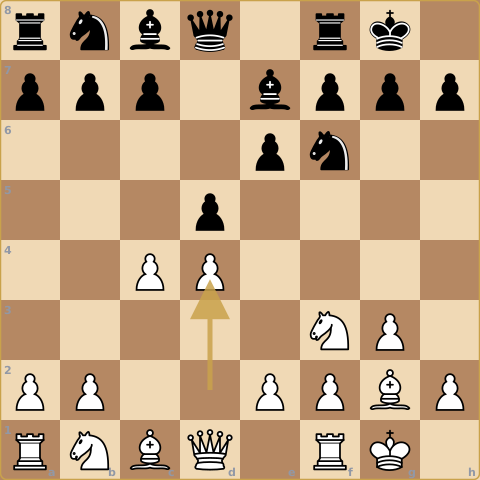
That exact position is in our Catalan trainer, reached by the Catalan's own move order. White could also keep the d-pawn back and play b3 and Bb2 instead. That's the point of the Reti: White gets to decide later which structure the game becomes.
Using move orders on purpose
Once you see transpositions, you can start using them. There are three main ways.
1. Steer into what you know. The Alapin to French example above is one. If you know a structure from another opening, look for move orders that lead into it.
2. Take away your opponent's favorite line. Some openings only work after a particular move. A few examples:
- The Budapest Gambit needs ...e5 against 1.d4 Nf6 2.c4. Play 2.Nf3 instead of 2.c4 and the knight already covers e5, so the gambit doesn't work.
- The Petroff only happens after 2.Nf3, when Black answers 2...Nf6 and hits e4. The Bishop's Opening, 1.e4 e5 2.Bc4, is played partly to avoid it, and our guide lists that as one of its strengths. Among 500 to 2000 rated players on Lichess, 2...Nf6 is still Black's most common reply (34.3%), but that isn't a Petroff.
- The Catalan, 1.d4 Nf6 2.c4 e6 3.g3, skips 3.Nc3 and so avoids the Nimzo-Indian pin with ...Bb4. Black can still give a check with 3...Bb4+, and our Catalan repertoire covers that.
3. Delay your decision. The English and Reti keep White's center flexible so Black has to commit first. Both start at 1000 Elo in our recommended ranges, against 400 for the London. That makes sense, because you need to know the positions you might transpose into.
Watch out for move-order tricks against you
Move orders cut both ways. If you play the Alapin, play 2.c3 straight away. After 2.Nf3 first, Black gets to pick a setup such as 2...d6 or 2...Nc6 before you commit, and your Alapin plan may no longer fit. And if you only know an opening from one move order, a transposition can drop you into it by surprise. The fix is to learn positions and plans, not just move sequences.
For the broader rules that make this easier, see our chess opening principles guide.
Frequently asked questions
What is transposition in chess?
Transposition means reaching the same position through a different order of moves. For example, 1.f4 e5 2.e4 and 1.e4 e5 2.f4 both reach the King's Gambit. Positions don't remember how they were reached, so the same theory applies either way.
Can a Sicilian turn into a French Defense?
Yes. After 1.e4 c5 2.c3 e6 3.d4 d5 4.e5, the position is exactly the French Advance reached by 1.e4 e6 2.d4 d5 3.e5 c5 4.c3. Among 900 to 2200 rated players on Lichess, Black plays 2...e6 in 14.3% of Alapin games.
How do I use move orders to avoid my opponent's opening?
Pick a move order that takes away the move their opening needs. Against the Budapest Gambit (1.d4 Nf6 2.c4 e5), playing 2.Nf3 instead of 2.c4 covers e5 so the gambit no longer works. Against the Petroff, 2.Bc4 (the Bishop's Opening) avoids the Petroff because White never plays 2.Nf3, the move the Petroff answers.
Which chess openings transpose the most?
Flank openings like the English (1.c4) and the Reti (1.Nf3) transpose the most, because White delays committing the center pawns. 1.c4 e6 2.Nc3 d5 3.d4, from our English repertoire, is a Queen's Gambit Declined position.
Copy the lines (PGN)
Every line in this article in standard PGN, ready to paste into Lichess, Chess.com or any chess database.
[Event "What Is Transposition in Chess, and How Can I Use Move Orders to Trick My Opponent?: King's Gambit by transposition"]
[Site "chesscoachacademy.com"]
[Result "*"]

1. f4 e5 2. e4 *

[Event "What Is Transposition in Chess, and How Can I Use Move Orders to Trick My Opponent?: London, 1...Nf6 move order"]
[Site "chesscoachacademy.com"]
[Result "*"]

1. d4 Nf6 2. Bf4 d5 3. e3 *

[Event "What Is Transposition in Chess, and How Can I Use Move Orders to Trick My Opponent?: Alapin into French Advance"]
[Site "chesscoachacademy.com"]
[Result "*"]

1. e4 c5 2. c3 e6 3. d4 d5 4. e5 *

[Event "What Is Transposition in Chess, and How Can I Use Move Orders to Trick My Opponent?: French Advance, normal order"]
[Site "chesscoachacademy.com"]
[Result "*"]

1. e4 e6 2. d4 d5 3. e5 c5 4. c3 *

[Event "What Is Transposition in Chess, and How Can I Use Move Orders to Trick My Opponent?: English into Queen's Gambit Declined"]
[Site "chesscoachacademy.com"]
[Result "*"]

1. c4 e6 2. Nc3 d5 3. d4 *

[Event "What Is Transposition in Chess, and How Can I Use Move Orders to Trick My Opponent?: Reti into Closed Catalan"]
[Site "chesscoachacademy.com"]
[Result "*"]

1. Nf3 d5 2. c4 e6 3. g3 Nf6 4. Bg2 Be7 5. O-O O-O 6. d4 *
Keep reading
- Chess Opening Principles for Beginners: The five core rules and the series this article belongs to.
Practice an opening built on move orders
The Reti is the best place to get a feel for transpositions. Our trainer covers 19 lines built from what 1000 to 2000 rated players play on Lichess, across Black's five main replies: the Reti Gambit 2...dxc4, the ambitious 2...d4, Slav-style 2...c6, Catalan-style 2...e6 and 2...Nf6, with a plain-English note on every move. If you'd rather start with something more direct, the Alapin trainer includes the 2...e6 branch where the French structures appear.
Everything is free during the open beta, and your progress on every line is tracked for free once you create an account.
Practice the Reti Opening →
Practice the Alapin Variation →
Browse all 36 openings →
19 Reti Opening lines built from 4.8 million Lichess games. Free during the open beta, with free progress tracking.
Practice the Reti free →