What Are the Most Important Chess Opening Principles for Beginners?
TL;DR
Short answer Put a pawn in the center, develop knights and bishops toward it, castle early, and don't spend early moves on your queen or on grabbing pawns. Then learn the handful of move-order rules your own openings add. Games behind this article About 394 million Lichess games across five beginner-friendly openings, each at its own rating range: Italian Game (131 million, 1000 to 1600), Petroff (98 million, 800 to 2400), Scandinavian (94 million, 400 to 1400), Caro-Kann Advance (37 million, 800 to 2200) and London System (35 million, 400 to 1400) Principles in practice In the Italian at 1000 to 1600, Black's top answers to 1. e4 e5 2. Nf3 Nc6 3. Bc4 are 3...Nf6 (31.7%) and 3...Bc5 (27.8%): both develop a piece toward the center Where principles bend The Scandinavian brings the queen out on move 2, and our trainer for it is built for 400 to 1400 Elo Best first openings London System (400 to 1400 Elo, 20 lines) and Italian Game (1000 to 1600 Elo, 20 lines) Our library 36 openings, 613 lines in total
The five principles, in order of importance
Every beginner book lists opening principles. Most lists are fine. The trouble is they rarely say which ones matter most, or when it's fine to break one. Here's the short version we'd give a new club member:
- Fight for the center. A pawn on e4 or d4 (or e5 or d5 for Black) gives your pieces room and takes squares away from your opponent's.
- Develop knights and bishops. Get them off the back rank and pointed at the center. Each opening move should ideally bring a new piece into play.
- Castle early. Your king is safest tucked away on the wing, and castling also brings a rook toward the middle.
- Don't bring the queen out early without a reason. She's easy to chase, and every time she moves, your opponent develops with tempo.
- Don't grab material you haven't checked. An extra pawn is worth less than it looks if it costs you three moves of development.
You can see the first three at work in ordinary club games. In our Italian Game data (1000 to 1600 on Lichess), 62.3% of Black players answer 2.Nf3 with 2...Nc6, and after 3.Bc4 the two most common replies are 3...Nf6 (31.7%) and 3...Bc5 (27.8%). Take the second one:
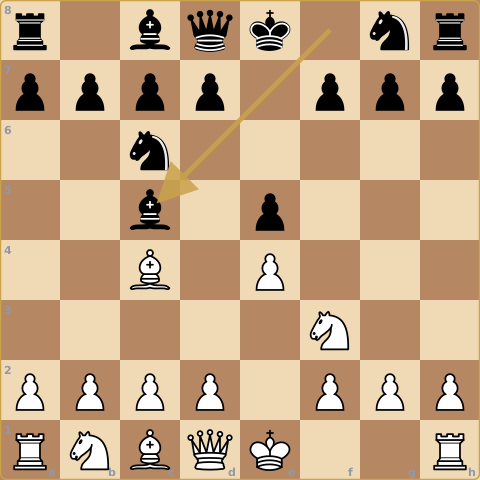
Look at what each side has done. One pawn move each to claim the center, then knight out, bishop out. Nobody has moved a piece twice, nobody has touched the queen, and White can already castle, with Black one knight move away from doing the same. That's the whole list in six moves.
Why the center comes first
A pawn on e4 does two jobs. It controls d5 and f5, and it opens lines for the queen and the light-squared bishop. That's why most of the openings in our library start with a pawn in the middle. The ones that don't, like the English (1.c4) or the Reti (1.Nf3), still aim at the center, just from the side.
A beginner's version of the rule: if you're not sure what to play on move one, play 1.e4 or 1.d4, and answer them with a pawn to the center of your own or a move that prepares one.
Develop, then castle
The Italian shows why castling isn't optional. White's bishop on c4 points straight at f7, the one square next to Black's king that only the king defends. After the usual
both kings are safe and the game can start properly. That's the most common line in our Italian trainer. After 4.d3, Black's replies at this level split 4...Bc5 (43.0%), 4...d5 (16.1%), 4...h6 (14.7%) and 4...d6 (8.5%).
The last one shows what happens when castling waits. After 4...d6, Black needs ...Be7 and ...O-O before the king is safe, and f7 is defended only by the king. So our trainer answers 5.Ng5, and f7 is attacked twice, by the knight and the bishop:
When a principle bends
Principles are defaults, not laws. The clearest example in our library is the Scandinavian Defense, which moves the queen on move two:
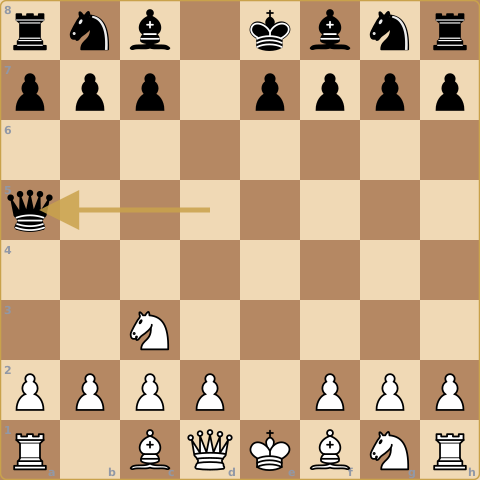
Yes, White gains a move with 3.Nc3. But a5 is a much harder square to harass than d5, and Black's plan afterwards is textbook development. Our Scandinavian trainer is built around 3...Qa5, for players rated 400 to 1400, from about 94 million Lichess games at that level. So the lesson is narrower than "queen moves are fine": you can break a principle when you know exactly why it works.
Principles plus move-order rules
Once you pick openings, each one adds a few specific rules on top of the general ones. They matter just as much:
- London System: play Bf4 before e3, or the bishop gets locked in behind its own pawn. Our London guide calls this the one rule that matters most.
- Caro-Kann: get the light-squared bishop out before ...e6. Against 3.e5, 64% of players at 800 to 2200 on Lichess answer 3...Bf5.
- Petroff: after 3.Nxe5, play 3...d6 first. Only 26% of players at 800 to 2400 find it, against 69% of players rated 2200 and up. Taking on e4 straight away walks into a well-known trap:
Here the knight uncovers a check from the queen on e2 and attacks the queen on d8 at the same time. Black loses the queen. General principles alone won't warn you about that, which is why a small amount of concrete opening study pays off.
Where to go next
This page is the starting point for our opening foundations series. Each of these answers one question beginners ask us all the time:
- Should beginners memorize opening lines or learn principles? How much of each, using our line counts.
- What's the difference between an opening, a defense, a gambit and a system? The names explained with examples from our library.
- How do I handle an unexpected move on move 2 or 3? A simple checklist for when your opponent leaves the book.
- What is transposition, and how do move orders trick opponents? Different routes to the same position.
- How far into a game does opening theory go? Line depths from all 613 lines in our library.
Frequently asked questions
What are the basic opening principles in chess?
Control the center with pawns, develop your knights and bishops toward the center, castle early to keep your king safe, avoid moving the queen early without a reason, and don't grab material unless you've checked it's safe. In the Italian Game at 1000 to 1600 on Lichess, Black's two most common answers to 1.e4 e5 2.Nf3 Nc6 3.Bc4 are 3...Nf6 (31.7%) and 3...Bc5 (27.8%), both developing moves aimed at the center.
Which opening principle is the most important?
Fighting for the center comes first, because it gives your pieces room and decides where they should develop. Development and castling follow directly from it. The other rules, like avoiding early queen moves, are there to protect those three.
Is it ever OK to break opening principles?
Yes, when you know the concrete reason it works. The Scandinavian Defense moves Black's queen on move two (1.e4 d5 2.exd5 Qxd5) and our Scandinavian trainer is still built for players from 400 to 1400 Elo, because the queen can retreat to a safe square on a5 and Black develops normally afterwards.
What opening should a beginner learn first?
The London System (1.d4 and 2.Bf4) is built for 400 to 1400 Elo, the lowest range in our library, and gives you one setup to play against almost anything. The Italian Game (1.e4 e5 2.Nf3 Nc6 3.Bc4), built for 1000 to 1600, follows the classical principles move by move. Both have 20 lines in our trainers.
Copy the lines (PGN)
Every line in this article in standard PGN, ready to paste into Lichess, Chess.com or any chess database.
[Event "What Are the Most Important Chess Opening Principles for Beginners?: Italian Game, both sides castle"]
[Site "chesscoachacademy.com"]
[Result "*"]

1. e4 e5 2. Nf3 Nc6 3. Bc4 Nf6 4. d3 Bc5 5. O-O O-O *

[Event "What Are the Most Important Chess Opening Principles for Beginners?: Italian Game, 4...d6 5.Ng5"]
[Site "chesscoachacademy.com"]
[Result "*"]

1. e4 e5 2. Nf3 Nc6 3. Bc4 Nf6 4. d3 d6 5. Ng5 *

[Event "What Are the Most Important Chess Opening Principles for Beginners?: Scandinavian Defense, 3...Qa5"]
[Site "chesscoachacademy.com"]
[Result "*"]

1. e4 d5 2. exd5 Qxd5 3. Nc3 Qa5 *

[Event "What Are the Most Important Chess Opening Principles for Beginners?: Petroff trap, 3...Nxe4?"]
[Site "chesscoachacademy.com"]
[Result "*"]

1. e4 e5 2. Nf3 Nf6 3. Nxe5 Nxe4 4. Qe2 Nf6 5. Nc6+ *
Keep reading
- Memorize Lines or Learn Principles?: How much of each a beginner needs, based on our line counts.
- Opening, Defense, Gambit or System?: What chess opening names tell you before you play a move.
- Handling Unexpected Opening Moves: What to do when your opponent leaves the book early.
- Transposition and Move Orders: Reaching the same position by a different road, and using it to your advantage.
- How Deep Does Opening Theory Go?: Line depths across our 36 openings.
- Five Openings, One Bishop: How five openings deal with the same bad-bishop problem, a principle in action.
- The Opening Isn't Always About the Position: When the right opening depends on who you're playing.
Put the principles to work in a real opening
Principles stick best when you play them over and over in one opening. The Italian Game is the cleanest place to start: 20 lines built from what 1000 to 1600 rated players actually play on Lichess, where every one of your moves follows the rules above, with a plain-English note on each one. If you'd rather play 1.d4, or you're rated under 1000, the London System trainer gives you one setup across 20 lines.
Everything is free during the open beta, and if you create an account your progress on every line is tracked for free.
Practice the Italian Game →
Practice the London System →
Browse all 36 openings →
20 Italian Game lines built from 131 million Lichess games. Free during the open beta, with free progress tracking.
Practice the Italian free →