How Do I Handle My Opponent Playing an Unexpected or Non-Book Move on Move 2 or 3?
TL;DR
Short answer Slow down and ask three questions: what does the move threaten, what did it give up, and which developing move fits my plan? Then play that move. Don't grab bait you haven't checked. Games behind this article About 324 million Lichess games, each opening at its own rating range: Italian Game (131 million), Scandinavian (94 million), Scotch Game (73 million) and Alapin (27 million) How often it happens Scandinavian: after 3...Qa5, the four White moves in our trainer cover 80.5% of games at 400 to 1400, so about one game in five leaves the tree on move four Rare but not bad Scotch: 4...Qf6 appears in 5.1% of games at 900 to 1800 and attacks the d4 knight a second time Classic bait 3...Nd4 in the Italian, where 4.Nxe5?? Qg5 hits two things at once. About 26% of 1000 to 1600 rated players on Lichess grab the pawn, and they lose 75% of those games
Why it happens so often
Opening books and trainers cover the moves players choose most. Everything else gets left out. Our own repertoires work the same way: each one is built from the replies players at its rating range actually choose most often on Lichess, and rarer moves aren't in the tree.
That means a slice of your games will leave your prepared lines early. Against the Alapin, Black's main replies at 900 to 2200 are 2...Nc6 (32.4%), 2...d6 (17.5%), 2...d5 (14.5%), 2...e6 (14.3%), 2...Nf6 (9.1%) and 2...e5 (5.2%). Our trainer covers all six, and 7.0% of games still see something else. In the Scandinavian, after 1.e4 d5 2.exd5 Qxd5 3.Nc3 Qa5, the four fourth moves in our trainer cover 80.5% of games at 400 to 1400, so about one game in five leaves the tree right there.
Many club opponents aren't following theory at all, so having a plan for "I don't know this move" matters as much as knowing your main lines.
The three-question check
When a move surprises you, don't reply straight away. Ask:
- What does it threaten? Check every capture and check it allows, and what it attacks now that it didn't before.
- What did it give up? A tempo, a square, control of the center, protection for a pawn or piece.
- Which developing move fits my plan? If there's no threat, bring out a new piece, ideally one your normal plan wants out anyway.
Most non-book moves are simply weaker than the book moves. You don't need to refute them. You need to keep developing and not fall for anything.
Example 1: the early queen defense
A common beginner move after 2.Nf3 is to defend e5 with the queen:
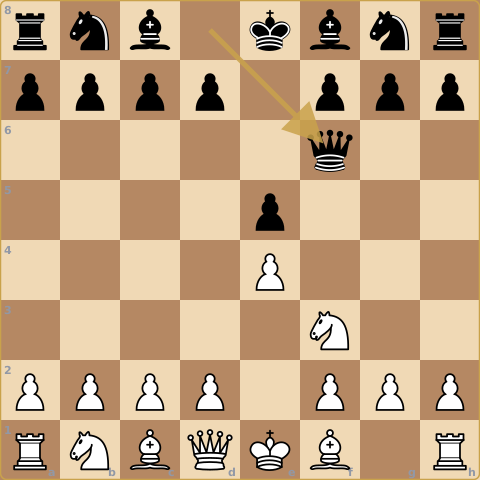
Run the check. The threat? Nothing serious. The queen eyes the knight on f3, but the g-pawn and the queen already guard it. What did it give up? The f6 square, which is where the g8 knight wants to go, and the queen is now out early where White can hit her with developing moves.
So just develop:
3.Nc3 brings out a new piece and eyes d5. From d5 a knight would attack both the queen on f6 and the pawn on c7, so Black has to spend time on that. 3.Bc4 is also a perfectly good choice. Either way, you're developing while Black is fixing problems.
Example 2: the bait
This one catches players who know the principle "take free material":
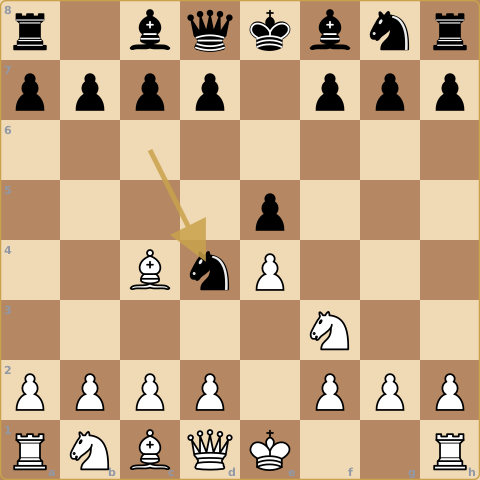
Run the check. What did it give up? The knight has moved twice and e5 is now undefended, so 4.Nxe5 looks like a free pawn. But question one comes first. After 4.Nxe5, what does Black threaten?
4...Qg5 attacks both the knight on e5 and the pawn on g2. If White greedily takes on f7 as well, Black's queen crashes through and the knight delivers mate on f3. This isn't a rare accident: at 1000 to 1600 on Lichess, about 26% of players facing 3...Nd4 grab the pawn with 4.Nxe5, and they lose 75% of those games.
The calm reply, and the one that needs no homework, is to trade the annoying knight and develop:
White is castled and has a pawn in the center. Black has moved the same knight twice and then swapped it off. Simply castling with 4.O-O is also fine.
Rare doesn't always mean bad
Don't assume every unusual move is a mistake. In the Scotch, after
Black's replies at 900 to 1800 on Lichess range from 4...Nxd4 (50.1%) down to 4...Qf6 (5.1%). That rare one looks like a beginner's queen sortie, yet our trainer treats it seriously. The queen attacks the knight on d4 a second time, so White has to react:
After 5.Be3 Bc5 it's exactly the Classical Variation position (4...Bc5 5.Be3 Qf6), and the knight is attacked three times. 6.c3 gives it a third defender, while the natural 6.Nc3?? would lose it. The three-question check finds this: what does the move threaten? The knight on d4. Deal with that first, then carry on with your plan.
After the game
- Look the move up. Find out whether it's a known sideline or just a weak move.
- Write down your best reply so you don't have to work it out again next time.
- Check your principles held. If you got into trouble, it's usually because you skipped question one.
For the core rules behind the check, see our chess opening principles guide.
Frequently asked questions
What should I do when my opponent plays an unexpected opening move?
Don't reply straight away. Ask what the move threatens, what it gave up, and which developing move fits your plan. If there's no threat, keep developing. Most non-book moves are weaker than the main moves, so solid development is usually enough to get a good position.
Should I always take free material in the opening?
Only after checking what your opponent gets in return. In the line 1.e4 e5 2.Nf3 Nc6 3.Bc4 Nd4, the pawn on e5 looks free, but 4.Nxe5 runs into 4...Qg5, attacking the knight and the g2 pawn at once, and the natural 5.Nxf7 loses to mate. If you don't know the theory, the calm 4.Nxd4 exd4 5.O-O or simply 4.O-O is the safer choice.
How often do opponents play moves I haven't prepared for?
Often, especially at club level. Among 900 to 2200 rated players on Lichess, even the most common reply to the Alapin (1.e4 c5 2.c3), 2...Nc6, comes up in only 32.4% of games, and 7.0% of games see a reply outside the six main moves. A narrow repertoire will be left behind in a good share of games.
Is an unusual opening move always a mistake?
No. Some rare moves are known sidelines with real ideas. In the Scotch, 4...Qf6 appears in only 5.1% of games at 900 to 1800 on Lichess, but it attacks the d4 knight a second time and White has to answer accurately. Treat every surprise with the same checklist rather than assuming it's bad.
Copy the lines (PGN)
Every line in this article in standard PGN, ready to paste into Lichess, Chess.com or any chess database.
[Event "How Do I Handle My Opponent Playing an Unexpected or Non-Book Move on Move 2 or 3?: Early queen, 2...Qf6"]
[Site "chesscoachacademy.com"]
[Result "*"]

1. e4 e5 2. Nf3 Qf6 3. Nc3 *

[Event "How Do I Handle My Opponent Playing an Unexpected or Non-Book Move on Move 2 or 3?: 3...Nd4 bait, 5.Nxf7? gets mated"]
[Site "chesscoachacademy.com"]
[Result "*"]

1. e4 e5 2. Nf3 Nc6 3. Bc4 Nd4 4. Nxe5 Qg5 5. Nxf7 Qxg2 6. Rf1 Qxe4+ 7. Be2 Nf3# *

[Event "How Do I Handle My Opponent Playing an Unexpected or Non-Book Move on Move 2 or 3?: 3...Nd4, calm reply"]
[Site "chesscoachacademy.com"]
[Result "*"]

1. e4 e5 2. Nf3 Nc6 3. Bc4 Nd4 4. Nxd4 exd4 5. O-O *

[Event "How Do I Handle My Opponent Playing an Unexpected or Non-Book Move on Move 2 or 3?: Scotch, 4...Qf6"]
[Site "chesscoachacademy.com"]
[Result "*"]

1. e4 e5 2. Nf3 Nc6 3. d4 exd4 4. Nxd4 Qf6 5. Be3 Bc5 6. c3 *
Keep reading
- Chess Opening Principles for Beginners: The five core rules and the series this article belongs to.
Know your main lines so surprises stand out
It's much easier to spot a strange move when you know what normal looks like. Our Italian Game trainer takes you through 20 lines built from what 1000 to 1600 rated players actually play on Lichess, including the 3...Nd4 bait, with a plain-English note on every move, so you'll recognize the main moves at a glance and know when your opponent has left them.
It's free during the open beta, and your progress on every line is tracked for free once you create an account.
20 Italian Game lines built from 131 million Lichess games. Free during the open beta, with free progress tracking.
Practice the Italian free →