How Far Into a Game Does Chess Opening Theory Usually Go?
TL;DR
Short answer For most club players, useful theory runs about 5 to 10 moves in their main lines. Top-level main lines go much deeper, often past move 10 and sometimes past move 20. Games behind this article About 341 million Lichess games, each opening at its own rating range: Italian Game (131 million), Petroff (98 million), Ruy Lopez Closed (58 million), London System (35 million), Sicilian Najdorf (17 million) and Sicilian Dragon, Yugoslav Attack (2.0 million) Our library 613 lines across 36 openings. Median line length 9 plies (White's fifth move). 365 lines end by ply 10 Deepest Sicilian Dragon, Yugoslav Attack: every line at least 17 plies, the longest 23. No other opening in our library goes past ply 18 Widest Six replies at one point is the most any of our trainers covers. The Sicilian Najdorf (1600 to 2400 Elo) has two six-way splits Beginner openings London median line 7 plies (400 to 1400 Elo), Italian 10 plies (1000 to 1600 Elo)
Moves, plies and what "theory" means
Opening theory is the set of moves that strong players and engines have tested enough to call standard. When you hear "he was still in book on move 15", that's what it means: both players were following known moves.
A quick note on counting. A ply is one move by one side. "Move 7" in chess notation is two plies, one for White and one for Black. So a 14-ply line is seven moves each.
What our 613 lines show
We measured every line in our library. Each one follows the replies that players at that opening's rating range actually choose most often on Lichess, so line length shows how far it's worth preparing at that level.
- Median length: 9 plies, which ends on White's fifth move.
- Short lines: 365 of the 613 end by ply 10.
- The middle: 178 end between ply 11 and ply 14.
- Long lines: 70 run 15 plies or more. Only 9 go past ply 18, and 5 reach our maximum of 23.
So in practical terms, the bulk of what you'd study for one opening sits in the first 5 to 7 moves.
The deep end: the Dragon and the Ruy Lopez
Some openings stay on known roads much longer. The Sicilian Dragon with the Yugoslav Attack is the clearest case in our library. Every one of its 10 lines is at least 17 plies long, and the nine longest lines in the whole library all belong to it. Black's main decision waits until White has castled queenside on move nine:
After 9.O-O-O, Black's replies split 9...d5 (34.6%), 9...Bd7 (22.2%), 9...Nxd4 (18.3%) and 9...a6 (11.1%) at 1700 to 2400 on Lichess. Even at move 12 the details matter: at that level, half of White players grab a pawn with 12.Nxd5 and win only 36%, while with 12.Bd4 White wins 47%.
The Closed Ruy Lopez is deep in a different way. Its main line takes nine moves just to reach the point where Black picks a named system:
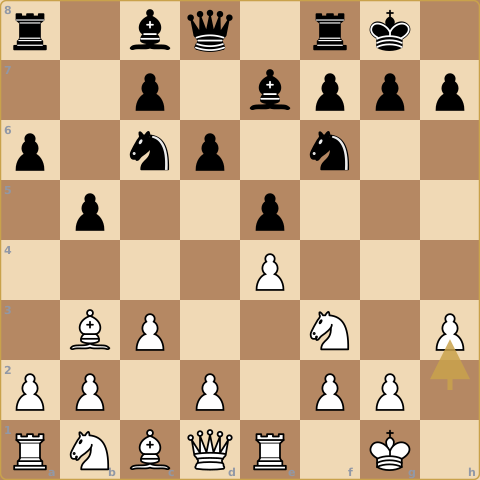
This is where the Chigorin, Breyer and Zaitsev systems begin, each with its own theory stretching well beyond this point, so our 17-ply line stops here. Earlier, after 7.Bb3, Black castles in 63% of games at 1600 to 2400 and keeps the Marshall Attack (8.c3 d5) in reserve. It's no surprise our recommended range for the Ruy starts at 1600.
The Petroff's classical main line is another long one, 18 plies in our trainer:
Both sides develop almost symmetrically, and only on move eight does White's c-pawn start to challenge the center.
Width matters as much as depth
Depth is only half the story. The other half is how many choices there are at each step. The Sicilian Najdorf is the clearest case:
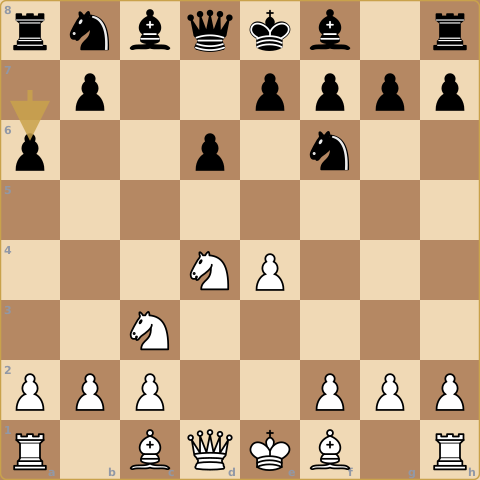
After 5...a6, White's replies at 1600 to 2400 split six ways: 6.Bg5 (24.2%), 6.Be3 (19.1%), 6.Bc4 (13.8%), 6.Be2 (12.4%), 6.f3 (7.8%) and 6.Bd3 (7.5%). And that's only if the game gets there. Only about 57% of White players answer 1...c5 with 2.Nf3, so the trainer also covers six different second moves, from 2.Nc3 to the Smith-Morra.
Six replies at one point is the most any of our trainers covers, and only three openings (the Najdorf, the King's Indian and the English) hit it twice. Our Najdorf lines have a median of just 8 plies, but a Najdorf player needs answers to all of those branches. That's why our Najdorf range starts at 1600. The lines are short, but there are a lot of them.
How deep do beginners need to go?
Much less than the numbers above suggest. Two of our most beginner-friendly White openings are short and narrow:
- London System: 20 lines, median 7 plies, and never more than four Black replies to prepare for at any point.
- Italian Game: 20 lines, median 10 plies, and no more than five Black replies at once.
Both follow a clear plan, so the later moves in each line are easy to find on principles even if you forget them. The first few moves are the ones worth drilling:
Here's a rough rule of thumb by rating:
- Under 1200: know the first 4 to 6 moves of your main lines, and the traps in them.
- 1200 to 1600: 8 to 10 moves in the lines you meet most, plus the typical plans after that.
- 1600 and up: go deeper in the lines your opponents actually play, especially the forcing ones.
When theory ends
Sooner or later you or your opponent will leave the book. That's normal, and it's where the game starts. Use the core rules from our chess opening principles guide: finish development, castle, and make a plan based on the pawn structure.
Frequently asked questions
How many moves is chess opening theory?
It depends on the opening and the level. Across the 613 lines in our library, the median line is 9 plies, ending on White's fifth move, and 543 lines end by ply 14. Deep main lines like the Sicilian Dragon's Yugoslav Attack run up to 23 plies in our trainer, and top-level preparation goes further still.
How many opening moves should a beginner memorize?
Around four to six moves of your main lines is enough under about 1200, plus the traps in them. Openings like the London System (median line 7 plies) and the Italian Game (median 10 plies) are built on a clear plan, so the later moves are easy to work out if you forget them.
What is the deepest chess opening?
The Ruy Lopez is famous for its depth: its main named systems (the Chigorin, Breyer and Zaitsev) don't start until Black's ninth move. In our library the deepest lines belong to the Sicilian Dragon's Yugoslav Attack. Every one of its 10 lines is at least 17 plies, and the longest run 23.
Why is the Najdorf considered so theory-heavy?
Because of its width. Only about 57% of White players at 1600 to 2400 on Lichess answer 1...c5 with 2.Nf3, so a Najdorf player needs answers to several second moves. Then after 1.e4 c5 2.Nf3 d6 3.d4 cxd4 4.Nxd4 Nf6 5.Nc3 a6, White has six common continuations, from 6.Bg5 (24.2%) to 6.Bd3 (7.5%). That's why our recommended range for it starts at 1600 Elo.
Copy the lines (PGN)
Every line in this article in standard PGN, ready to paste into Lichess, Chess.com or any chess database.
[Event "How Far Into a Game Does Chess Opening Theory Usually Go?: Sicilian Dragon, Yugoslav Attack, 9...d5"]
[Site "chesscoachacademy.com"]
[Result "*"]

1. e4 c5 2. Nf3 d6 3. d4 cxd4 4. Nxd4 Nf6 5. Nc3 g6 6. Be3 Bg7 7. f3 O-O 8. Qd2 Nc6 9. O-O-O d5 10. exd5 Nxd5 11. Nxc6 bxc6 12. Bd4 *

[Event "How Far Into a Game Does Chess Opening Theory Usually Go?: Closed Ruy Lopez to 9.h3"]
[Site "chesscoachacademy.com"]
[Result "*"]

1. e4 e5 2. Nf3 Nc6 3. Bb5 a6 4. Ba4 Nf6 5. O-O Be7 6. Re1 b5 7. Bb3 d6 8. c3 O-O 9. h3 *

[Event "How Far Into a Game Does Chess Opening Theory Usually Go?: Petroff classical main line"]
[Site "chesscoachacademy.com"]
[Result "*"]

1. e4 e5 2. Nf3 Nf6 3. Nxe5 d6 4. Nf3 Nxe4 5. d4 d5 6. Bd3 Bd6 7. O-O O-O 8. c4 c6 *

[Event "How Far Into a Game Does Chess Opening Theory Usually Go?: Sicilian Najdorf"]
[Site "chesscoachacademy.com"]
[Result "*"]

1. e4 c5 2. Nf3 d6 3. d4 cxd4 4. Nxd4 Nf6 5. Nc3 a6 *

[Event "How Far Into a Game Does Chess Opening Theory Usually Go?: Italian Game, most common line"]
[Site "chesscoachacademy.com"]
[Result "*"]

1. e4 e5 2. Nf3 Nc6 3. Bc4 Nf6 4. d3 Bc5 5. O-O O-O *
Keep reading
- Chess Opening Principles for Beginners: The five core rules and the series this article belongs to.
Learn the part of theory that matters
You don't need 23-ply lines to start. Our Italian Game trainer covers 20 lines built from what 1000 to 1600 rated players play on Lichess, with no more than five Black replies at any point, and every move comes with a plain-English note so the later moves make sense even when you forget them. When you want to see what deep, symmetrical theory feels like, the Petroff trainer covers 22 lines built from what 800 to 2400 rated players play on Lichess.
Both are free during the open beta, and your progress on every line is tracked for free once you create an account.
Practice the Italian Game →
Practice the Petroff Defense →
Browse all 36 openings →
20 Italian Game lines built from 131 million Lichess games. Free during the open beta, with free progress tracking.
Practice the Italian free →