The Danish Gambit at 900 to 2000: A One-Pawn Version Built From Real Games
TL;DR: the data
Built from 17 million Lichess games played by 900 to 2000 rated players You play White, 6 practice lines, every move of yours checked by Stockfish Most common line 1. e4 e5 2. d4 exd4 3. c3 dxc3 4. Nxc3 Replies to 2.d4 2...exd4 62% · 2...Nc6 13% · 2...d6 8% Worth knowing After 2...Nc6 3.d5, 28% of players reply 3...Nd4?, and after 4.c3 traps the knight White wins 69% of games.
The Danish Gambit starts 1.e4 e5 2.d4 exd4 3.c3. Instead of taking back on d4, you offer a pawn. If Black takes it, your pieces come out fast along open lines while Black still has nothing developed.
This guide is built from 17 million Lichess games played by 900 to 2000 rated players, and it makes one choice that differs from the classic Danish. After 3...dxc3 most White players go 4.Bc4 and give up a second pawn. Here you take back with 4.Nxc3 instead: one pawn down, not two, with the same fast development. Stockfish rates that close to level, while the two-pawn version leaves Black better.
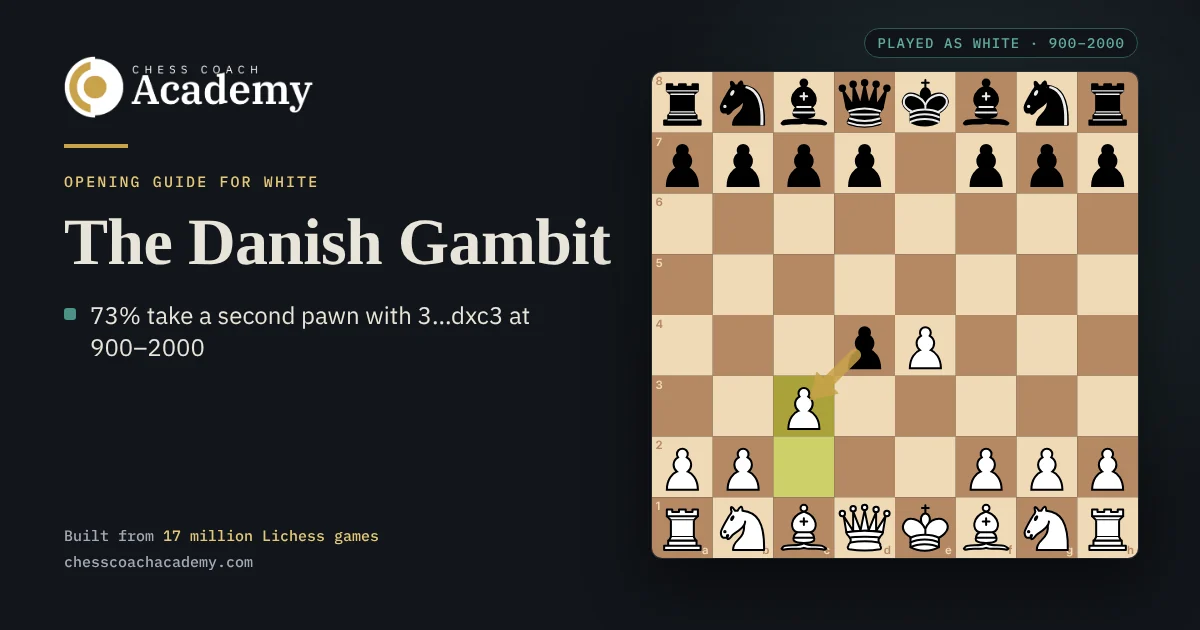
1. e4 e5 2. d4 exd4 3. c3 dxc3 4. Nxc3
Practice the Danish Gambit free →Who it's for
Players rated roughly 900 to 2000 who enjoy open positions and don't mind being a pawn down for active pieces. The plans are simple: develop fast, castle, and aim at f7 and the open files.
It suits you if you want to take your opponent out of familiar territory on move three. If you'd rather keep material level and play for a slow squeeze, the Scotch or the Italian will feel more comfortable.
Why it works at 900 to 2000
- Most opponents accept. After 3.c3, 73% of players take a second pawn with 3...dxc3, and White wins 56% of those games at this level.
- Against the declines you get the ideal center, with pawns on e4 and d4 and easy development.
- It comes with a real trap: after 2...Nc6 3.d5, 28% of players answer 3...Nd4? and lose the knight.
- In the accepted line you're a real pawn down. Stockfish rates it close to level, a shade better for Black, so your compensation has to come from activity.
- The main line is short. After 4.Nxc3 you need to understand the plans (Bc4, Nf3, O-O, Qb3) rather than memorize moves.
- Black's cleanest answer, 3...d5, gives back the pawn at once and leads to a level game. It's rare at this level, but it exists.
What 900 to 2000 players actually play
Most Black players (62%) take on d4, which is exactly what you want: now 3.c3 offers the gambit. Only 13% defend with 2...Nc6, which you meet with 3.d5, and 8% hold e5 with 2...d6. Both declines get their own answer below.
Three numbers from the data are worth remembering:
- After 3.c3, 73% of players at 900-2000 take a second pawn with 3...dxc3, and White wins 56% of those games.
- After 3...dxc3, 79% of White players go for the two-pawn version 4.Bc4 (White wins 57% of games) and 16% play 4.Nxc3 (White wins 53%).
- After 2...Nc6 3.d5, 28% of players reply 3...Nd4?, and after 4.c3 traps the knight White wins 69% of games.
How to play the Danish Gambit: move by move
Each board below is a decision point from the practice lines. The arrows show Black's most common replies at 900 to 2000, labeled with how often each one is played in that exact position. Under each board you'll find why players choose the move and the answer you play.
After 1. e4 e5 2. d4
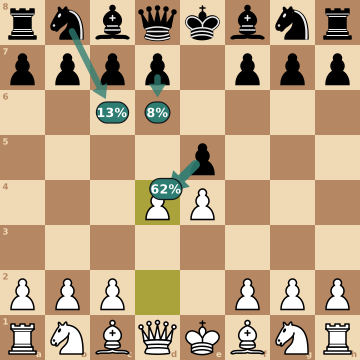
- 2...exd4 (62%). Nc6 would then chase your queen with gain of time.
Your answer: 3. c3. The Danish Gambit: you offer a pawn to open lines and develop quickly. - 2...Nc6 (13%). Nc6 develops and adds pressure to your d4 pawn.
Your answer: 3. d5. Push with tempo and chase the knight. - 2...d6 (8%). d6 keeps a pawn on e5, but it blocks Black's f8 bishop.
Your answer: 3. c3. Back up d4 with a pawn, Danish-style.
After 1. e4 e5 2. d4 exd4 3. c3
The gambit is on the board. Most players take, so the rest of the guide is about what to do a pawn down. Against 3...Nc6 you simply recapture on d4 and keep a big center.
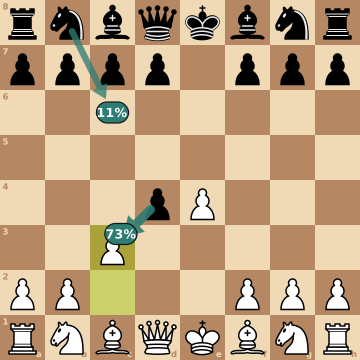
- 3...dxc3 (73%). Black is a pawn up for now, but hasn't developed a single piece.
Your answer: 4. Nxc3. Take back with a developing move. You're one pawn down, not two. - 3...Nc6 (11%). Nc6 develops and protects Black's pawn on d4.
Your answer: 4. cxd4. Take back and build the ideal center with pawns on e4 and d4.
After 1. e4 e5 2. d4 exd4 3. c3 Nc6 4. cxd4
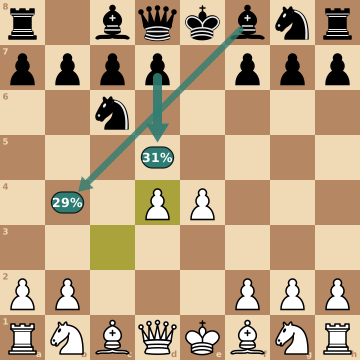
- 4...d5 (31%). d5 attacks your e4 pawn and opens Black's c8 bishop.
Your answer: 5. e5. Push past and gain space instead of trading. - 4...Bb4+ (29%). Now you need a good way to block.
Your answer: 5. Nc3. Block the check with a developing move.
After 1. e4 e5 2. d4 Nc6 3. d5
Your pawn kicks the knight. Look closely at the second most common reply: from d4 the knight has no way back.
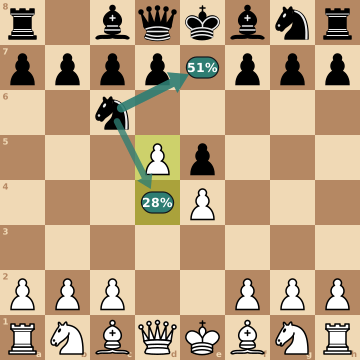
- 3...Nce7 (51%). But the knight now blocks Black's f8 bishop, so it usually has to move again, to g6.
Your answer: 4. c4. Support your d5 pawn and grab more space. - 3...Nd4 (28%). Nd4? looks active, but the knight has no safe way back.
Your answer: 4. c3. Attack the knight. It's trapped.
Your plan after the opening
In the accepted Danish: develop, castle, then Qb3
After 4.Nxc3 your plan is Bc4, Nf3 and castling, then Qb3 to pile up on f7 together with the c4 bishop. Your rooks come to d1 and e1, where the open files are. Against 4...Bc5 5.Nf3 d6, 6.Bg5 develops with a threat to the queen on d8 and prepares Bc4. You have real play for the pawn because Black has nothing out yet.
1. e4 e5 2. d4 exd4 3. c3 dxc3 4. Nxc3 Bc5 5. Nf3 d6 6. Bg5 Ne7 7. Bc4
Against 3...Nc6: take back and push e5
Recapture with 4.cxd4 and you have pawns on e4 and d4. If Black strikes with 4...d5, don't trade: 5.e5 gains space and takes f6 from Black's knight. Then Nf3 to support d4, and Bb5 to pin the c6 knight so it can't take on d4 or e5. Stockfish rates it level, with more space for you.
If Black checks first with 4...Bb4+, block with 5.Nc3. After 5...d5 6.e5 f6 7.Bb5 fxe5 8.Qh5+ Kf8, Black's king has lost the right to castle.
1. e4 e5 2. d4 exd4 3. c3 Nc6 4. cxd4 Bb4+ 5. Nc3 d5 6. e5 f6 7. Bb5 fxe5 8. Qh5+ Kf8 9. dxe5
Against 2...Nc6: d5, then a pawn wall with c4
After 3.d5 Nce7, support your d5 pawn with 4.c4. Pawns on c4, d5 and e4 give you a lot of space, and your pieces come out behind them: Nc3, Be3 or Bd3, Nf3 and castle. Black's knight usually has to move again to g6, so you're ahead in time too.
1. e4 e5 2. d4 Nc6 3. d5 Nce7 4. c4 Ng6 5. Be3
Against 2...d6: c3 and the ideal center
Back up d4 with 3.c3. If Black takes on d4, recapture with the c-pawn. This time there's no annoying ...Bb4+ check, because Black's own pawn on d6 blocks the bishop. Develop with Nc3, Nf3, Bd3 and castle.
1. e4 e5 2. d4 d6 3. c3 exd4 4. cxd4
Traps and common mistakes
The trapped knight: 2...Nc6 3.d5 Nd4?
1. e4 e5 2. d4 Nc6 3. d5 Nd4? 4. c3
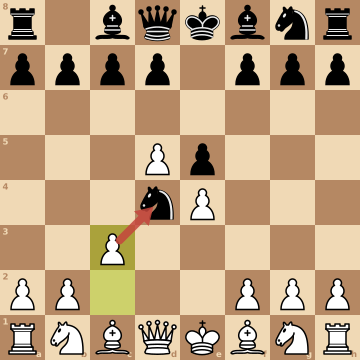
When your pawn kicks the knight, 28% of players jump into the center with 3...Nd4. It looks active, but 4.c3 leaves it with no safe square. Your queen and a-pawn cover b3 and c2, the f1 bishop covers b5 and e2, your d5 pawn covers c6 and e6, the e4 pawn covers f5, and the g-pawn and knight cover f3.
After 4.c3 traps the knight, White wins 69% of games at this level. If Black tries 4...Qh4, just take the knight with 5.cxd4 and after 5...Qxe4+ block with 6.Ne2. You're still a piece for a pawn up.
Blocking the check with Nd2
1. e4 e5 2. d4 exd4 3. c3 Nc6 4. cxd4 Bb4+ 5. Nc3
After 3...Nc6 4.cxd4 Bb4+, 29% of players give the check. The d4 pawn is attacked by the c6 knight and defended by your queen. 5.Nd2? cuts the queen off from d4, and ...Nxd4 wins a pawn. Block with 5.Nc3, which develops the piece you wanted out anyway.
Trusting a pinned knight to guard e4
1. e4 e5 2. d4 exd4 3. c3 Nc6 4. cxd4 Bb4+ 5. Nc3 Nf6 6. Bd3
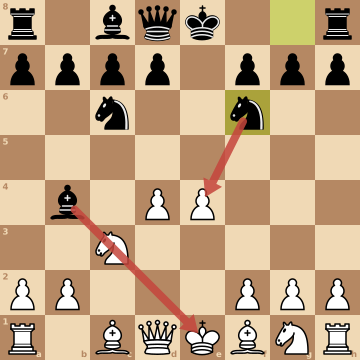
After 5.Nc3 Nf6, it looks like the c3 knight protects e4. It doesn't: it's pinned to your king by the b4 bishop. The natural 6.Nf3? runs into 6...Nxe4 and you lose a pawn. Protect e4 with 6.Bd3 or 6.f3.
Black's development mistake: 4...Nf6? 5.e5!
1. e4 e5 2. d4 exd4 3. c3 dxc3 4. Nxc3 Nf6 5. e5
In the accepted line, 4...Nf6 looks like normal development. But 5.e5 kicks the knight, and its only safe square is back on g8: d5 and e4 are covered by your c3 knight, and g4 and h5 by your queen. Black is a pawn up with nothing developed at all.
Frequently asked questions
Is the Danish Gambit sound?
Not quite, but it's very playable. Stockfish rates the accepted line after 4.Nxc3 close to level, a shade better for Black. In practice it does well: after 3.c3, 73% of players at 900 to 2000 take a second pawn with 3...dxc3, and White wins 56% of those games.
Why play 4.Nxc3 instead of the classic 4.Bc4?
After 3...dxc3, 79% of White players go for the two-pawn version 4.Bc4 (White wins 57% of games) and 16% play 4.Nxc3 (White wins 53%). So the classic version scores a bit better on Lichess. But Stockfish rates 4.Bc4 cxb2 5.Bxb2 about two thirds of a pawn in Black's favor, while 4.Nxc3 is close to level. This guide chooses the sounder version, which also holds up better against opponents who know the defense.
Is the Danish Gambit good for beginners?
It's a good way to learn the value of development and open lines. The trap after 2...Nc6 3.d5 Nd4? 4.c3 is also easy to remember. You do need to be comfortable playing a pawn down.
What if Black doesn't take the Danish Gambit?
At this level 13% play 2...Nc6 and 8% play 2...d6 before the gambit is even offered, and 11% answer 3.c3 with 3...Nc6. In all three cases you get a big center with pawns on e4 and d4 (or d5), and the plans are covered in this guide.
What is the most common reply to 2.d4?
At 900 to 2000 on Lichess, 62% of players take with 2...exd4. That's the move that lets you play 3.c3 and offer the gambit.
Keep learning
- All 36 opening guides: every opening on the site, grouped by what you play as White and Black.
- Surviving the Danish Gambit: The same opening from Black's side, so you know what a well-prepared opponent will try.
- The most aggressive chess openings for White: How the Danish compares with other attacking choices, with move data for each.
- The best trap-heavy openings for blitz: Why the Danish works so well when the clock is short.
The Coach plays the Danish Gambit against you with the moves 900 to 2000 players actually choose, including the 3...Nd4 trap, and explains every move in plain English. Progress tracking is free during the open beta.
Practice the Danish Gambit free →