En Passant in Chess: The Rule Explained, With Examples
TL;DR
In one sentence When a pawn moves two squares and lands beside your pawn, your pawn can capture it as if it had moved one. Meaning French for "in passing". Say it "on pa-SAHN". Who can do it Only a pawn, and only against a pawn Deadline The very next move. Wait, and the chance is gone. Is it forced? No, it's optional, unless it's your only legal move
The en passant rule
Pawns normally capture one square diagonally forward. On its first move, a pawn may also jump two squares. En passant is the rule that stops that jump from being used to slip past an enemy pawn.
1. e4 a6 2. e5 d5
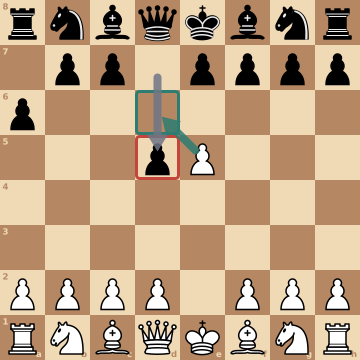
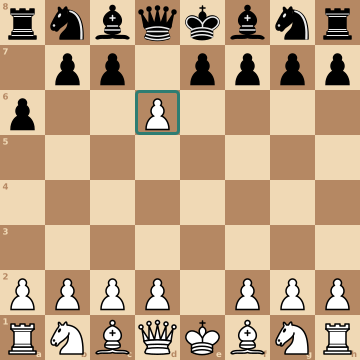
So White is allowed to capture it anyway: the e5 pawn moves diagonally to d6, the square Black's pawn skipped over, and Black's pawn on d5 is removed from the board.
3. exd6
The three conditions
En passant is only possible when all three of these are true:
- Your pawn is on your fifth rank. For White that's the 5th rank, for Black the 4th rank.
- An enemy pawn has just moved two squares from its starting square and landed right beside yours, on the next file.
- You capture immediately. En passant is only allowed on the very next move. If you play anything else, you can't take that pawn en passant later.
If the enemy pawn got there in two single steps (d7-d6, then d6-d5), en passant is not allowed. It's only about the two-square jump.
Where you'll see it in the opening
En passant comes up whenever a pawn on the fifth rank meets a two-square push next to it. A common example is the Benoni structure: after 1. d4 Nf6 2. c4 c5 3. d5 e5, White may take on e6 en passant with 4.dxe6. In the French Advance, after 1.e4 e6 2.d4 d5 3.e5, a later ...f5 by Black gives White the option of exf6 en passant. Our guide to pawn breaks in the French Advance covers why that choice matters.
A real example: en passant with check
Here's a position from one of our puzzles, taken from a real Lichess game. White's queen gave check on c4, and Black blocked it by pushing the d-pawn two squares, ...d5.
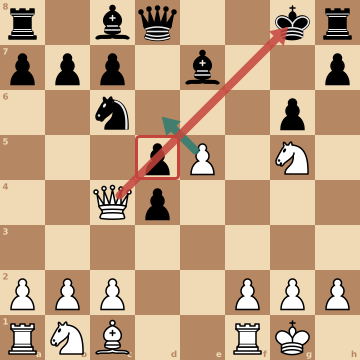
12. exd6+ takes the d5 pawn en passant. The block is gone, so Black is in check again from the queen on c4, and the new pawn on d6 attacks the bishop on e7 and the pawn on c7. Black can't deal with everything, and White wins material. Many players never consider en passant, which is exactly why it makes such a good puzzle.
Common mistakes
- Forgetting it exists. Before you push a pawn two squares, check whether an enemy pawn on the next file can take it en passant.
- Waiting a move. You can't save en passant for later. It's now or never.
- Trying it with the wrong piece. Only pawns can capture en passant, and only pawns can be captured that way.
Practice it
We have a small set of en passant puzzles from real games, plus thousands more by theme. For the other special move every beginner needs, read how castling works. And if a word on this page is new to you, our chess terms glossary explains it.
FAQ
What is en passant in chess?
En passant is a special pawn capture. When a pawn moves two squares from its starting square and lands right beside an enemy pawn, that enemy pawn can capture it as if it had only moved one square. The capturing pawn moves diagonally to the square the other pawn skipped over.
Is en passant forced?
No. En passant is optional, like any other capture. The only time you have to play it is when it's your only legal move, for example when it's the only way out of check.
When can you capture en passant?
Only on the very next move after the enemy pawn makes its two-square jump. Your pawn must be on your fifth rank (the 5th rank for White, the 4th rank for Black), on a file next to the pawn that moved. If you wait even one move, the chance is gone.
Can other pieces capture en passant?
No. Only a pawn can capture en passant, and only another pawn can be captured that way.
How do you write en passant in notation?
Like a normal pawn capture, to the square the pawn lands on: exd6, for example. Some books add "e.p." after it (exd6 e.p.), but it isn't required.
Why does en passant exist?
When pawns were allowed to move two squares on their first move, a pawn could suddenly skip past an enemy pawn that would have been able to capture it. En passant keeps that capture possible, so the two-square move can't be used to sneak past.
These puzzles come from real Lichess games where en passant was the winning move. Can you spot it?
Try the en passant puzzles →