The French Advance: Holding d4 Against Real 900 to 1800 Opponents
TL;DR: the data
Built from 30 million Lichess games played by 900 to 1800 rated players You play White, 15 practice lines, every move of yours checked by Stockfish Most common line 1. e4 e6 2. d4 d5 3. e5 c5 4. c3 Nc6 5. Nf3 Qb6 6. Be2 cxd4 7. cxd4 Bb4+ 8. Nc3 Nge7 9. O-O Replies to 6.Be2 6...cxd4 36% · 6...Nge7 26% · 6...Bd7 20% Worth knowing After 7...Nge7 in that line, 63% of White players castle, which lets 8...Nf5 win the d4 pawn. White wins only 40% of those games, compared with 49% after 8.Na3.
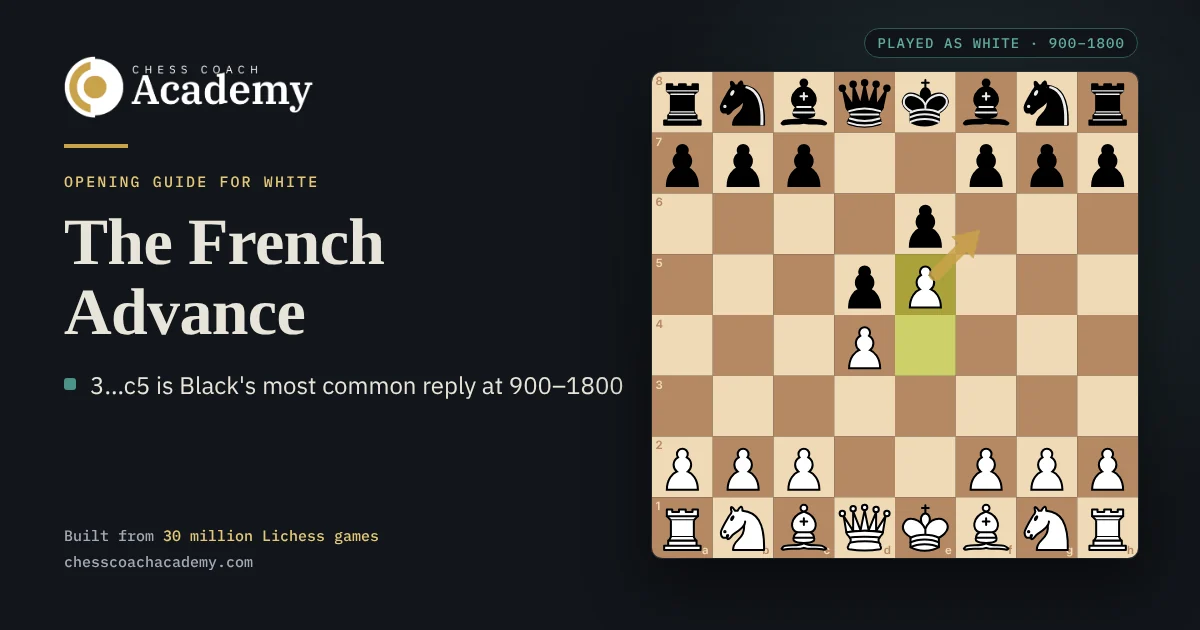
The Advance Variation is the simplest way to take the fight to the French Defense. After 1.e4 e6 2.d4 d5 you push 3.e5, grab space, and take the f6 square away from Black's knight. Black's light-squared bishop is stuck behind the e6 pawn, and Black has to find counterplay somewhere else.
That counterplay almost always aims at one pawn: d4, the base of your chain. This guide is built from 30 million Lichess games played by 900 to 1800 rated players, and it shows you what they actually throw at d4 and how to hold it. The short version: c3, Nf3, Be2, and count before you castle.
1. e4 e6 2. d4 d5 3. e5 c5 4. c3 Nc6 5. Nf3 Qb6 6. Be2
Practice the French Defense: Advance Variation free →Who it's for
Players rated roughly 900 to 1800 who meet the French often and want one setup instead of a pile of theory. At this level 3.e5 is already the most popular choice: 47% of White players push the pawn.
It suits you if you like space and clear plans more than early tactics. You need patience: the Advance rarely wins in 15 moves, but it gives you a position where Black has to solve problems for a long time.
Why it works at 900 to 1800
- One setup against almost everything: c3, Nf3, Be2 and castle. The same moves come up whatever order Black plays in.
- The most common check at this level is a mistake. 7...Bb4+ in the main line runs into 8.Nc3, and Stockfish rates you more than a pawn better.
- Your e5 pawn cramps Black for the whole game. Black's knight can't use f6 and the c8 bishop has few good squares.
- d4 is under constant attack. You must count attackers and defenders before routine moves, and castling at the wrong moment loses the pawn.
- Your c1 bishop has to stay home early to guard b2 against the queen on b6, so your development is a little slower than usual.
- Against the best replies (7...Nge7 in the main line, or an early ...Nge7-f5) you get a small edge or a level game, not a quick win.
What 900 to 1800 players actually play
This is the position where most French Advance games are decided. After 6.Be2 Black trades with 6...cxd4 in 36% of games, sends the knight toward f5 with 6...Nge7 in 26%, plays the quiet 6...Bd7 in 20%, and goes for 6...Nh6 in 13%. Each of these needs a different answer: take back, play Na3, castle, or castle and then change the structure with dxc5.
Three numbers from the data worth remembering:
- At 900-1800 on Lichess, 47% of White players choose 3.e5 after 1.e4 e6 2.d4 d5, and 70% of Black players answer with 3...c5.
- After 4.c3 Nc6 5.Nf3 Qb6 6.Be2 cxd4 7.cxd4, 41% of players check with 7...Bb4+. White wins 52% of games after 8.Nc3, but only 42% after 8.Bd2.
- After 7...Nge7 in that line, 63% of White players castle, which lets 8...Nf5 win the d4 pawn. White wins only 40% of those games, compared with 49% after 8.Na3.
How to play the French Defense: Advance Variation: move by move
Every board below is a real decision point from the practice lines. The arrows show Black's most common replies at 900 to 1800, labeled with how often each one is played in that exact position. Under each board you'll find why players choose the move and the answer the Coach teaches.
After 1. e4 e6 2. d4 d5 3. e5
Black almost always attacks d4 with 3...c5. If you see 3...Nc6 instead, the knight blocks Black's own c-pawn, and your center is safer than usual.
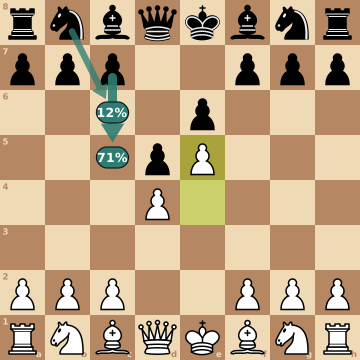
- 3...c5 (71%). Your pawns on d4 and e5 form a chain, and d4 is its base: it holds the e5 pawn up. Black's standard plan is to hit d4 again and again.e5 this way.
Your answer: 4. c3. Support d4 with another pawn. - 3...Nc6 (12%). c5 plan is hard to play.
Your answer: 4. c3. Support d4 with a pawn.
After 1. e4 e6 2. d4 d5 3. e5 c5 4. c3
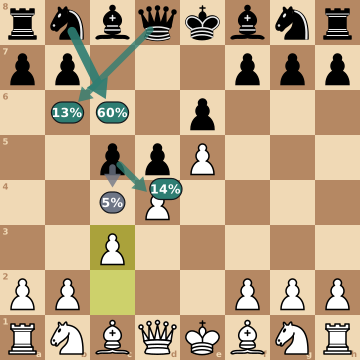
- 4...Nc6 (60%). Now d4 is attacked by the c5 pawn and the knight, so you need to add a defender.
Your answer: 5. Nf3. Develop and defend d4 at the same time. - 4...cxd4 (14%). You take back and keep a pawn on d4.
Your answer: 5. cxd4. Recapture with the pawn and keep your center. - 4...Qb6 (13%). b2 is safe because your c1 bishop guards it.
Your answer: 5. Nf3. Develop and protect d4. - 4...c4 (5%). Your center is now safe, which makes your life easier.
Your answer: 5. Nf3. Develop calmly. Your center isn't under attack any more.
After 1. e4 e6 2. d4 d5 3. e5 c5 4. c3 Nc6 5. Nf3
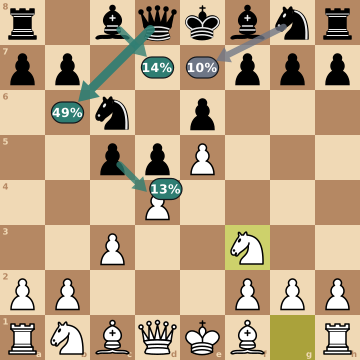
- 5...Qb6 (49%). The queen attacks your b2 pawn and lines up on d4 behind the c5 pawn. b2 is safe for now because your c1 bishop protects it.
Your answer: 6. Be2. Develop and get ready to castle, while your queen keeps watching d4. - 5...Bd7 (14%). It gets the bishop out and connects Black's pieces, but it doesn't attack anything yet.
Your answer: 6. Be2. The same calm setup: develop and prepare to castle. - 5...cxd4 (13%). Black trades on d4 straight away.
Your answer: 6. cxd4. Take back and keep your pawn on d4. - 5...Nge7 (10%). Black plays Nge7, heading for f5.
Your answer: 6. Be2. Develop and get ready to castle.
After 1. e4 e6 2. d4 d5 3. e5 c5 4. c3 Nc6 5. Nf3 Qb6 6. Be2
Why Be2 and not Bd3? On e2 the bishop leaves the d-file open, so your queen on d1 keeps guarding d4. The c1 bishop stays home because it's the piece protecting b2.
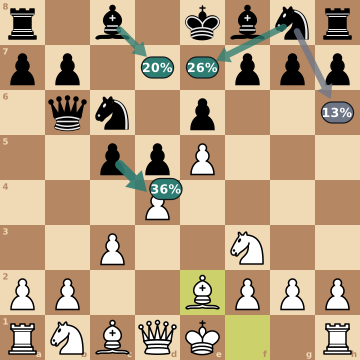
- 6...cxd4 (36%). It opens the c-file and gets ready to attack your d4 pawn with pieces.
Your answer: 7. cxd4. Take back and keep your pawn on d4. - 6...Nge7 (26%). The knight is heading for f5 to add pressure on d4.
Your answer: 7. Na3. Same idea: the knight is on its way to c2 to protect d4. - 6...Bd7 (20%). cxd4 for later.
Your answer: 7. O-O. Castle while d4 is still well protected. - 6...Nh6 (13%). From h6 the knight can go to f5 and hit d4.
Your answer: 7. O-O. Castle first.
After 1. e4 e6 2. d4 d5 3. e5 c5 4. c3 Nc6 5. Nf3 Qb6 6. Be2 cxd4 7. cxd4
Count before you move. Right now d4 is attacked twice and defended twice. The check 7...Bb4+ changes nothing, but 7...Nge7 prepares ...Nf5 and a third attacker.
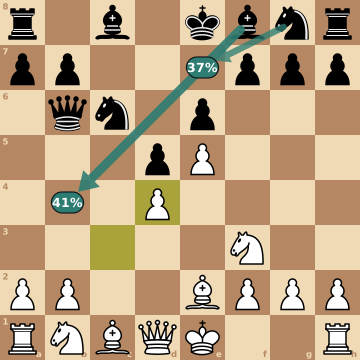
- 7...Bb4+ (41%). Your knight can block the check, and then the bishop on b4 is just a target.
Your answer: 8. Nc3. Block the check with a new piece. - 7...Nge7 (37%). Once the knight reaches f5, d4 is attacked by three pieces: the two knights and the queen.
Your answer: 8. Na3. The knight heads for c2 to guard d4 a third time.
After 1. e4 e6 2. d4 d5 3. e5 c5 4. c3 cxd4 5. cxd4
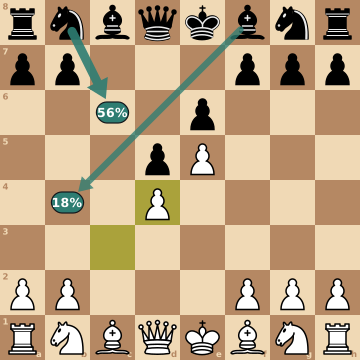
- 5...Nc6 (56%). It develops and puts pressure on d4.
Your answer: 6. Nf3. Defend d4 by developing. - 5...Bb4+ (18%). The bishop gets out, but it doesn't attack anything after you block.
Your answer: 6. Nc3. Develop while blocking the check.
After 1. e4 e6 2. d4 d5 3. e5 c5 4. c3 Qb6 5. Nf3 Nc6 6. Be2
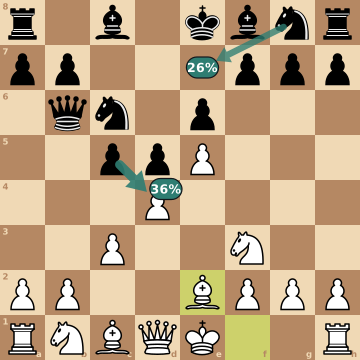
- 6...cxd4 (36%). Black trades pawns on d4.
Your answer: 7. cxd4. Take back and keep your pawn on d4. - 6...Nge7 (26%). Nf5 to hit d4 a third time.
Your answer: 7. Na3. Your knight heads for c2 to protect d4.
After 1. e4 e6 2. d4 d5 3. e5 Nc6 4. c3
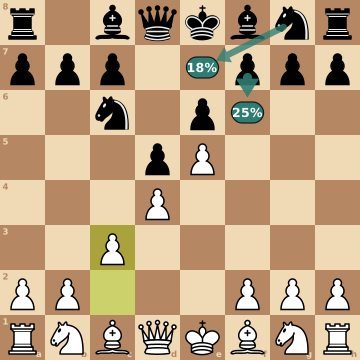
- 4...f6 (25%). It opens lines, but it also weakens the squares around Black's king.
Your answer: 5. Nf3. Develop and add a defender to e5. - 4...Nge7 (18%). Black has no easy way to attack your center.
Your answer: 5. Nf3. Develop and protect d4 and e5.
Your plan after the opening
The main setup: guard d4 with pieces, keep b2 covered
Play c3 so you can take back on d4 with a pawn, Nf3 to guard d4 and e5, and Be2 so the queen still sees d4. Leave the c1 bishop at home while Black's queen sits on b6.
If Black checks on b4, block with the knight. After you castle, a3 asks the bishop to leave and Na4 can hit Black's queen.
1. e4 e6 2. d4 d5 3. e5 c5 4. c3 Nc6 5. Nf3 Qb6 6. Be2 cxd4 7. cxd4 Bb4+ 8. Nc3 Nge7 9. O-O
When a knight heads for f5: Na3 and Nc2 before castling
Once Black plays ...Nge7, the knight is coming to f5 and d4 will be attacked three times. Bring your queen's knight to c2 through a3 so d4 has three defenders too, then castle. Later, h4 or Bd3 can gain space and question the knight on f5.
1. e4 e6 2. d4 d5 3. e5 c5 4. c3 Nc6 5. Nf3 Qb6 6. Be2 cxd4 7. cxd4 Nge7 8. Na3 Nf5 9. Nc2
When you can't hold d4: change the structure with dxc5 and b4
If Black has already piled up on d4 while the c-pawns are still on the board, don't cling to the pawn. Take on c5, and after ...Bxc5 push b4. Your pawn chases the bishop, you gain space on the queenside, and your e5 pawn still cramps Black. Follow up with Bd3, Bf4, Nbd2 and Re1.
1. e4 e6 2. d4 d5 3. e5 c5 4. c3 Nc6 5. Nf3 Qb6 6. Be2 Nh6 7. O-O Nf5 8. dxc5 Bxc5 9. b4
Against 3...Nc6: keep developing, and take back on e5
With the knight in front of the c-pawn, Black struggles to hit d4. Play c3, Nf3, Bd3 and castle. If Black attacks e5 with ...f6, take back with the knight and then with the d-pawn. Black's king has lost its f-pawn cover and the e6 pawn becomes a long-term weakness.
1. e4 e6 2. d4 d5 3. e5 Nc6 4. c3 f6 5. Nf3 fxe5 6. Nxe5 Nxe5 7. dxe5
Traps and common mistakes
Castling while Black piles up on d4
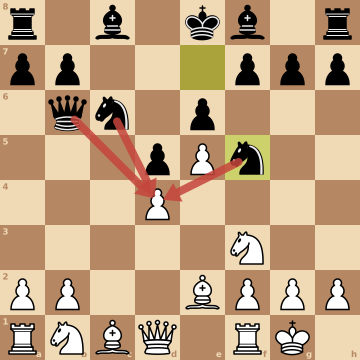
1. e4 e6 2. d4 d5 3. e5 c5 4. c3 Nc6 5. Nf3 Qb6 6. Be2 cxd4 7. cxd4 Nge7 8. O-O? Nf5
This is the most common mistake in the whole opening. After 7...Nge7, 63% of White players castle at this level. Then 8...Nf5 attacks d4 three times (both knights and the queen), and you only have two defenders. White wins only 40% of those games, compared with 49% after 8.Na3.
Play 8.Na3 and 9.Nc2 first. Castling can wait one or two moves; the d4 pawn can't.
Blocking ...Bb4+ with the bishop
1. e4 e6 2. d4 d5 3. e5 c5 4. c3 Nc6 5. Nf3 Qb6 6. Be2 cxd4 7. cxd4 Bb4+ 8. Nc3!
41% of players at this level check with 7...Bb4+. Blocking with 8.Bd2 lets Black trade off its bishop for free and takes the guard away from b2. Block with 8.Nc3 instead: you develop a new piece and Black's bishop on b4 becomes a target for a3.
The data backs it up: White wins 52% of games after 8.Nc3, but only 42% after 8.Bd2.
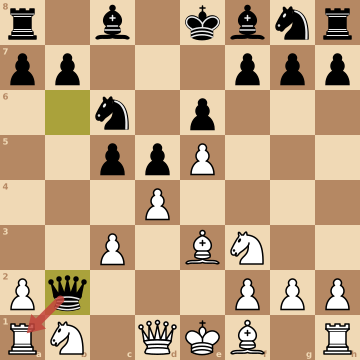
Moving the c1 bishop too soon
1. e4 e6 2. d4 d5 3. e5 c5 4. c3 Qb6 5. Nf3 Nc6 6. Be3? Qxb2
Be3 looks like a natural way to add a defender to d4, but the c1 bishop is the only piece guarding b2. Once it moves, the queen on b6 takes the pawn and attacks your rook on a1. Stockfish rates Black clearly better.
Play 6.Be2 instead. The bishop on c1 can come out later, once Black's queen has left b6 or you've played dxc5 and b4.
Panicking when d4 looks loose
1. e4 e6 2. d4 d5 3. e5 c5 4. c3 Nc6 5. Nf3 Qb6 6. Be2 cxd4 7. cxd4 Nxd4? 8. Nxd4 Qxd4?? 9. Qxd4
When d4 is attacked twice and defended twice, it's safe, even if it doesn't feel that way. If Black grabs it with 7...Nxd4?, your knight takes back and Black is simply a piece down for a pawn. And if the queen then takes on d4, your queen takes it. Trust the count and keep developing.
Frequently asked questions
Is the French Advance good for beginners?
Yes. It uses one setup (c3, Nf3, Be2 and castle) against almost every reply, and the main idea, protecting d4, is easy to understand. At 900 to 1800 it's also the most popular choice: 47% of White players answer 2...d5 with 3.e5.
What is the most common reply to the French Advance?
At 900 to 1800 on Lichess, 70% of Black players answer 3.e5 with 3...c5, hitting the base of your pawn chain. After 4.c3, 4...Nc6 is the most common follow-up (60%), and after 5.Nf3 about half of players bring the queen to b6.
When should White castle in the Advance Variation?
Only when d4 is safe. If Black has played ...Nge7 and the knight is heading for f5, play Na3 and Nc2 first. At this level 63% of White players castle too early in that line and win only 40% of those games, compared with 49% after 8.Na3.
How do I answer ...Bb4+ in the French Advance?
Block with the knight on c3, not the bishop on d2. Nc3 develops a piece and leaves Black's bishop loose on b4, and White wins 52% of games after 8.Nc3 at this level, against 42% after 8.Bd2.
What is Black's main plan against the Advance Variation?
To attack d4 with ...c5, ...Nc6, ...Qb6 and a knight on f5, and sometimes to hit e5 with ...f6. Your job is to keep d4 protected, and to switch to dxc5 and b4 when holding it would cost too much.
Keep learning
- All 36 opening guides: every opening on the site, grouped by what you play as White and Black.
- Pawn Breaks for Black in the French Advance: Black's ...c5, ...f6 and ...c4 plans, and how to meet them.
- How to Counter the French Defense as White: Why the Advance is the most practical answer to 1...e6, plus a trap to know.
- Five Openings, One Bishop: Why Black's c8 bishop is such a problem in the French, and how other openings handle it.
The Coach plays the French against you with the moves 900 to 1800 players actually choose, from 7...Bb4+ to the ...Nge7-f5 squeeze, and explains every move in plain English. Progress tracking is free during the open beta.
Practice the French Defense: Advance Variation free →