The Grunfeld Defense: How to Attack the Center Against Real 1800 to 2400 Opponents
TL;DR: the data
Built from 4.9 million Lichess games played by 1800 to 2400 rated players You play Black, 16 practice lines, every move of yours checked by Stockfish Most common line 1. d4 Nf6 2. c4 g6 3. Nc3 d5 4. cxd5 Nxd5 5. e4 Nxc3 6. bxc3 Bg7 7. Bc4 c5 8. Ne2 O-O 9. O-O Nc6 Replies to 3...d5 4. cxd5 44% · 4. Nf3 23% · 4. Bg5 9% Worth knowing After 4.Bg5 Ne4 5.Nxe4 dxe4, Black wins 57% of games at this level.
The Grunfeld is a deal you offer White on move three. You challenge the center with 3...d5, and in the main line you let White build a big pawn center on c3, d4 and e4. Then you spend the rest of the opening attacking it with pieces: the bishop on g7, the c5 pawn, the knight on c6 and the queen on the d-file all aim at d4.
Most guides teach this opening from games between masters. This one is built from 4.9 million Lichess games played by 1800 to 2400 rated players, so the lines follow what White really does against you. At this level the Exchange Variation is the most common reply by a distance, but almost a quarter of White players prefer the quieter 4.Nf3, and the early bishop moves 4.Bg5 and 4.Bf4 come with their own tricks.
1. d4 Nf6 2. c4 g6 3. Nc3 d5
Practice the Grunfeld Defense free →Who it's for
Players rated roughly 1800 to 2400 who like active, counterattacking chess and are comfortable giving White space in return for targets. You need to be happy counting attackers and defenders, because nearly every line comes down to one question: can d4 be won yet?
It suits you if you enjoy concrete positions and don't mind learning some lines. If you'd rather keep the center closed and attack on the kingside later, the King's Indian starts the same way and is a better fit.
Why it works at 1800 to 2400
- One clear plan in almost every line: hit d4. The Exchange Variation, the 4.Nf3 lines and the quiet 4.e3 setups all come down to ...Bg7, ...c5 and ...Nc6.
- The early bishop moves are good news for you. Against 4.Bg5, the jump ...Ne4 gives you an easy game, and against Bf4 setups the ...Qa5 pin sets a real trap.
- Most lines in the Coach's tree end level by Stockfish, and several leave White with a lonely a2 pawn that becomes a long-term target.
- White gets a lot of space. If you drift, a big center can turn into an attack, so you have to keep the pressure on.
- In some lines White keeps a small edge, around a third of a pawn to 0.4 pawns by Stockfish, for example 4.Bg5 Ne4 5.Bh4 and the 7.Nf3 c5 8.Be3 Exchange line.
- Timing matters. Grabbing d4 when White has enough defenders loses a piece, and that mistake is easy to make in a fast game.
What 1800 to 2400 players actually play
Here is what White plays once you've pushed 3...d5. The Exchange Variation, 4.cxd5, is the clear favorite at 44%. The flexible 4.Nf3 comes second at 23%, and after that the replies spread out: 4.Bg5 (9%), 4.e3 (9%) and 4.Bf4 (6%). That's five moves worth knowing, but your answer to three of them is the same quiet 4...Bg7.
Three numbers from the data are worth remembering:
- At this rating range, 3...d5 is played in about 27% of games after 1.d4 Nf6 2.c4 g6 3.Nc3.
- After 3...d5, White's most common replies are 4.cxd5 (44%), 4.Nf3 (23%), 4.Bg5 (9%) and 4.e3 (9%).
- After 4.Bg5 Ne4 5.Nxe4 dxe4, Black wins 57% of games at this level.
How to play the Grunfeld Defense: move by move
Every position below comes straight from the practice lines. The boards are shown from your side, and the arrows mark White's most common replies at 1800 to 2400, labeled with how often each one is played in that exact position. Under each board you'll find the reply, why White plays it, and the move you answer with.
After 1. d4 Nf6 2. c4 g6 3. Nc3 d5
The starting position of the Grunfeld. Against 4.cxd5 you recapture with the knight, against 4.Bg5 you jump to e4, and against everything else you develop with 4...Bg7.
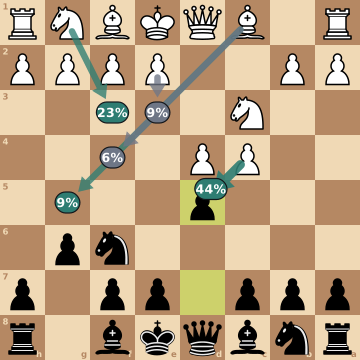
- 4. cxd5 (44%). White wants to follow up with e4, kicking your knight and building a big center.
Your answer: 4...Nxd5. Take back with the knight. - 4. Nf3 (23%). White develops Nf3 and keeps the tension.
Your answer: 4...Bg7. Complete your fianchetto. - 4. Bg5 (9%). But the bishop on g5 has nothing defending it.
Your answer: 4...Ne4. Attack the undefended bishop and the c3 knight. - 4. e3 (9%). White plays the quiet e3.
Your answer: 4...Bg7. Develop and aim at d4. - 4. Bf4 (6%). From f4 it watches c7.
Your answer: 4...Bg7. Develop and get ready to castle.
After 1. d4 Nf6 2. c4 g6 3. Nc3 d5 4. cxd5 Nxd5
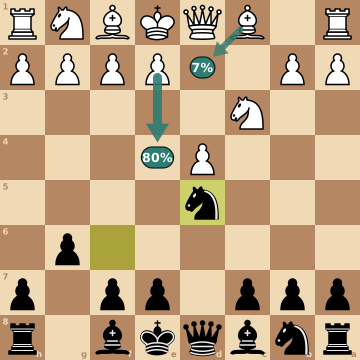
- 5. e4 (80%). Your knight on d5 has to do something now.
Your answer: 5...Nxc3. Trade knights instead of retreating. - 5. Bd2 (7%). White plays Bd2 instead of e4.
Your answer: 5...Bg7. Develop your bishop to the long diagonal.
After 1. d4 Nf6 2. c4 g6 3. Nc3 d5 4. cxd5 Nxd5 5. e4 Nxc3 6. bxc3 Bg7
White has the big center, and your bishop is already pointing at it. Against all three common moves, your next move is ...c5.
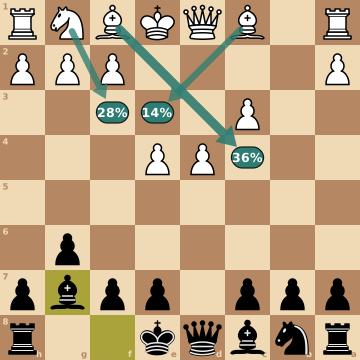
- 7. Bc4 (36%). The bishop points at f7, which only your king defends until you castle.
Your answer: 7...c5. Hit the d4 pawn from the side. - 7. Nf3 (28%). The knight guards d4 and gets White ready to castle.
Your answer: 7...c5. Hit d4 straight away. - 7. Be3 (14%). White often follows with Qd2 and Rc1.
Your answer: 7...c5. Attack d4 again.
After 1. d4 Nf6 2. c4 g6 3. Nc3 d5 4. cxd5 Nxd5 5. e4 Nxc3 6. bxc3 Bg7 7. Bc4 c5
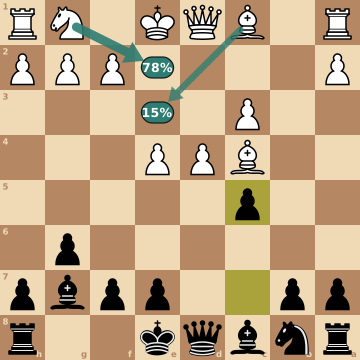
- 8. Ne2 (78%). White develops the knight to e2.
Your answer: 8...O-O. King to safety, and now f7 has a rook guarding it too. - 8. Be3 (15%). The knight usually comes to e2 next move.
Your answer: 8...O-O. Castle first, then bring out the knight.
After 1. d4 Nf6 2. c4 g6 3. Nc3 d5 4. cxd5 Nxd5 5. e4 Nxc3 6. bxc3 Bg7 7. Bc4 c5 8. Ne2 O-O
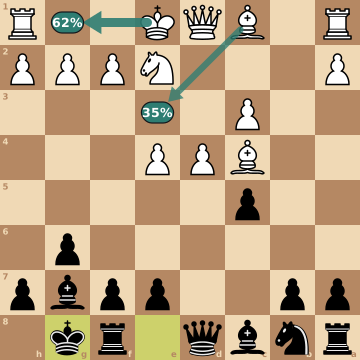
- 9. O-O (62%). Both kings are safe, so the whole game now turns on the d4 pawn.
Your answer: 9...Nc6. Another attacker on d4. - 9. Be3 (35%). White's king is still in the center for one more move.
Your answer: 9...Nc6. Develop and add pressure on d4.
After 1. d4 Nf6 2. c4 g6 3. Nc3 d5 4. cxd5 Nxd5 5. e4 Nxc3 6. bxc3 Bg7 7. Nf3 c5
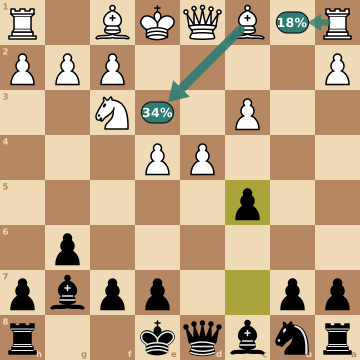
- 8. Be3 (34%). Now d4 is guarded by the c3 pawn, the f3 knight, the e3 bishop and the queen.
Your answer: 8...O-O. Castle and decide your plan once White commits. - 8. Rb1 (18%). From b1 it also attacks b7, which only your c8 bishop defends.
Your answer: 8...O-O. Castle before anything else.
After 1. d4 Nf6 2. c4 g6 3. Nc3 d5 4. Nf3 Bg7
White has kept the tension. Against 5.cxd5 you're back in an Exchange Variation, against 5.Bg5 the ...Ne4 jump works again, and against the quiet moves you castle.
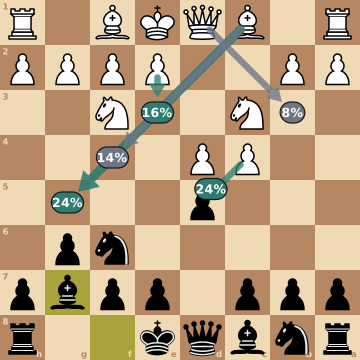
- 5. Bg5 (24%). If the knight disappears, d5 could fall.
Your answer: 5...Ne4. Attack the bishop on g5 and the knight on c3. - 5. cxd5 (24%). White takes on d5.
Your answer: 5...Nxd5. Recapture with the knight. - 5. e3 (16%). White plays the quiet e3.
Your answer: 5...O-O. c5. - 5. Bf4 (14%). From f4 it watches c7.
Your answer: 5...O-O. Castle first. - 5. Qb3 (8%). White brings the queen to b3.
Your answer: 5...dxc4. Take the pawn and make the queen recapture.
After 1. d4 Nf6 2. c4 g6 3. Nc3 d5 4. Bg5 Ne4
The bishop on g5 has no defender and your knight hits it. More than half of White players trade on e4, which brings your d-pawn to a useful square.
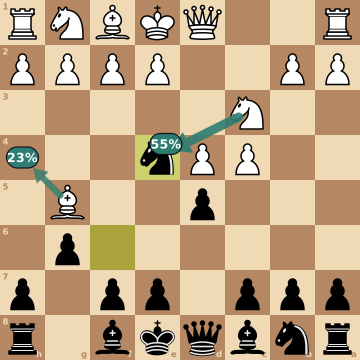
- 5. Nxe4 (55%). White trades knights on e4.
Your answer: 5...dxe4. Recapture with the pawn. - 5. Bh4 (23%). White keeps the bishop and retreats to h4.
Your answer: 5...Nxc3. Trade knights and pull White's b-pawn to c3.
Your plan after the opening
Exchange Variation with 7.Bc4: ...c5, castle, ...Nc6
Hit d4 with ...c5 at once, castle to take the sting out of the bishop on c4, then add the knight with ...Nc6. At that point d4 is attacked by the c5 pawn, the knight, the g7 bishop and the queen, so White has to add a defender, usually with Be3.
Once d4 is defended four times, don't grab it. Keep the pressure with ...Bg4 (hitting the e2 knight, one of d4's defenders) or ...b6 and ...Bb7, and wait for White to slip.
1. d4 Nf6 2. c4 g6 3. Nc3 d5 4. cxd5 Nxd5 5. e4 Nxc3 6. bxc3 Bg7 7. Bc4 c5 8. Ne2 O-O 9. O-O Nc6
Exchange Variation with 7.Nf3: open the c-file and check on a5
With the knight on f3, White's c3 square becomes the weak spot. After ...cxd4 and cxd4, your queen can check from a5 along the diagonal to e1. If White blocks with Bd2, the queen can often take the loose pawn on a2. If White blocks with Qd2, trade queens into a level game.
1. d4 Nf6 2. c4 g6 3. Nc3 d5 4. cxd5 Nxd5 5. e4 Nxc3 6. bxc3 Bg7 7. Nf3 c5 8. Rb1 O-O 9. Be2 cxd4 10. cxd4 Qa5+
Against 4.Nf3, 4.e3 and 4.Bf4: develop, castle, then ...c5
These are the quiet lines. Play ...Bg7, castle, and then strike with ...c5. When White's bishop is on f4 and d2 is empty, remember the pin: if White takes on c5, ...Qa5 pins the c3 knight to the king.
If White later takes on d5 and follows up with e4 or Bc4, trade knights on c3 and you reach an Exchange Variation structure. The same plans apply: ...Nc6, pressure on d4, and an eye on the a2 pawn.
1. d4 Nf6 2. c4 g6 3. Nc3 d5 4. Nf3 Bg7 5. Bf4 O-O 6. e3 c5
Against 4.Bg5: ...Ne4, then play on the dark squares
After 5.Nxe4 dxe4, your pawn on e4 takes d3 and f3 away from White's pieces, so the g1 knight has no good square. Play ...Bg7 to hit d4, then ...c5, and ...h6 to chase White's bishop. At this level Black wins 57% of games after 4.Bg5 Ne4 5.Nxe4 dxe4.
1. d4 Nf6 2. c4 g6 3. Nc3 d5 4. Bg5 Ne4 5. Nxe4 dxe4 6. e3 Bg7
Traps and common mistakes
Grabbing d4 when White has enough defenders
1. d4 Nf6 2. c4 g6 3. Nc3 d5 4. cxd5 Nxd5 5. e4 Nxc3 6. bxc3 Bg7 7. Bc4 c5 8. Ne2 O-O 9. O-O Nc6 10. Be3 cxd4 11. cxd4 Bxd4? 12. Nxd4 Nxd4 13. Qxd4 Qxd4 14. Bxd4
The whole Grunfeld is about d4, so it's tempting to take it the moment you can. But after 10.Be3, the pawn is defended by the e2 knight, the e3 bishop and the queen. If you open the c-file and take with the bishop, the trades end with White a piece up for a pawn.
Count before you capture. When attackers and defenders are equal, keep the pressure with 10...Bg4 or 10...b6 and let White make the first concession.
The ...Qa5 pin in the Bf4 lines
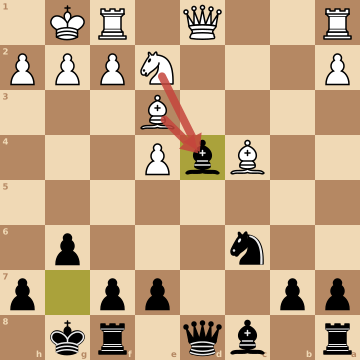
1. d4 Nf6 2. c4 g6 3. Nc3 d5 4. Nf3 Bg7 5. Bf4 O-O 6. e3 c5 7. dxc5 Qa5 8. cxd5? Nxd5 9. Qxd5?? Bxc3+ 10. bxc3 Qxc3+
This is a trap for White, and it comes up because White's bishop left c1 before d2 was covered. After 7.dxc5 Qa5, the c3 knight is pinned to the king. If White grabs a pawn with 8.cxd5?, then 8...Nxd5! and the knight can't take back.
If White takes with the queen, 9.Qxd5?? Bxc3+ wins material: after 10.bxc3 Qxc3+ your queen picks up the rook on a1, and blocking with 10.Nd2 still leaves Stockfish rating you more than three pawns ahead. The same trap appears after 4.Bf4 Bg7 5.e3 O-O 6.Nf3 c5, so learn it once and use it in both move orders.
Panicking about the c7 pawn
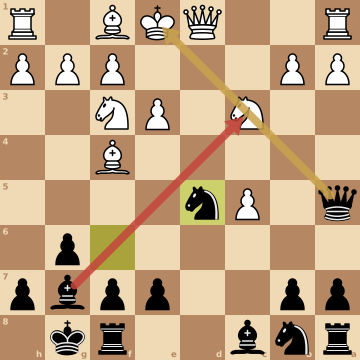
1. d4 Nf6 2. c4 g6 3. Nc3 d5 4. Bf4 Bg7 5. e3 O-O 6. cxd5 Nxd5 7. Nxd5 Qxd5 8. Bxc7 Na6
Against 4.Bf4, castling allows White to trade on d5 and grab the pawn on c7. That's fine. After 8.Bxc7, 8...Na6! attacks the bishop, and your fast development makes up for the pawn. Stockfish rates it close to level.
What you shouldn't do is bend your setup out of shape to protect c7. Getting your king castled and your pieces out matters more than the pawn.
Retreating the knight after 5.e4
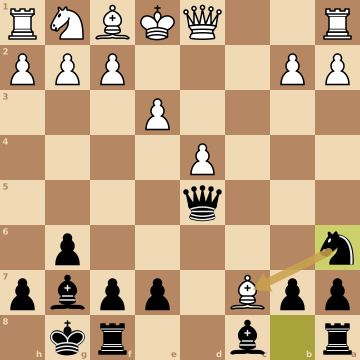
1. d4 Nf6 2. c4 g6 3. Nc3 d5 4. cxd5 Nxd5 5. e4 Nxc3
In the Exchange Variation, 5.e4 (80% of games) kicks your knight from d5. Pulling it back to b6 or f6 loses time and gives White the center for free. Trade with 5...Nxc3 instead, so White has to recapture with the b-pawn and the a2 pawn is left without a neighbor.
Forgetting that the g5 bishop is undefended
1. d4 Nf6 2. c4 g6 3. Nc3 d5 4. Bg5 Ne4
After 4.Bg5, it's natural to play 4...Bg7 and carry on. But the bishop on g5 has no defender, and 4...Ne4 hits it right away while also attacking the c3 knight.
If White retreats with 5.Bh4, trade on c3 with 5...Nxc3 and hit d4 with ...Bg7 and ...c5. If White trades with 5.Nxe4 dxe4, your pawn on e4 keeps White's knight off f3.
Frequently asked questions
Is the Grunfeld Defense good for club players?
It's best from about 1800 up. The ideas are simple (hit d4 with ...Bg7, ...c5 and ...Nc6), but you have to calculate whether d4 can really be won, and giving White a big center is risky if you play passively. At 1800 to 2400 on Lichess, 3...d5 is played in about 27% of games after 1.d4 Nf6 2.c4 g6 3.Nc3.
What is the most common reply to the Grunfeld at club level?
At 1800 to 2400 on Lichess it's the Exchange Variation, 4.cxd5, in 44% of games. 4.Nf3 is second at 23%, and 4.Bg5 and 4.e3 each appear in 9% of games.
How do you play against the Grunfeld Exchange Variation?
Recapture with 4...Nxd5, trade knights with 5...Nxc3 after 5.e4, then play ...Bg7, ...c5, castle and ...Nc6. Every one of those moves adds pressure to d4. The only thing to avoid is grabbing d4 before you have more attackers than White has defenders.
What's the difference between the Grunfeld and the King's Indian?
Both start 1.d4 Nf6 2.c4 g6, and they split on move three. In the Grunfeld you play ...d5 and challenge the center at once. In the King's Indian you let White have the center and fight back later with ...e5 or ...c5. The Grunfeld is more concrete, the King's Indian more about long plans.
What should Black do against 4.Bg5 in the Grunfeld?
Play 4...Ne4, attacking the undefended bishop. After 5.Nxe4 dxe4 your pawn on e4 cramps White's kingside, and Black wins 57% of games at this level. After 5.Bh4, trade with 5...Nxc3 and aim at d4.
Keep learning
- All 36 opening guides: every opening on the site, grouped by what you play as White and Black.
- King's Indian Defense vs Grunfeld Defense: How the two hypermodern defenses differ in plans, theory and rating range.
- The most reliable 1.d4 defenses for Black: Nine 1.d4 defenses compared with Lichess data at club level.
The Coach plays White against your Grunfeld with the moves 1800 to 2400 players actually choose, from the Exchange Variation to 4.Bg5, and explains every move in plain English. Progress tracking is free during the open beta.
Practice the Grunfeld Defense free →