King's Indian Defense vs Grünfeld Defense: Which Hypermodern Defense Is Right for You?
TL;DR
Short answer Pick the King's Indian if you want a closed center and a kingside attack. Pick the Grünfeld if you want to trade White's center off at once and pressure what's left. The King's Indian is easier to start with; the Grünfeld is sharper and more theoretical. Games behind this article King's Indian: about 183 million Lichess games at 1400 to 2200 (the largest dataset on our site) · Grünfeld: about 4.9 million at 1800 to 2400 Where they split After 1. d4 Nf6 2. c4 g6 3. Nc3: 3...Bg7 and ...d6 is the King's Indian, 3...d5 is the Grünfeld. At 1800 to 2400 on Lichess, 3...d5 is played in about 27% of games. Recommended range King's Indian 1400 to 2200 Elo · Grünfeld 1800 to 2400 Elo Lines in our trainers King's Indian 21 · Grünfeld 16 What White plays Against 1...Nf6: 2.c4 44% · 2.Nf3 18% · 2.Bf4 16%. Against the Grünfeld's 3...d5: 4.cxd5 44% · 4.Nf3 23% · 4.Bg5 9% · 4.e3 9%.
Same start, different idea
Both openings are hypermodern. Black doesn't fight for the center with pawns right away. The bishop goes to g7, White is allowed to build a big center, and Black attacks it later. The difference is when and how.
On move three, you choose:
- 3...Bg7 and ...d6: the King's Indian. White gets d4, c4 and e4, and Black keeps the pawns back, planning to strike with ...e5 or ...c5 after castling.
- 3...d5: the Grünfeld. Black hits the center immediately, invites White to take on d5 and build a pawn mass, then trades pieces into it.
The King's Indian: lock it, then attack
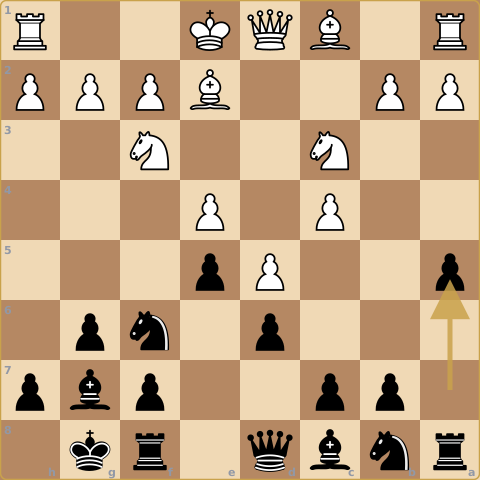
This is the Classical main line, and 5.Nf3 is White's most common fifth move at 1400 to 2200 (30%). Black castles, then plays the signature 6...e5, challenging d4. White often answers 7.d5, closing the center. From there the game becomes a race on opposite wings. White pushes on the queenside, aiming for c5 to open lines. Black goes for the king with ...f5, then ...f4 and ...g5. The move 7...a5 in this line controls b4 and slows White's queenside pawns down.
Timing is everything, because whoever breaks through first gets the initiative. It's a fighting opening, with unbalanced positions for both sides. White's sharpest try is the Saemisch with 5.f3, one of White's best-scoring systems at this level: Black wins 44% of games after 5.f3 on Lichess, but 48% after 5.f3 O-O 6.Be3 c5.
The King's Indian also has a trap every player needs to know. Against the Averbakh setup with Be2 and Bg5, the natural ...e5 drops material:
The knight on d5 hits c7 and f6, and the f6 knight is pinned to the rook on d8 by the bishop on g5. Black loses material, which is why our King's Indian guide recommends 6...c5 instead.
The Grünfeld: trade the center, then hit it
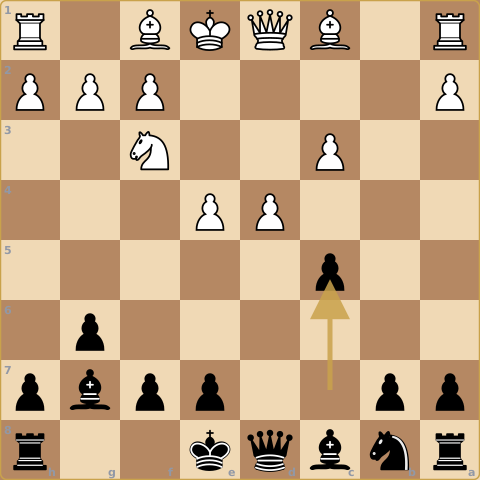
This is the Exchange Variation, the Grünfeld's most important line and White's most common choice (44%). White takes on d5, kicks the knight with e4 and gets a big pawn center. Black trades knights on c3, which leaves White with pawns on c3, d4 and e4.
Now Black piles up on White's center, and d4 is the main target. The bishop on g7 looks straight at it down the long diagonal, and ...c5 hits it from the side. Next come ...Nc6, ...Bg4 (pinning the knight that defends d4) and ...Qa5 (hitting c3). White has space; Black has pressure. The whole game revolves around whether that center stands or cracks. At this level 7.Bc4 (36%) is a little more common than 7.Nf3 (29%), but the plan against d4 is the same.
White has other tries, and our trainer covers them: 4.Nf3 (23%, including a later Qb3), 4.Bg5 (9%), 4.e3 (9%) and 4.Bf4 (6%). Each needs specific knowledge. Against 4.Bg5, the jump 4...Ne4 hits the undefended bishop, and after 4.Bg5 Ne4 5.Nxe4 dxe4, Black wins 57% of games at 1800 to 2400 on Lichess.
How they compare
| King's Indian | Grünfeld | |
| Center | Closed, locked with d5 | Open, traded early |
| Black's main plan | Kingside attack with ...f5 | Piece pressure on d4 |
| Timing | Slow build, then a race | Concrete from move four |
| Recommended range | 1400 to 2200 Elo | 1800 to 2400 Elo |
| Lichess games in our data | About 183 million | About 4.9 million |
| Trainer lines | 21 | 16 |
The Elo ranges tell the biggest part of the story. The Grünfeld has the highest floor of the nine 1.d4 defenses in our library. That's not because it's worse. It's because the positions are open and concrete early, and a single slow move can let White's center roll forward. The King's Indian gives you more time. You can reach a familiar setup (fianchetto, castle, ...d6) against almost anything and think once the center takes shape.
The King's Indian setup also works against White's quieter systems. Our trainer covers the Classical, Four Pawns and Saemisch after 2.c4, plus the London, Colle, Torre and fianchetto setups you'll meet after 2.Nf3, 2.Bf4 and 2.e3. The core plan stays the same: fianchetto, castle, then ...e5 or ...c5. The Grünfeld's main lines depend on White playing Nc3 and allowing the knight trade on c3. Against setups without an early Nc3, such as the g3 fianchetto, the game takes a different shape, and our Grünfeld trainer doesn't cover those.
Which one should you play?
Choose the King's Indian if you like attacking the king, don't mind a cramped position for a while, and want one setup you can play against most 1.d4 systems. Between 1400 and 1800, it's the one of the two our library recommends.
Choose the Grünfeld if you enjoy open, tactical positions, like hitting a target with all your pieces, and are willing to study concrete lines. It's named after Ernst Grünfeld, who brought it into international play at Vienna in 1922, and it has been a top-level weapon ever since.
Not sure? The two share their first moves, so a few games with each will tell you a lot. Play ten games with the King's Indian, then ten with the Grünfeld, and notice which middlegames you enjoy more.
Frequently asked questions
What is the difference between the King's Indian and the Grünfeld?
Both start 1.d4 Nf6 2.c4 g6. In the King's Indian, Black plays ...Bg7 and ...d6, lets White build a big center and usually attacks on the kingside after the center closes. In the Grünfeld, Black plays 3...d5, trades the center off with ...Nxd5 and ...Nxc3, and then pressures White's d4 pawn with pieces and ...c5.
Is the Grünfeld harder than the King's Indian?
Generally yes. Our library recommends the Grünfeld for 1800 to 2400 Elo, the highest floor of any 1.d4 defense on the site, compared with 1400 to 2200 for the King's Indian. Grünfeld positions become concrete very early and need more precise preparation.
Is the King's Indian Defense good for club players?
Yes, for players from around 1400 upward. The plan is clear (fianchetto, castle, strike with ...e5 or ...c5) and works against 2.c4 and the quiet London, Colle and Torre systems alike. Our King's Indian trainer is built from about 183 million Lichess games at 1400 to 2200, the largest dataset on the site.
What is the main line of the Grünfeld Defense?
The Exchange Variation: 1.d4 Nf6 2.c4 g6 3.Nc3 d5 4.cxd5 Nxd5 5.e4 Nxc3 6.bxc3 Bg7, usually followed by ...c5 to attack White's d4 pawn.
Copy the lines (PGN)
Every line in this article in standard PGN, ready to paste into Lichess, Chess.com or any chess database.
[Event "King's Indian Defense vs Grünfeld Defense: Which Hypermodern Defense Is Right for You?: King's Indian Classical"]
[Site "chesscoachacademy.com"]
[Result "*"]

1. d4 Nf6 2. c4 g6 3. Nc3 Bg7 4. e4 d6 5. Nf3 O-O 6. Be2 e5 7. d5 a5 *

[Event "King's Indian Defense vs Grünfeld Defense: Which Hypermodern Defense Is Right for You?: King's Indian Averbakh trap"]
[Site "chesscoachacademy.com"]
[Result "*"]

1. d4 Nf6 2. c4 g6 3. Nc3 Bg7 4. e4 d6 5. Be2 O-O 6. Bg5 e5 7. dxe5 dxe5 8. Qxd8 Rxd8 9. Nd5 *

[Event "King's Indian Defense vs Grünfeld Defense: Which Hypermodern Defense Is Right for You?: King's Indian vs Averbakh"]
[Site "chesscoachacademy.com"]
[Result "*"]

1. d4 Nf6 2. c4 g6 3. Nc3 Bg7 4. e4 d6 5. Be2 O-O 6. Bg5 c5 *

[Event "King's Indian Defense vs Grünfeld Defense: Which Hypermodern Defense Is Right for You?: Grünfeld Exchange"]
[Site "chesscoachacademy.com"]
[Result "*"]

1. d4 Nf6 2. c4 g6 3. Nc3 d5 4. cxd5 Nxd5 5. e4 Nxc3 6. bxc3 Bg7 7. Nf3 c5 *

[Event "King's Indian Defense vs Grünfeld Defense: Which Hypermodern Defense Is Right for You?: Grünfeld with Qb3"]
[Site "chesscoachacademy.com"]
[Result "*"]

1. d4 Nf6 2. c4 g6 3. Nc3 d5 4. Nf3 Bg7 5. Qb3 dxc4 6. Qxc4 O-O 7. e4 a6 *
Keep reading
- The Most Reliable 1.d4 Defenses for Black: The King's Indian, Grünfeld and seven other defenses compared by Lichess data and Elo range.
Try both hypermodern defenses before you commit
Our King's Indian trainer has 21 lines built from about 183 million Lichess games at 1400 to 2200, covering the Classical, Four Pawns and Saemisch plus the London, Colle, Torre and fianchetto systems. Our Grünfeld trainer has 16 lines built from about 4.9 million games at 1800 to 2400, including the Exchange Variation, 4.Nf3 with 5.Qb3, 4.Bg5, 4.e3 and 4.Bf4. Every one of your moves is checked by Stockfish.
Both are free during the open beta, and you can track your progress on every line for free with an account, so you can see which one sticks.
21 King's Indian lines and 16 Grünfeld lines. Free during the open beta, with free progress tracking.
Practice the King's Indian free →