How to Beat the Caro-Kann Defense as White
TL;DR
Short answer Play the Advance, 3. e5, and follow up calmly with Nf3, Be2 and O-O (the Short System). Take space, keep your structure healthy, and make Black find a plan. Games behind this article About 24 million Lichess games at 900 to 1800 Black's replies to 3.e5 3...Bf5 61.5% · 3...c5 24.1% · 3...e6 7.5% After 4.Nf3 e6 5.Be2 5...c5 42.4% · 5...Nd7 22.3% · 5...Ne7 9.4% · 5...h6 7.2% · 5...Bb4+ 6.6% Idea to know Against ...Qb6, hit the queen with dxc5 and follow up with b4 Lichess results 900 to 1800: after 5...Nd7 6.O-O c5, only 12% of White players find 7.c4, but they win 69% of those games. After 5...c5 6.O-O cxd4 7.Nxd4 Bg6, 8.c4 wins 65%. Recommended range 900 to 1800 Elo, 13 lines
Why the Caro-Kann is hard to beat
The Caro-Kann has a reputation because it's well built: the d5 pawn is supported, the light-squared bishop gets out before ...e6, and Black ends up with no obvious weaknesses. (We cover this in detail in why the Caro-Kann is so solid.) So you won't beat it with a trap on move six. You beat it by getting a position where you have more space and a clearer plan, then outplaying your opponent in the middlegame.
The Advance Variation is the most practical way to do that.
The Advance with the Short System
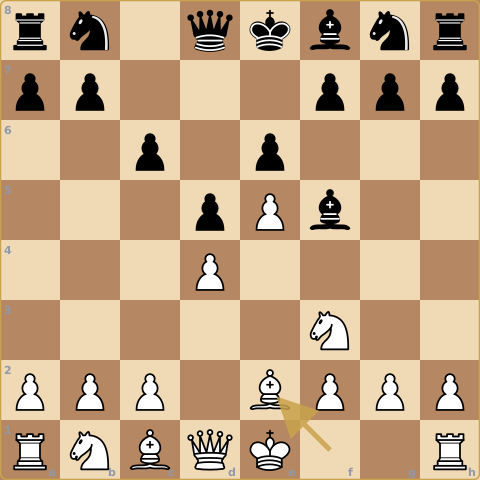
3.e5 grabs space and takes the f6 square away from Black's knight. Black's usual reply is 3...Bf5 (61.5% of games at 900 to 1800 on Lichess). Instead of chasing the bishop, White develops with 4.Nf3, Black plays 4...e6 (84.6% of the time), and White follows with 5.Be2 and castles.
This setup, named after Nigel Short, who used it at the top level, has two big advantages for club players. You don't need to memorize sharp forcing lines, and your pawn structure stays healthy. You're asking Black a simple question: now what?
From here Black has three main moves in our data, and White castles against all of them:
- 5...c5 (42.4%): the most direct. Black hits d4 at once. White answers with 6.O-O, getting the king off the e-file before the center opens.
- 5...Nd7 (22.3%): natural development. After 6.O-O c5, the strong 7.c4! hits d5 while Black's king is still in the middle. Only 12% of White players at this level find it, but they win 69% of those games on Lichess.
- 5...Ne7 (9.4%): heading for g6 or f5. White castles and plays c3, since e5 is already protected by d4 and the f3 knight.
The slow 5...h6 (7.2%) and the check 5...Bb4+ (6.6%) are met the same way: finish development, castle and keep d4 solid.
The critical test: 5...c5 and the queen on b6
After 6...Nc6 (60.4%), White props up d4 with 7.c3. Black now has three common tries: 7...cxd4 (29.0%), met by 8.cxd4, the queen sortie 7...Qb6 (28.7%), and 7...Nge7 (16.6%). The queen move looks the most dangerous, because it hits b2 and adds to the pressure on d4. It's actually the one you want to see:
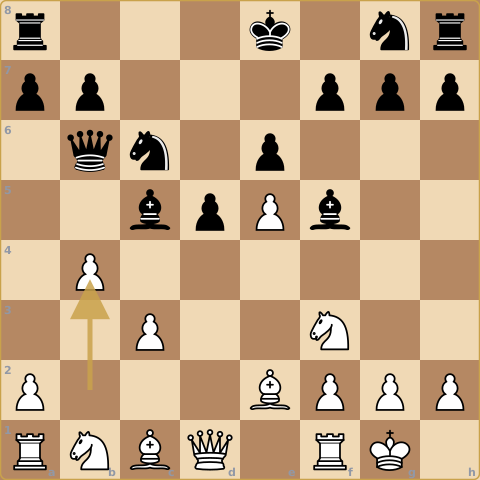
8.dxc5! attacks the queen with a pawn, and Black almost always (98.3%) takes back with 8...Bxc5. Then 9.b4 kicks the bishop and gains queenside space with tempo. Don't fear 9...Bxb4: after 10.cxb4 Qxb4, Black has given a bishop for two pawns.
The same trade works against 7...Nge7. The knight on e7 blocks Black's f8 bishop, so 8.dxc5 wins a pawn that Black can't simply take back, and 9.b4 holds it. And if Black swaps early with 6...cxd4 (28.4%), take back with the knight: 7.Nxd4 hits the bishop, and after 7...Bg6, 8.c4 opens lines while Black's king is still in the center. White wins 65% of games after 8.c4 at this level on Lichess.
If Black plays 3...c5 instead
About one game in four (24.1% in our data), Black hits the center straight away with 3...c5. Our trainer doesn't rush: 4.Nf3 develops and protects both d4 and e5. Then it depends on Black. Against 4...Nc6 (44.9%), 5.Bb5 pins the knight to the king and takes the pressure off d4. Against 4...cxd4 (16.9%), take back with the knight. And against 4...Bg4 (28.5%), take the pawn with 5.dxc5. White isn't trying to keep it forever. The point is that Black's pin was aimed at d4, d4 is gone, and Black has to spend moves winning the pawn back instead of developing. Meanwhile you develop naturally and keep the e5 pawn.
White's general plans in the Advance
- Keep e5 and d4 solid. They're the reason you have more space. c3, Nf3 and your queen are the usual supports for d4.
- Use the kingside space. With Black's knight kept off f6, White can build a kingside attack later with Nbd2-f1-g3 or a timely h4.
- Watch for ...c5. It's Black's main break in almost every line. Be ready to castle and support d4 with c3, or to take with dxc5 when Black's pieces give you a target.
- Don't chase the bishop blindly. Moves like g4 and h4 can work, but only if you've checked the resulting weaknesses. The Short System lets you avoid them.
Other ways to play against the Caro-Kann
The Advance isn't the only option. You'll also see:
- The Classical (3.Nc3 or 3.Nd2, 3...dxe4 4.Nxe4). The traditional main line, with a lot of theory.
- The Panov-Botvinnik (3.exd5 cxd5 4.c4). White accepts an isolated d-pawn for active piece play.
- The Two Knights (2.Nc3 d5 3.Nf3). A flexible move order that avoids some main lines.
- The Fantasy Variation (3.f3). Sharp and a bit risky, good as a surprise.
We only have trainer data for the Advance, so we'll stick to what we can back up: after 3.e5 Bf5, the calm 4.Nf3 is White's most common choice at 800 to 2200 on Lichess (28%), our White trainer is built for 900 to 1800, and it gives you a clear plan without a mountain of theory.
Frequently asked questions
What is the best way to play against the Caro-Kann?
For most players, the Advance Variation (3.e5) with the Short System (Nf3, Be2, O-O) is the most practical. It gains space, keeps White's structure healthy and needs far less theory than the Classical. At 900 to 1800 on Lichess, Black answers 3.e5 with 3...Bf5 61.5% of the time, 3...c5 24.1% and 3...e6 7.5%.
How do you punish ...Qb6 in the Caro-Kann Advance?
After 5.Be2 c5 6.O-O Nc6 7.c3 Qb6, play 8.dxc5, hitting the queen with a pawn. After 8...Bxc5, 9.b4 chases the bishop and gains queenside space with tempo. If Black takes 9...Bxb4, 10.cxb4 Qxb4 leaves Black with two pawns for a bishop.
What does White do against 3...c5 in the Caro-Kann Advance?
Develop with 4.Nf3, which protects both d4 and e5. Then pin with 5.Bb5 against 4...Nc6, recapture with the knight against 4...cxd4, and take 5.dxc5 against 4...Bg4. In that last line Black has to spend moves winning the pawn back, which gives White time to develop and keep the e5 pawn.
Is the Caro-Kann Advance good for club players as White?
Yes. Our Caro-Kann Advance repertoire for White is recommended for 900 to 1800 Elo. It covers 3...Bf5, 3...c5 and 3...e6 in 13 lines and relies on plans rather than memorized forcing sequences.
Copy the lines (PGN)
Every line in this article in standard PGN, ready to paste into Lichess, Chess.com or any chess database.
[Event "How to Beat the Caro-Kann Defense as White: Short System"]
[Site "chesscoachacademy.com"]
[Result "*"]

1. e4 c6 2. d4 d5 3. e5 Bf5 4. Nf3 e6 5. Be2 c5 6. O-O Nc6 7. c3 *

[Event "How to Beat the Caro-Kann Defense as White: 7...Qb6 8.dxc5"]
[Site "chesscoachacademy.com"]
[Result "*"]

1. e4 c6 2. d4 d5 3. e5 Bf5 4. Nf3 e6 5. Be2 c5 6. O-O Nc6 7. c3 Qb6 8. dxc5 Bxc5 9. b4 *

[Event "How to Beat the Caro-Kann Defense as White: 5...Nd7 and 7.c4"]
[Site "chesscoachacademy.com"]
[Result "*"]

1. e4 c6 2. d4 d5 3. e5 Bf5 4. Nf3 e6 5. Be2 Nd7 6. O-O c5 7. c4 *

[Event "How to Beat the Caro-Kann Defense as White: 3...c5 4.Nf3"]
[Site "chesscoachacademy.com"]
[Result "*"]

1. e4 c6 2. d4 d5 3. e5 c5 4. Nf3 Bg4 5. dxc5 *
Keep reading
- Why Is the Caro-Kann Considered So Solid?: What makes the Caro-Kann hard to crack, from Black's point of view.
- What Is the Best Defense Against 1.e4?: All the 1.e4 defenses you'll meet, compared.
Practice the Advance against every common Black reply
Our Caro-Kann Advance trainer for White covers 13 lines built from what 900 to 1800 rated players actually play on Lichess, including 3...Bf5 with Black's main fifth moves, the ...Qb6 pressure, 3...c5 and 3...e6. The trainer plays Black's real replies, and you get a short explanation after each move.
It's free during the open beta, and progress tracking on every line is free when you sign up.
13 lines from 24 million Lichess games. Free during the open beta, with free progress tracking.
Practice as White free →