Is the Bishop's Opening (1.e4 e5 2.Bc4) Good?
TL;DR
Short answer Yes. It's sound and easy to set up, and like the main 2.Nf3 lines it leads to balanced positions with accurate play. Its main selling point is practical: Black never gets to play the Petroff, one setup works against almost everything, and you often reach a quiet Italian by a different road. Games behind this article About 143 million Lichess games at 500 to 2000 Black's second move 2...Nf6 34.3% · 2...Nc6 29.5% · 2...Bc5 12.5% · 2...d6 9.6% Black's third move after 2...Nf6 3.d3 3...Bc5 33.7% · 3...Nc6 21.3% · 3...d5 12.5% · 3...h6 9.4% · 3...c6 8.9% Lichess results 500 to 2000 on Lichess: after 2...Nf6 3.d3 Bc5 4.Nf3 Ng4?, only about 3% of players find 5.Bxf7+!, and they win 64% of those games Recommended range 500 to 2000 Elo in our library, 21 lines
Why play 2.Bc4 at all?
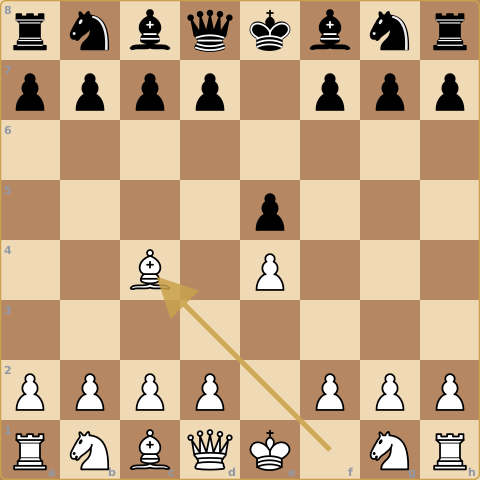
Almost everyone plays 2.Nf3 here. At 500 to 2000 on Lichess, 2.Bc4 comes up in about 11% of games after 1.e4 e5, second only to 2.Nf3. The problem with 2.Nf3 is that it lets Black choose the Petroff with 2...Nf6, a solid defense that many players prepare in depth. If your opponent is a Petroff player, you're walking into their home ground.
2.Bc4 takes that option away. The bishop comes out first, aiming at f7, and the knight on g1 waits. Black never gets to meet a knight on f3 with ...Nf6, so the Petroff simply can't happen. That's the main reason to play it.
The move is also flexible. White can decide later whether the knight goes to f3 or e2, and whether to aim for the Italian or something of its own.
The key move: 3.d3
Black's most common reply is 2...Nf6 (34.3%). It's called the Berlin Defense to the Bishop's Opening, and it attacks the e4 pawn straight away.
3.d3 is the calm, safe answer, and it's the move our repertoire plays. There's a reason not to play 3.Nf3 here: after 3...Nxe4 you reach exactly the same position as 1.e4 e5 2.Nf3 Nf6 3.Bc4 Nxe4, a Petroff sideline. The whole point of 2.Bc4 is to avoid that, so the pawn goes to d3 first.
From here Black's main choices are 3...Bc5 (33.7%), 3...Nc6 (21.3%), 3...d5 (12.5%), 3...h6 (9.4%) and 3...c6 (8.9%). Against almost all of them the plan is the same: Nf3, c3 and castle.
Transposing to the Italian
After 3...Nc6 4.Nf3, Black plays 4...Bc5 in 45.0% of games, and you're in a quiet Italian Game.
The position before 5.c3 is identical to the slow Italian after 1.e4 e5 2.Nf3 Nc6 3.Bc4 Bc5 4.d3 Nf6. With 5.c3 you reach the Giuoco Pianissimo, the "very quiet" Italian: c3 keeps Black's knight off d4, prepares d3-d4 later and gives your bishop a retreat to c2. If you already play the Italian with c3 and d3, you're on familiar ground, reached by a route that took the Petroff off the table.
2...Nc6 and 2...Bc5 don't need a separate repertoire either. Our lines answer both with d3 and Nf3, and the same Italian positions keep coming back in a different order. A Vienna player can use 2.Bc4 as a way in too: 2...Nf6 3.Nc3 gives the position from 1.e4 e5 2.Nc3 Nf6 3.Bc4.
The trap: 4...Ng4?
After 3...Bc5 4.Nf3, 13.8% of players jump 4...Ng4, attacking f2. It looks dangerous, but it leaves the knight loose while f7 is still defended only by the king.
After 6.Ng5+ and 7.Qxg4, White wins back the piece, stays a pawn up, and Black's king can no longer castle. If Black grabs the knight with 6...Qxg5, then 7.Bxg5 wins the queen. Only about 3% of players at this level find 5.Bxf7+, and they win 64% of those games on Lichess.
The independent line: 3...c6
This is the move that stops the Bishop's Opening from being a simple Italian in disguise. Black prepares ...d5 to hit the center and the bishop.
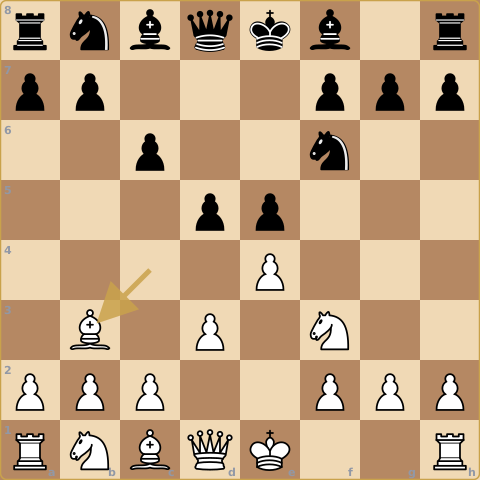
Black strikes with 4...d5 in 66.8% of games. Don't grab e5 with 5.Nxe5?, because 5...dxc4 wins your bishop. Instead the bishop drops back to b3, on the same diagonal, pointing at d5 with f7 behind it.
If Black now takes with 5...dxe4 (34%), the knight jumps in:
With the d5 pawn gone, the bishop on b3 sees all the way to f7, and the knight on g5 hits it too. Only the king defends it, and Stockfish rates White about a pawn better. This is the part of the Bishop's Opening you have to study on its own terms, and it's why the opening isn't just a move-order trick.
What 2.Bc4 doesn't do
It doesn't win anything by force. The quiet d3 setup leads to level positions against good play, the same as most main lines after 2.Nf3. The value is practical: you choose the battleground, and Petroff specialists lose their preparation.
You also need to watch your own f2 pawn. Against ...Bc5 setups, ...Qf6 or ...Qh4 can team up with the bishop against f2, and ...Ng4 can hit it too. Nf3 and castling keep it safe, and once c3 is in, ...Ng4 can be met by d4, which blocks the bishop's line to f2.
And don't grab e5 too early. After 3...Bc5 4.Nf3 O-O, the pawn looks free, but 5.Nxe5? runs into 5...d5!, hitting your bishop and e4. Finish development first.
The verdict
The Bishop's Opening is a good, sound choice. It suits two kinds of players. The first is an Italian player who's tired of facing the Petroff and wants to reach their usual positions by a different road. The second is a newer player who wants one simple setup, Bc4, d3, Nf3, c3 and castle, that works against almost everything Black does after 1...e5.
Our library recommends it from 500 up to 2000 Elo, one of the widest ranges we have. That tells you how well it scales: easy to start with, and still useful once your opponents know their theory.
Frequently asked questions
Is the Bishop's Opening good?
Yes. 1.e4 e5 2.Bc4 is sound and flexible. It doesn't give White more than 2.Nf3, but it avoids the Petroff completely and often transposes into a quiet Italian Game. Our library recommends it from 500 to 2000 Elo.
How does the Bishop's Opening avoid the Petroff?
The Petroff is 1.e4 e5 2.Nf3 Nf6. With 2.Bc4, White hasn't played Nf3 yet, so Black can't reach it. After 2...Nf6, White plays 3.d3 rather than 3.Nf3, because 3.Nf3 Nxe4 gives the same position as a Petroff sideline.
Does the Bishop's Opening transpose into the Italian Game?
Often. After 1.e4 e5 2.Bc4 Nf6 3.d3 Nc6 4.Nf3 Bc5, the position is the same as the slow Italian (1.e4 e5 2.Nf3 Nc6 3.Bc4 Bc5 4.d3 Nf6), and 5.c3 gives the Giuoco Pianissimo. Black can stay independent with 3...c6 and ...d5, which 8.9% of players at 500 to 2000 on Lichess choose after 3.d3.
What is Black's most common reply to the Bishop's Opening?
2...Nf6, attacking e4, played in 34.3% of games at 500 to 2000 on Lichess. 2...Nc6 (29.5%), 2...Bc5 (12.5%) and 2...d6 (9.6%) are the other main replies. With normal development both sides get a level game.
Copy the lines (PGN)
Every line in this article in standard PGN, ready to paste into Lichess, Chess.com or any chess database.
[Event "Is the Bishop's Opening (1.e4 e5 2.Bc4) Good?: Main line, 3.d3"]
[Site "chesscoachacademy.com"]
[Result "*"]

1. e4 e5 2. Bc4 Nf6 3. d3 *

[Event "Is the Bishop's Opening (1.e4 e5 2.Bc4) Good?: Transposition to the Italian"]
[Site "chesscoachacademy.com"]
[Result "*"]

1. e4 e5 2. Bc4 Nf6 3. d3 Nc6 4. Nf3 Bc5 5. c3 *

[Event "Is the Bishop's Opening (1.e4 e5 2.Bc4) Good?: 4...Ng4 trap"]
[Site "chesscoachacademy.com"]
[Result "*"]

1. e4 e5 2. Bc4 Nf6 3. d3 Bc5 4. Nf3 Ng4 5. Bxf7+ Kxf7 6. Ng5+ Kg8 7. Qxg4 *

[Event "Is the Bishop's Opening (1.e4 e5 2.Bc4) Good?: 3...c6 with 5...dxe4"]
[Site "chesscoachacademy.com"]
[Result "*"]

1. e4 e5 2. Bc4 Nf6 3. d3 c6 4. Nf3 d5 5. Bb3 dxe4 6. Ng5 *
Keep reading
- What Is the Best Defense Against 1.e4?: The Petroff and other answers to 1.e4 from Black's side, compared.
Practice the Bishop's Opening move order
Our Bishop's Opening trainer covers 21 lines built from about 143 million Lichess games at 500 to 2000, including the 3.d3 main line, the transpositions into Italian structures, the 4...Ng4 trap and the independent 3...c6 system. You play White against the moves Black players really choose, every one of your moves is checked by Stockfish, and each move comes with a short explanation.
It's free during the open beta, and your progress on every line is tracked for free once you sign up.
21 lines built from 143 million Lichess games. Free during the open beta, with free progress tracking.
Practice the Bishop's Opening free →