Is the Petroff Defense Really Drawish?
TL;DR
Short answer It's solid, not automatically drawish. The main line can stay symmetrical for a long time, but White has sharp options, and at club level there are plenty of ways for both sides to go wrong. Games behind this article About 98 million Lichess games at 800 to 2400 White's 3rd move 3.Nc3 32.6% · 3.Nxe5 32.3% · 3.Bc4 18.0% · 3.d3 7.1% · 3.d4 6.2% How symmetrical? In the Classical, 5.Qe2 (32.7%) often means an early queen trade. After 5.d4 d5, 6.Bd3 (84.6%) and 7.O-O (77.9%) are common, and White breaks the symmetry with 8.c4 (48.4%). Sharpest common line 5. Nc3: doubled pawns for White, queenside castling and often opposite-side attacks Lichess result In the fork trick (3.Nc3 Nc6 4.Bc4 Nxe4 5.Nxe4 d5), 51% of White players take with 6.Bxd5, and Black then scores 59% (800 to 2400). Recommended range 800 to 2400 Elo, 22 lines Our data doesn't give a draw percentage for the Petroff as a whole, only results for specific lines like the fork trick. The move data tells a clearer story anyway.
Where the reputation comes from
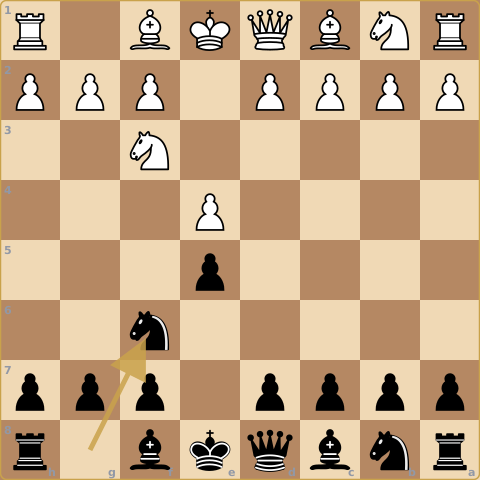
Instead of defending the e5 pawn, Black attacks White's e4 pawn in return. If White takes on e5, Black takes on e4, and the position often becomes symmetrical. At the very top, players like Vladimir Kramnik and Fabiano Caruana have used it as a near-unbreakable wall with the black pieces, and when two elite players who both know the theory meet in a symmetrical position, a lot of games end in draws. That's where the reputation comes from.
Even at that level it isn't a guaranteed draw: Caruana had three decisive results with it in the 2018 Candidates Tournament. The Petroff is an elite defense. But "elite players draw with it" isn't the same as "it's drawish when you play it".
What the move data actually shows
After 2...Nf6, White's choices at 800 to 2400 on Lichess are spread out: 3.Nc3 (32.6%), 3.Nxe5 (32.3%), 3.Bc4 (18.0%), 3.d3 (7.1%) and 3.d4 (6.2%). So the first thing the data shows is that most of your opponents never enter the symmetrical Classical at all. 3.Nc3 leads to a Four Knights position, where the fork trick (3...Nc6 4.Bc4 Nxe4!) gives Black a sharp, open game.
The Classical, 3.Nxe5, is where the symmetry lives:
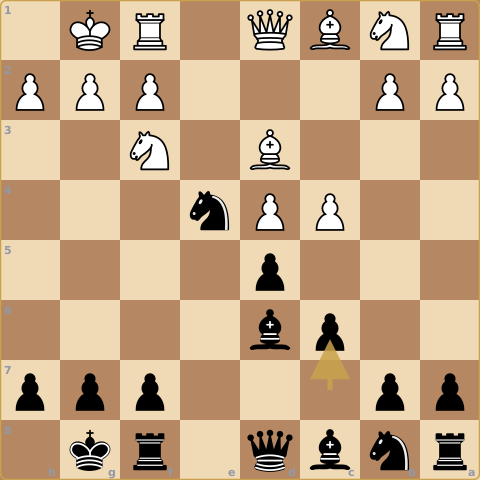
After 5.d4 d5, White's next moves are common choices: 6.Bd3 in 84.6% of games and 7.O-O in 77.9%. But White doesn't have to keep copying. 8.c4, played in 48.4% of games, is White's way of breaking the symmetry and challenging d5.
Notice, though, that 5.d4 is only White's second choice here (23.7%). The most common fifth move is 5.Qe2 (32.7%), which pins the e4 knight against Black's king. Black defends with 5...Qe7, and after 6.d3 Nf6, 42.8% of White players trade queens with 7.Qxe7+. That line is where the drawish feeling comes from: queens off early in a symmetrical structure.
So yes, the Classical can be quiet. But even the queen trade leaves an endgame with every minor piece still on the board, and the main line is a fight over d5 and the knight on e4, not a copy-and-paste draw.
The line that isn't quiet at all: 5.Nc3
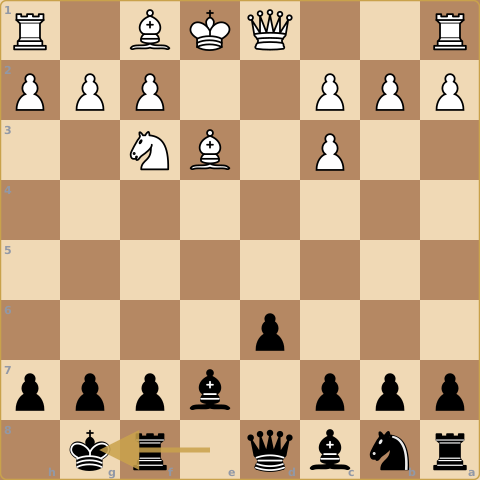
Here White (17.1% of games at this level) lets Black double White's c-pawns. After 5...Nxc3, White takes back with the d-pawn in 93.6% of games, opening the d-file. In return, White gets open lines for the pieces, and the usual plan is Qd2 and castling queenside. With Black's king already on the kingside, the kings end up on opposite wings, and both sides can push pawns at the enemy king. That's about as far from drawish as an opening gets.
Why copying White is a mistake
The Petroff has one famous trap that shows how the symmetry has limits. On move three, Black must not take back on e4 straight away:
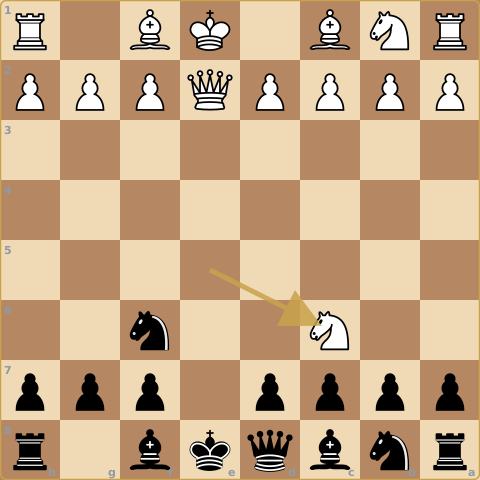
This isn't a rare slip. At 800 to 2400 on Lichess, only 26% of players find the correct 3...d6 here, against 69% of players rated 2200 and above. After 3...Nxe4?, 4.Qe2 attacks the knight down the e-file. If Black retreats with 4...Nf6??, 5.Nc6+ uncovers check from the queen while the knight hits Black's queen on d8. Black can limit the damage with 4...Qe7, but still ends up a pawn down. That's why the correct move order is 3...d6 first, kicking the knight, and only then ...Nxe4.
At club level, traps and imbalances like these mean the Petroff is far less of a guaranteed quiet game than its reputation suggests.
Who should play it?
- Players who want a solid, low-risk answer to 1.e4 e5 without learning the Ruy Lopez, the Italian, the Scotch and every gambit White might try. The Petroff sidesteps most of them.
- Players who are happy to win slowly. You'll rarely blow your opponent off the board in the opening, but you'll rarely be blown off it either.
- Anyone from about 800 upward. Our recommended range is 800 to 2400, one of the widest in our library, because the ideas are simple and the theory scales up with you.
If you want sharp, unbalanced positions every game, look at the Sicilian instead. If you want a defense that holds up against almost anything and still lets you outplay weaker opponents later, the Petroff is a strong choice.
Frequently asked questions
Is the Petroff Defense drawish?
At elite level it has a drawish reputation because top players can hold the symmetrical positions easily. At club level it's much less so. White has sharp options like 5.Nc3 with queenside castling, and Black has to avoid known traps.
What is White's most common reply to the Petroff?
At 800 to 2400 on Lichess, 3.Nc3 (32.6%) and 3.Nxe5 (32.3%) are almost level, followed by 3.Bc4 (18.0%), 3.d3 (7.1%) and 3.d4 (6.2%).
What is the Petroff trap?
After 1.e4 e5 2.Nf3 Nf6 3.Nxe5, the natural-looking 3...Nxe4? is a mistake. 4.Qe2 attacks the knight, and if 4...Nf6?? then 5.Nc6+ is a discovered check that wins Black's queen. The correct move is 3...d6 first.
Is the Petroff good for beginners?
Yes. Our recommended range starts at 800 Elo. The ideas are simple and Black avoids most of White's sharp e4 e5 openings, as long as the 3...d6 move order is learned properly.
Copy the lines (PGN)
Every line in this article in standard PGN, ready to paste into Lichess, Chess.com or any chess database.
[Event "Is the Petroff Defense Really Drawish?: Classical main line"]
[Site "chesscoachacademy.com"]
[Result "*"]

1. e4 e5 2. Nf3 Nf6 3. Nxe5 d6 4. Nf3 Nxe4 5. d4 d5 6. Bd3 Bd6 7. O-O O-O 8. c4 c6 *

[Event "Is the Petroff Defense Really Drawish?: 5.Qe2 and the queen trade"]
[Site "chesscoachacademy.com"]
[Result "*"]

1. e4 e5 2. Nf3 Nf6 3. Nxe5 d6 4. Nf3 Nxe4 5. Qe2 Qe7 6. d3 Nf6 7. Qxe7+ Bxe7 *

[Event "Is the Petroff Defense Really Drawish?: 5.Nc3"]
[Site "chesscoachacademy.com"]
[Result "*"]

1. e4 e5 2. Nf3 Nf6 3. Nxe5 d6 4. Nf3 Nxe4 5. Nc3 Nxc3 6. dxc3 Be7 7. Be3 O-O *

[Event "Is the Petroff Defense Really Drawish?: The 3...Nxe4 trap"]
[Site "chesscoachacademy.com"]
[Result "*"]

1. e4 e5 2. Nf3 Nf6 3. Nxe5 Nxe4 4. Qe2 Nf6 5. Nc6+ *

[Event "Is the Petroff Defense Really Drawish?: Four Knights, the fork trick"]
[Site "chesscoachacademy.com"]
[Result "*"]

1. e4 e5 2. Nf3 Nf6 3. Nc3 Nc6 4. Bc4 Nxe4 5. Nxe4 d5 *
Keep reading
- What Is the Best Defense Against 1.e4?: How the Petroff compares with the Caro-Kann, Scandinavian, Sicilian and others.
Practice the Petroff against every White try
Our Petroff trainer covers 22 lines built from what 800 to 2400 rated opponents actually play on Lichess, including the Classical with 5.Qe2, 5.d4 and the sharp 5.Nc3, the Four Knights with the fork trick, 3.Bc4, 3.d3 and 3.d4. You play Black, the trainer answers with White's real moves, and each move has a plain-English note.
It's free during the open beta, and your progress on every line is tracked for free once you create an account.
22 lines from 98 million Lichess games. Free during the open beta, with free progress tracking.
Practice the Petroff free →