Is the Scandinavian Defense (1.e4 d5) Sound at Higher Levels?
TL;DR
Short answer Yes, it's sound. White gets a small, lasting edge from the tempo gained on Black's queen, but Black's position has no structural flaws. It works at every level and is a respected surprise weapon at the top. Games behind this article About 94 million Lichess games at 400 to 1400 White's 2nd move 2.exd5 50.8% · 2.e5 17.9% · 2.Nc3 8.7% · 2.Nf3 6.2% White's 4th move after 3...Qa5 4. Nf3 39.5% · 4.d4 24.8% · 4.d3 10.3% · 4.Bc4 5.9% Trick to know The quiet Bd2 setup, which prepares a discovered attack on the queen with Ne4. After 4.d4 Nf6, 5.Bd2 is played in 47.1% of games. Lichess result After 4.d4 Nf6 5.Bd2 c6 6.Ne4, about 2% of players take 6...Nxe4?? and lose the queen to 7.Bxa5. White wins 93% of those games (400 to 1400). Recommended range 400 to 1400 Elo in our library, 15 lines
The objection everyone raises
Every beginner book says don't bring your queen out early. In the Scandinavian, Black does exactly that on move two, and White kicks it with 3.Nc3, gaining a tempo. So the question is fair: if Black breaks a basic principle and loses time, how can the opening be sound?
The answer is that the tempo matters less than it looks, because of where the queen goes next.
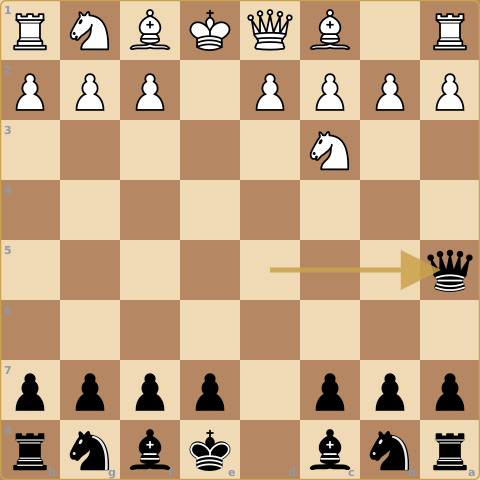
On a5 the queen is hard to attack with more tempo gains. It watches the a5-e1 diagonal, which matters once White's d-pawn moves, and it keeps an eye on e5 and the knight on c3. Black then develops the rest normally: ...Nf6, ...Bf5 or ...Bg4, ...c6 and ...e6. The result looks a lot like a Caro-Kann with the pawns on c6 and e6 and the bishop outside the chain. That's a very healthy structure.
What White actually plays
At 400 to 1400 on Lichess, 1...d5 is played in about 10% of games after 1.e4, and only 50.8% of White players take on d5. The rest try 2.e5 (17.9%), 2.Nc3 (8.7%) or 2.Nf3 (6.2%), and 2.Nf3? simply loses the e4 pawn to 2...dxe4. After 2.exd5 Qxd5 3.Nc3 Qa5, White's fourth move splits like this:
- 4.Nf3 (39.5%). Flexible development, the most common choice at this level.
- 4.d4 (24.8%). The principled main line, taking the center.
- 4.d3 (10.3%). A modest setup, usually followed by Bd2.
- 4.Bc4 (5.9%). Aiming at f7 straight away.
Our trainer answers all of them with the same setup: ...Nf6, ...c6, then ...Bf5. Against the most common move order it goes like this:
Where it gets harder: the tries stronger players use
At club level, White often just develops and Black gets a comfortable game. There are two specific ways to make Black's life awkward. The first is common at every level, the second shows up more as opponents get stronger.
The Bd2 setup
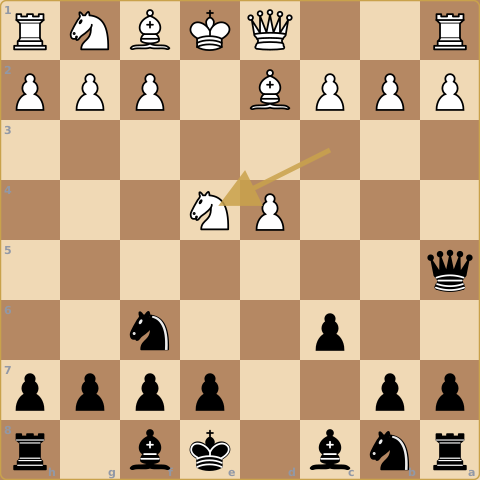
Bd2 looks modest, but the bishop now sits on the same diagonal as Black's queen, with only White's own knight in between. When that knight jumps, it's a discovered attack on the queen. At 400 to 1400, 5.Bd2 is White's most common answer to 4...Nf6 (47.1%), and 6.Ne4 follows in 41.3% of games. The knight also hits f6, which is what makes 6...Nxe4?? so tempting. About 2% of players take it, 7.Bxa5 wins the queen, and White wins 93% of those games on Lichess. The fix is simple: move the queen first with 6...Qc7. The pawn on c6 is what gives the queen that way home.
The kingside push
Here White centralizes the knight and throws the g-pawn at Black's bishop right away. It's sharp and risky for both sides, and exactly the kind of line where preparation decides the game. You won't meet it often below 1400, and it isn't part of our trainer, but it's worth knowing it exists if you take the Scandinavian higher up.
So how sound is it at higher levels?
Here's where things stand. Like almost every opening, the Scandinavian gives White a small edge with best play. The source of that edge is clear: White gets a tempo and some extra space in the center. Black's compensation is a sound, weakness-free structure and easy development.
At club level, that trade works well for Black, which is why our library recommends it from 400 up to 1400 Elo. Opponents at this level play Bd2 a lot, but once you know to move the queen before anything else, the trick loses its sting, and Black gets a familiar position every game.
Higher up, strong White players know how to keep the small edge, so the Scandinavian becomes more of a surprise weapon than an every-game defense. It's been used that way by elite players, including Magnus Carlsen, and grandmaster Sergei Tiviakov built a long career on it. It's not a bad opening at that level, it's just one where Black needs to know the critical lines as well as White does.
Our data doesn't give an overall win or draw percentage for the Scandinavian, only results after specific positions like the Ne4 trick above. What the move data shows is that White's replies are concentrated: after 3...Qa5, 4.Nf3 (39.5%) and 4.d4 (24.8%) are the two main choices, and Black's setup is the same against both. That's good news for a Scandinavian player, because most of your preparation goes into one plan.
What about 2...Nf6?
There's a second way to play the Scandinavian: 1.e4 d5 2.exd5 Nf6, taking back on d5 with the knight later. It's called the Modern or Marshall Scandinavian and avoids the early queen move entirely, often at the cost of a pawn in some lines. Our trainer covers the 2...Qxd5 and 3...Qa5 system, which is the easier of the two to learn.
Frequently asked questions
Is the Scandinavian Defense a good opening?
Yes. It's sound, easy to learn and gives Black a healthy pawn structure. White usually gets a small edge from the tempo gained on the queen, but that's true of most defenses. Our library recommends it for 400 to 1400 Elo.
Do grandmasters play the Scandinavian?
Yes, mostly as a surprise weapon. Magnus Carlsen has used it in elite events, and grandmaster Sergei Tiviakov is known as one of its biggest specialists.
Isn't moving the queen early a mistake in the Scandinavian?
It costs a tempo after 3.Nc3, but after 3...Qa5 the queen is hard to attack again and supports Black's development. The rest of Black's setup (...Nf6, ...Bf5, ...c6, ...e6) is very solid.
What is White's best try against the Scandinavian?
At 400 to 1400 on Lichess, 4.Nf3 (39.5%) and 4.d4 (24.8%) are the most common fourth moves after 3...Qa5. The follow-up to know is the Bd2 setup, because a knight jump like Ne4 then uncovers an attack on the queen on a5. Move the queen first (for example 6...Qc7) and Black is fine.
Copy the lines (PGN)
Every line in this article in standard PGN, ready to paste into Lichess, Chess.com or any chess database.
[Event "Is the Scandinavian Defense (1.e4 d5) Sound at Higher Levels?: Scandinavian main line"]
[Site "chesscoachacademy.com"]
[Result "*"]

1. e4 d5 2. exd5 Qxd5 3. Nc3 Qa5 4. Nf3 Nf6 5. d4 c6 6. Bd2 Bf5 *

[Event "Is the Scandinavian Defense (1.e4 d5) Sound at Higher Levels?: Bd2 and the Ne4 trick"]
[Site "chesscoachacademy.com"]
[Result "*"]

1. e4 d5 2. exd5 Qxd5 3. Nc3 Qa5 4. d4 Nf6 5. Bd2 c6 6. Ne4 Qc7 7. Nxf6+ exf6 *

[Event "Is the Scandinavian Defense (1.e4 d5) Sound at Higher Levels?: Ne5 and g4"]
[Site "chesscoachacademy.com"]
[Result "*"]

1. e4 d5 2. exd5 Qxd5 3. Nc3 Qa5 4. d4 Nf6 5. Nf3 Bf5 6. Ne5 c6 7. g4 *
Keep reading
- What Is the Best Defense Against 1.e4?: How the Scandinavian compares with the Caro-Kann, Petroff, Sicilian and others.
Practice the Scandinavian against every White system
Our Scandinavian trainer covers 15 lines built from what 400 to 1400 rated players actually play on Lichess, including 4.Nf3, 4.d4, 4.d3, 4.Bc4, the Bd2 trick and White's second-move alternatives 2.e5, 2.Nc3 and 2.Nf3. You play Black against White's real moves, with a plain-English explanation after each one.
It's free during the open beta, and once you sign up we track your progress on every line for free.
15 lines from 94 million Lichess games. Free during the open beta, with free progress tracking.
Practice the Scandinavian free →