The King's Gambit at 900 to 2200: Risky on Paper, Dangerous in Real Games

TL;DR: the data
Built from 78 million Lichess games played by 900 to 2200 rated players You play White, 14 practice lines, every move of yours checked by Stockfish Most common line 1. e4 e5 2. f4 exf4 3. Nf3 g5 4. h4 Replies to 3.Nf3 3...g5 17% · 3...Nc6 17% · 3...d6 16% Worth knowing At 900-2200, White wins 53% of games after 2.f4 and Black wins 44%. Among 2200+ players it's even: both sides win 47%.
The King's Gambit is 1.e4 e5 2.f4. You offer your f-pawn to pull Black's e-pawn away from the center, then build a big center with d4 and use the open f-file later. It's named after the pawn you give up: the one in front of your king.
Let's be honest about it first. Stockfish rates the position after 2.f4 as about half a pawn better for Black. But this guide is built from 78 million Lichess games at 900 to 2200, and in those games White wins 53% of the time after 2.f4 and Black wins 44%. The reason is simple: the natural-looking moves are often wrong, and your opponents have to find the right ones under pressure.
1. e4 e5 2. f4 exf4 3. Nf3
Practice the King's Gambit free →Who it's for
Players rated roughly 900 to 2200 who enjoy sharp, tactical positions and are happy to take some risk for the initiative. It rewards players who calculate well and know a handful of key moves.
It's not a good first opening. You need to know precise answers in a few lines (5.Ne5 against 4...g4, 6.Ng1 when your knight is attacked) and to respect ...Qh4+ in every line. If you want something calmer against 1...e5, the Italian or the Bishop's Opening is a better start.
Why it works at 900 to 2200
- Your opponents often go wrong. Natural moves like 4...Bg4, 4...Nd5 and 3...Bc5 let you win back your pawn with a strong center, or even win material.
- Black's replies are spread across six common moves after 3.Nf3, so few opponents have deep experience with any one of them.
- The plans repeat: Nf3 to cover h4, d4 for the center, Nc3 to chase an early queen, and Bxf4 to win the pawn back.
- It's objectively risky. Against the ...g5 lines played accurately, Black stays slightly better.
- Your f-pawn is gone, so your king is more exposed. Tricks with ...Qh4+ and ...Qxe4+ appear in many lines.
- Among players rated 2200 and above the results even out, so the practical edge shrinks as your opponents get stronger.
What 900 to 2200 players actually play
Here's why the King's Gambit is hard to prepare against from Black's side, and why you need to know several lines. After 3.Nf3 no reply dominates. 3...g5 and 3...Nc6 share the top spot at 17%, 3...d6 is right behind at 16%, and 3...Nf6, 3...d5 and 3...Be7 each show up in about one game in ten.
Three numbers from the data are worth remembering:
- After 1.e4 e5 2.f4, Black takes with 2...exf4 in 45% of games, declines with 2...Nc6 in 21% and 2...d6 in 13%, and plays the Falkbeer 2...d5 in 9%.
- At 900-2200, White wins 53% of games after 2.f4 and Black wins 44%. Among 2200+ players it's even: both sides win 47%.
- After 2...exf4 3.Nf3 d6 4.d4, 28% of players answer 4...Bg4, and White wins 60% of games after 5.Bxf4.
How to play the King's Gambit: move by move
Each board below is a decision point from the practice lines. The arrows show Black's most common replies at 900 to 2200, labeled with how often each one is played in that exact position. Under each board you'll find why players choose the move and the answer you play.
After 1. e4 e5 2. f4
Only 45% of players accept the gambit. Against the declines, watch out for ...Qh4+ before you take on e5.
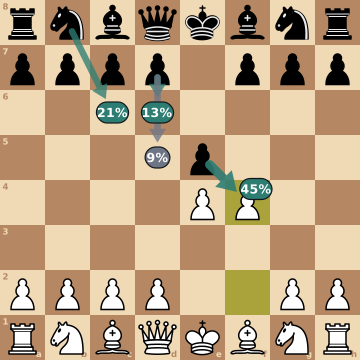
- 2...exf4 (45%). g5.
Your answer: 3. Nf3. Develop, and stop Black's queen from giving a check on h4. - 2...Nc6 (21%). fxe5?g3 Qxe4+, forking your king and the rook on h1.
Your answer: 3. Nf3. Develop, attack e5 again, and cover h4. - 2...d6 (13%). If Black later takes on f4, it's a version of Fischer's Defense.
Your answer: 3. d3. Support e4 and open your c1 bishop toward f4. - 2...d5 (9%). Black counterattacks in the center with d5, the Falkbeer Countergambit.
Your answer: 3. Nf3. Qh4+.
After 1. e4 e5 2. f4 exf4 3. Nf3
The most varied position in the guide. Your answer depends on whether Black defends the f4 pawn (...g5, ...d6) or develops and lets it go.
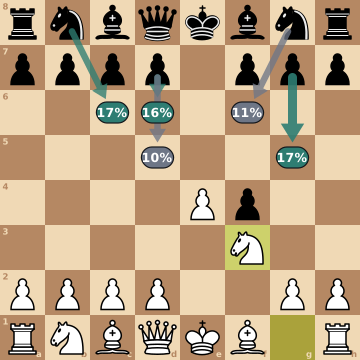
- 3...g5 (17%). The g5 pawn defends f4, and if it's allowed to stay, Black's kingside pawns can become a wall.
Your answer: 4. h4. Attack the g5 pawn right away, before Black's pawns get settled. - 3...Nc6 (17%). It develops, but it doesn't protect the f4 pawn, so you can aim to win it back.
Your answer: 4. d4. Take the center, and your c1 bishop can now see f4. - 3...d6 (16%). g5 to hold on to the f4 pawn.
Your answer: 4. d4. Build your center and open the c1 bishop toward f4. - 3...Nf6 (11%). Black develops Nf6 and attacks your e4 pawn.
Your answer: 4. e5. Push the pawn and kick the knight away. - 3...d5 (10%). Black doesn't try to keep the f4 pawn forever.
Your answer: 4. exd5. Take the pawn. - 3...Be7 (10%). Black develops the bishop to e7, planning Bh4+.
Your answer: 4. Bc4. Develop toward f7, Black's weakest square.
After 1. e4 e5 2. f4 exf4 3. Nf3 Nc6 4. d4
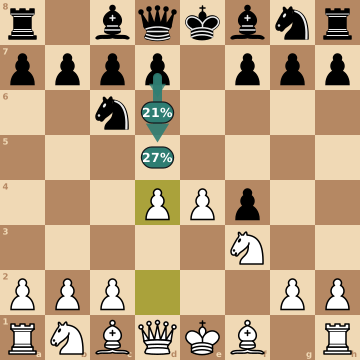
- 4...d5 (27%). It challenges your e4 pawn before you can finish developing.
Your answer: 5. exd5. Take the pawn and make Black's queen come out early. - 4...d6 (21%). d6 is solid, but no black piece or pawn protects the f4 pawn. You can simply take it back.
Your answer: 5. Bxf4. Win your pawn back with a developing move.
After 1. e4 e5 2. f4 exf4 3. Nf3 d6 4. d4
Black has to decide about the f4 pawn right now. The pin with ...Bg4 looks natural but leaves f4 hanging.
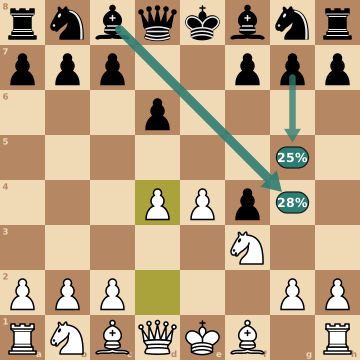
- 4...Bg4 (28%). Bg4? You take it back at once and Black has no compensation.
Your answer: 5. Bxf4. Take the pawn back. Material is level and your center is strong. - 4...g5 (25%). g5 line. Black's pawns on f4 and g5 support each other.
Your answer: 5. h4. Challenge the g5 pawn before Black's pawn wall is secure.
After 1. e4 e5 2. f4 Nc6 3. Nf3
Now e5 is attacked twice and your knight covers h4. The ...Qh4+ tricks are gone for the moment.
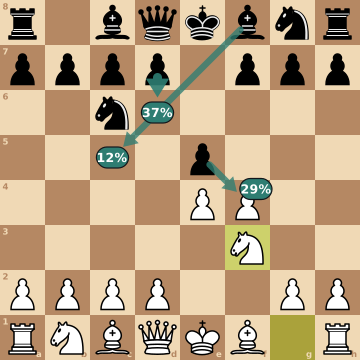
- 3...d6 (37%). The position now looks more like a quiet opening than a gambit.
Your answer: 4. Bc4. Develop and aim at f7. - 3...exf4 (29%). Nf3 Nc6, so you already know the plan.
Your answer: 4. d4. Take the center, just like in the accepted line. - 3...Bc5 (12%). Black develops Bc5, but the e5 pawn is now short of defenders.
Your answer: 4. Nxe5. Take the pawn. If Black takes back, d4 forks bishop and knight.
After 1. e4 e5 2. f4 d5 3. Nf3
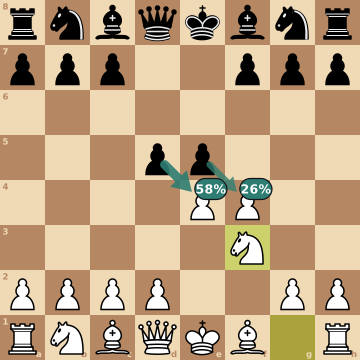
- 3...dxe4 (58%). exf3 wins the knight.
Your answer: 4. Nxe5. Take back a pawn and put your knight in the center. - 3...exf4 (26%). Nf3 d5.
Your answer: 4. exd5. Take the pawn, and you're level on material.
Your plan after the opening
Against 3...Nc6 and 3...d5: center first, then chase the queen
Play d4 (or exd5 against 3...d5) and let Black's queen recapture in the center. Then Nc3 hits it, and every queen move gives you a free developing move. If the queen checks on e6, block with Be2 and castle. Later, win back the f4 pawn with Bxf4. Stockfish rates you slightly better.
1. e4 e5 2. f4 exf4 3. Nf3 Nc6 4. d4 d5 5. exd5 Qxd5 6. Nc3
Against 3...g5: h4, and the knight goes to e5
Hit the g5 pawn at once with 4.h4. Black's best is 4...g4, attacking your knight, and here you must play 5.Ne5, putting the knight in the center where it attacks g4. After 5...Nf6 6.d4 d6 7.Nd3 Nxe4 8.Bxf4, Black is a pawn up and slightly better, but your pieces are active and Black's kingside pawns are spread out.
1. e4 e5 2. f4 exf4 3. Nf3 g5 4. h4 g4 5. Ne5 Nf6 6. d4 d6 7. Nd3 Nxe4 8. Bxf4
Against 3...d6: d4, and know when the knight must retreat
After 4.d4 your c1 bishop eyes f4. If Black holds it with 4...g5 5.h4 g4, the knight is attacked and it goes home: 6.Ng1. Then Nc3, Bc4 and Nge2, and win back the f4 pawn later. This is the line where Black does best, so be accurate.
1. e4 e5 2. f4 exf4 3. Nf3 d6 4. d4 g5 5. h4 g4 6. Ng1
Against the declines: stay solid
Against 2...Nc6, play 3.Nf3 and, after 3...d6, 4.Bc4. If Black pins with 4...Bg4, support the center with 5.d3. Against 2...d6, 3.d3 means any ...exf4 is met by Bxf4. Against the Falkbeer 2...d5, develop 3.Nf3 first, and after 3...dxe4 take back a pawn with 4.Nxe5.
1. e4 e5 2. f4 Nc6 3. Nf3 d6 4. Bc4 Bg4 5. d3
Traps and common mistakes
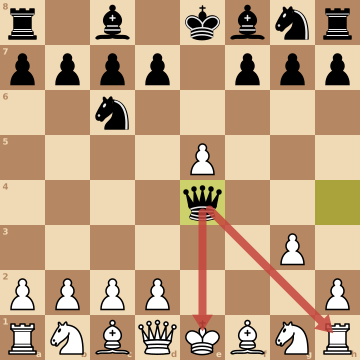
Taking on e5 while ...Qh4+ is possible
1. e4 e5 2. f4 Nc6 3. fxe5? Qh4+ 4. g3 Qxe4+
After 2...Nc6 (21% of games) the e5 pawn looks free. It isn't. 3.fxe5? Qh4+ 4.g3 Qxe4+ checks your king and attacks the rook on h1 at the same time. Play 3.Nf3 first.
The same trick comes back after 3...Bc5 4.Nxe5 Nxe5. Don't recapture with 5.fxe5?. Play 5.d4!, forking the bishop and the knight.
Putting the knight on g5 instead of e5
1. e4 e5 2. f4 exf4 3. Nf3 g5 4. h4 g4 5. Ne5
After 3...g5 4.h4 g4, your knight is attacked. 5.Ng5? looks aggressive, but Stockfish rates it about a pawn and a half for Black. The knight belongs in the center: 5.Ne5, where it hits g4 and keeps Black busy.
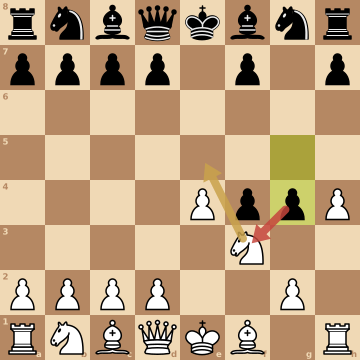
Forgetting that the knight is attacked
1. e4 e5 2. f4 exf4 3. Nf3 d6 4. d4 g5 5. h4 g4 6. Ng1
In the 3...d6 line, after 5...g4 it's tempting to grab the pawn with 6.Bxf4?. But 6...gxf3 takes your knight. Retreat 6.Ng1 first.
The same thing happens in the Falkbeer: after 2...d5 3.Nf3 dxe4, 4.fxe5? loses the knight to 4...exf3. Take with 4.Nxe5 instead.
Black's favorite mistake: 4...Bg4?
1. e4 e5 2. f4 exf4 3. Nf3 d6 4. d4 Bg4 5. Bxf4
After 3...d6 4.d4, 28% of players pin your knight with 4...Bg4. It develops, but it leaves the f4 pawn undefended. Just take it with 5.Bxf4. White wins 60% of games after 5.Bxf4 at this level, and Stockfish rates you more than a pawn better. If Black trades with ...Bxf3, recapture with the queen and enjoy the two bishops.
The free rook after 4...h6?
1. e4 e5 2. f4 exf4 3. Nf3 g5 4. h4 h6 5. hxg5 hxg5?? 6. Rxh8
Against 4.h4, some players protect g5 with 4...h6. After 5.hxg5, taking back with 5...hxg5?? opens the h-file, and 6.Rxh8 wins a whole rook.
Frequently asked questions
Is the King's Gambit good for beginners?
It's fun, but it's not a good first opening. You need to know a few precise moves and respect ...Qh4+ in almost every line. Once you're comfortable with basic tactics, it's a great way to practice attacking chess.
Is the King's Gambit sound?
Objectively, not quite: Stockfish rates Black about half a pawn better after 2.f4. In practice it works well. At 900-2200, White wins 53% of games after 2.f4 and Black wins 44%. Among 2200+ players it's even: both sides win 47%.
What is the most common reply to the King's Gambit?
On Lichess at 900 to 2200, Black takes with 2...exf4 in 45% of games, declines with 2...Nc6 in 21% and 2...d6 in 13%, and plays the Falkbeer 2...d5 in 9%. After 2...exf4 3.Nf3, the replies are spread out, led by 3...g5 and 3...Nc6.
How should White meet 3...g5 in the King's Gambit?
This guide plays 4.h4 to hit the g5 pawn at once. After 4...g4, the knight must go to e5, not g5. After 5.Ne5 Nf6 6.d4 d6 7.Nd3 Nxe4 8.Bxf4, Black is a pawn up and slightly better, but you have active pieces and targets.
What if Black checks with ...Bh4+ after 3...Be7?
After 4.Bc4 Bh4+, step aside with 5.Kf1. You lose the right to castle, but the king is safe on f1 and Black's bishop on h4 is loose. Then play d4, Nc3 and Bxf4. Stockfish rates it about level.
Keep learning
- All 36 opening guides: every opening on the site, grouped by what you play as White and Black.
- Is the King's Gambit Sound?: What the engine says about 2.f4, compared with what happens in real Lichess games.
- How to punish the King's Gambit as Black: The other side of the board: the defenses your opponents are most likely to have studied.
- The most aggressive chess openings for White: How the King's Gambit compares with other attacking choices.
The Coach plays the King's Gambit against you with the moves 900 to 2200 players actually choose, from 3...g5 to the Falkbeer, and explains every move in plain English. Progress tracking is free during the open beta.
Practice the King's Gambit free →