Is the King's Gambit Sound? Engine Analysis & Refutation
TL;DR
- Bobby Fischer declared the King's Gambit "busted" in a real 1961 article, "A Bust to the King's Gambit," recommending 3...d6 as Black's strongest reply.
- Modern engines broadly agree that Black keeps a small edge with accurate defense: Stockfish rates the position after 2.f4 as about half a pawn better for Black, and the ...g5 lines and Fischer's 3...d6 hold that edge.
- But in this site's Lichess data, about 78 million games at 900 to 2200, Fischer's 3...d6 is played in only 16% of games after 3.Nf3. No reply dominates: 3...g5 (17%) and 3...Nc6 (17%) are just as common, and three more moves each take about 10%.
- In practice White does well: at 900 to 2200 on Lichess, White wins 53% of games after 2.f4 and Black wins 44%. Among 2200+ players it's even, with both sides winning 47%.
- Even inside Fischer's own line, most players go wrong: after 3...d6 4.d4, 28% play 4...Bg4?, and White wins 60% of games after 5.Bxf4.
What "Busted" Actually Means, and What It Doesn't
In 1961, a young Bobby Fischer published an article titled "A Bust to the King's Gambit," arguing that 3...d6, quietly preparing ...g5 while taking the e5 square away from White's knight, refuted the whole opening. It hasn't been refuted, but modern engines do broadly agree with Fischer that Black keeps a small edge with accurate defense. Fischer himself never faced the King's Gambit as Black again after his 1960 loss to Spassky, so his refutation was never tested by its own author.
That's a real, checkable result. But it answers a narrower question than "is the King's Gambit playable", it answers "does Black have a theoretically best response, if both sides play perfectly." Those are different questions, and this site's Lichess data shows exactly how different.
What Real Players Actually Do
1. e4 e5 2. f4
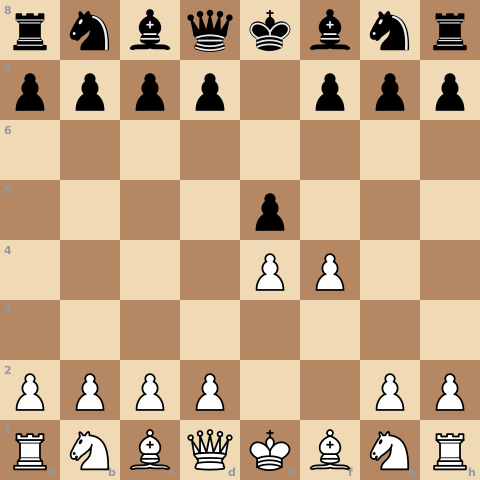
At 900 to 2200 on Lichess, Black accepts the gambit with 2...exf4 (the pawn on e5 captures the offered pawn on f4) in 45% of games. The rest decline: 2...Nc6 in 21%, 2...d6 in 13%, and the Falkbeer Countergambit, 2...d5, in 9%.
Following the accepted line:
3. Nf3
The standard move, and the one our trainer plays: it develops and stops Black's queen from checking on h4. This is where Fischer's whole argument centers, and where the real data gets interesting.
Black's options here split six ways:
- 3...g5 (pushing the g-pawn two squares to defend the extra pawn), the classical way to hold it, 17%, the most common choice by a hair.
- 3...Nc6, simple development that leaves f4 undefended, also 17%.
- 3...d6 (pushing the d-pawn one square), Fischer's own recommended "bust," 16%.
- 3...Nf6, 3...d5 and 3...Be7, about 10% each.
Fischer's engine-supported move is real and defensible. It is not, in this data, what most real opponents at this level play. Someone preparing to face the King's Gambit purely on Fischer's recommendation would meet it in only 16% of these games, and would be unprepared for the other five replies.
Into the Sharpest Line
Following the most common reply, 3...g5:
4. h4
Pushing the h-pawn two squares to challenge the g5 pawn before Black's kingside pawns settle into a wall. This is the move our trainer plays. After 4...g4, attacking White's knight, White has one precise answer:
5. Ne5
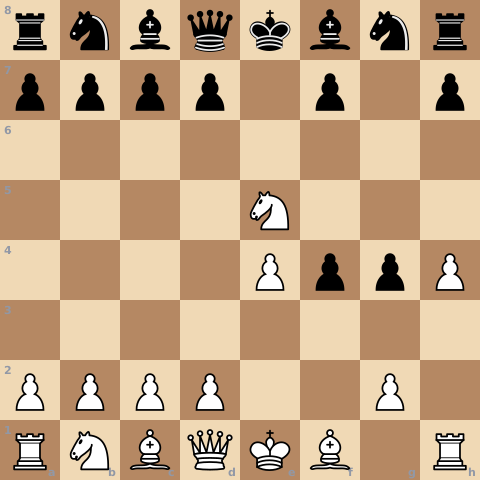
The knight jumps to e5, out of the pawn's reach and onto an active central square. This is the Kieseritzky Gambit, one of the most deeply analyzed sequences in the history of opening theory. The tempting 5.Ng5? is a mistake: Stockfish rates the position about a pawn and a half better for Black after it.
Fischer's line has its own precise move. After 3...d6 4.d4 g5 5.h4 g4, White retreats with 6.Ng1, because 6.Bxf4? gxf3 loses the knight. But at this level Black rarely reaches that position: 4...g5 is played in 25% of games, while 28% choose 4...Bg4?, which leaves f4 undefended. White takes it back with 5.Bxf4 and wins 60% of those games.
So, Is It Sound?
Both things are true at once, and this site's data backs both. Engines agree with Fischer that Black keeps a small edge with best play. And at 900 to 2200 on Lichess, White still wins 53% of games after 2.f4, because the positions are hard for Black to play and opponents spread across six different replies. Among 2200+ players the results even out at 47% each.
"Busted" in the engine-analysis sense and "unplayable" in the practical sense are not the same claim. This repertoire covers both realities: the Fischer's Defense line Bobby himself recommended, the Kieseritzky after 3...g5, and the other replies real opponents actually play.
Read the full King's Gambit repertoire →
Keep reading
Next in this part of the series:
- How to Beat the King's Gambit as Black: A practical, move-by-move plan for the Black side, built on the same Lichess data.
More traps and gambits
Back to the full series:
- Chess Opening Traps & Gambits: Every trap and gambit guide in this series, checked against our data.
Try It Yourself for Free
Every line above, Fischer's engine-approved defense, the sharp Kieseritzky and the other replies real opponents play, is fully interactive on this site. All 36 openings, including the King's Gambit, are completely unlocked during this site's open beta, no card, no limit, no account required to start, with your progress tracked for free if you create one.
Every line checked the same way, against real game data, not against what sounds right.
Browse all 36 openings free →