What Are the Main Ideas Behind the King's Indian Attack (KIA)?
TL;DR
Short answer The KIA is a system, not a sequence of moves. White plays Nf3, g3, Bg2, castles, then d3, Nbd2 and e4. It's the King's Indian Defense with the colors reversed and an extra move. Main plan Push e4 to e5, cramp Black's kingside, then attack with h4, Bf4 and a knight heading for g4. Black's plan Expand on the queenside with ...b5, ...b4 and ...a5 while White attacks. Our data We don't have a KIA dataset or trainer yet, so there are no move percentages in this article. The closest trainer is the Réti (19 lines built from 4.8 million Lichess games at 1000 to 2000 Elo), which uses the same Nf3, g3, Bg2 start against most replies.
The setup in one sentence
White puts the knight on f3, fianchettoes the king's bishop, castles, and then builds a small center with d3 and e4, usually supported by a knight on d2. That's it. You can reach this setup against almost any Black defense, which is why club players like it so much.
Here's what it looks like when Black sets up with ...d5 and ...c6:
If you know the King's Indian Defense from Black's side, this will look familiar. The pawns on d3 and e4, the bishop on g2 and the castled king mirror Black's ...d6, ...e5, ...Bg7 setup. The difference is that White is a whole move ahead.
Different ways to get there
You don't have to start with 1.Nf3. The KIA is often reached from 1.e4, as a way to meet the French or the Sicilian without learning their main lines.
In both cases White follows up with g3, Bg2 and castling. The move order you choose decides which Black setups you can meet. Starting with 1.Nf3 lets you use it against 1...d5, while starting with 1.e4 means your opponent chooses the defense first.
Plan A: the e5 push and the kingside attack
The classic KIA battle comes against a French-style setup, where Black has pawns on e6 and d5 and pushes on the queenside.
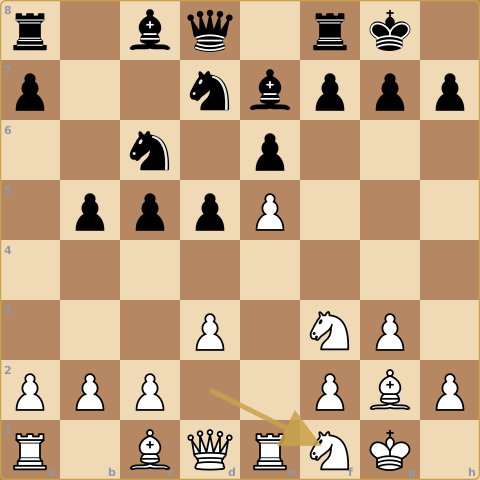
A few things are happening here:
- 8.Re1 puts the rook behind the e-pawn, so when it goes to e5 it has support.
- 9.e5 gains space and takes the f6 square away from Black's knight. With fewer pieces able to defend the kingside, Black's king becomes a target.
- 10.Nf1 reroutes the knight toward the kingside, typically via h2 to g4 or via e3.
From here White usually adds h4 and Bf4, and sometimes pushes the h-pawn further to loosen Black's king. Every piece is pointed at one side of the board.
Black's counterplay: the queenside race
Black isn't sitting still. With ...b5 already played, Black continues with ...b4, ...a5 and ...a4, sometimes ...a3 to open lines against White's queenside. The game often turns into a race: White attacks the king, Black attacks the queenside pawns.
That race is the reason the KIA rewards knowing typical patterns more than exact moves. You need a feel for how many moves your attack needs, and when to stop and deal with Black's pawns.
Plan B: when Black plays ...e5
If Black grabs the center with ...d5 and ...e5, as in the first line above, pushing e5 isn't possible, because Black's own pawn is sitting there. The KIA then plays like a reversed King's Indian Defense. White often keeps the tension in the center, reroutes the f3 knight (to e1 or h4) and prepares f4, the mirror of Black's ...f5 break in the King's Indian.
These positions are slower and more strategic. White is a tempo ahead of a normal King's Indian, but Black has a solid center, so patience matters more than speed.
Is the KIA a good choice?
For club players it has clear strengths. There's very little forcing theory, the setup barely changes, and the attacking plan against French-style positions is easy to learn. Bobby Fischer played it in the 1960s, so it has pedigree too.
The trade-off is that it doesn't ask Black many hard questions early. A well-prepared opponent can reach a comfortable position, and the game is decided later by who understands the middlegame better. If you enjoy that kind of game, it's a solid choice. If you want a clear edge out of the opening, you'll need something more direct.
The KIA shares its first moves with the Réti, and many players use both. We compare the Réti with the English in our English vs Réti guide.
Frequently asked questions
What is the King's Indian Attack?
The King's Indian Attack is a setup for White built with Nf3, g3, Bg2, castling, d3, Nbd2 and e4. It's the King's Indian Defense with colors reversed, so White is a move ahead. It can be played against almost any Black defense.
What is the main plan in the King's Indian Attack?
Against French-style setups with ...e6 and ...d5, White pushes e4 to e5 to gain space and take the f6 square from Black's knight, then attacks the kingside with h4, Bf4 and a knight rerouted via f1 to h2 or e3. Black usually counterattacks on the queenside with ...b5, ...b4 and ...a5.
Is the King's Indian Attack good for beginners?
It's a practical choice for club players because it has little forcing theory and the setup barely changes. The downside is that it doesn't put much early pressure on Black, so the game is decided by middlegame understanding rather than opening knowledge.
Can you play the King's Indian Attack against the Sicilian?
Yes. After 1.e4 c5 2.Nf3 e6 3.d3, White can continue with g3, Bg2 and castling to reach KIA structures. It's a common way to avoid the Open Sicilian's heavy theory.
Copy the lines (PGN)
Every line in this article in standard PGN, ready to paste into Lichess, Chess.com or any chess database.
[Event "What Are the Main Ideas Behind the King's Indian Attack (KIA)?: KIA vs ...d5 and ...c6"]
[Site "chesscoachacademy.com"]
[Result "*"]

1. Nf3 d5 2. g3 Nf6 3. Bg2 c6 4. O-O Bg4 5. d3 Nbd7 6. Nbd2 e5 7. e4 *

[Event "What Are the Main Ideas Behind the King's Indian Attack (KIA)?: KIA vs the French"]
[Site "chesscoachacademy.com"]
[Result "*"]

1. e4 e6 2. d3 d5 3. Nd2 Nf6 4. Ngf3 c5 5. g3 Nc6 6. Bg2 Be7 7. O-O O-O 8. Re1 b5 9. e5 Nd7 10. Nf1 *

[Event "What Are the Main Ideas Behind the King's Indian Attack (KIA)?: KIA vs the Sicilian"]
[Site "chesscoachacademy.com"]
[Result "*"]

1. e4 c5 2. Nf3 e6 3. d3 *
Keep reading
- English vs Réti: Which Flank Opening Should You Play?: How 1.c4 compares with 1.Nf3, and how to play the Réti step by step.
Practice the setup with the Réti trainer
We don't have a King's Indian Attack trainer yet. The closest one is our Réti trainer: it starts with the same 1.Nf3, and against 2...d4, 2...c6 and 2...e6 it uses the same g3, Bg2 and castling setup. Against 2...d4 White even follows up with d3, just like the KIA. It covers 19 lines built from what 1000 to 2000 rated players actually play on Lichess, with a plain-English note on every move.
If you want to understand the mirrored plans, our King's Indian Defense trainer covers the same pawn structure from Black's side, the setup the KIA copies with an extra move.
Both trainers are free during the open beta, and your progress is tracked for free when you sign up.
Practice the Réti Opening →
Practice the King's Indian Defense →
19 Réti lines built from 4.8 million Lichess games. Free during the open beta, with free progress tracking.
Practice the Réti free →