The King's Indian Defense at 1400 to 2200: One Setup, Real Opponents
TL;DR: the data
Built from 183 million Lichess games played by 1400 to 2200 rated players You play Black, 21 practice lines, every move of yours checked by Stockfish Most common line 1. d4 Nf6 2. c4 g6 3. Nc3 Bg7 4. e4 d6 5. Nf3 O-O 6. Be2 e5 Replies to 4...d6 5. Nf3 30% · 5. f4 17% · 5. f3 14% Worth knowing The Saemisch (5.f3) is one of White's best-scoring systems here: Black wins 44% of games after 5.f3, but 48% after 5.f3 O-O 6.Be3 c5.
The King's Indian Defense lets White build a big pawn center and then attacks it. You play ...Nf6, ...g6, ...Bg7, castle and ...d6, and only then hit back with ...e5 or ...c5. Your bishop on g7 looks down the long diagonal at d4 the whole time, and once the center opens, it comes to life.
This guide is built from 183 million Lichess games played by 1400 to 2200 rated players. That matters, because club players don't follow the book. After 4...d6 White's most popular move is the calm 5.Nf3, but the aggressive 5.f4 and 5.f3 together make up nearly a third of White's choices there, and plenty of White players skip 2.c4 for the London or a quiet e3 setup. The same few moves handle all of it.
1. d4 Nf6 2. c4 g6 3. Nc3 Bg7 4. e4 d6
Practice the King's Indian Defense free →Who it's for
Players rated about 1400 to 2200 who like counterattacking and don't mind giving White some space early. You castle quickly, keep your king safe behind the g7 bishop, and then pick the right moment to strike.
It's a poor fit if you want to equalize quickly and trade pieces. In the main lines White keeps a small edge in space, and you have to be patient before your counterplay arrives. If that sounds good to you, the King's Indian rewards it.
Why it works at 1400 to 2200
- One setup against almost everything. ...Nf6, ...g6, ...Bg7, ...O-O and ...d6 work against 2.c4, 2.Nf3, the London and the Colle.
- Clear plans. You have two pawn breaks, ...e5 and ...c5, and each line below tells you which one to use.
- Quiet White systems give you an easy game. Against the London, the Colle and the Torre, Stockfish rates the positions about level, and ...Qb6 against b2 is often annoying for White.
- White gets more space. In the main 2.c4 lines Stockfish gives White a small edge, around half a pawn, and you need patience.
- Some move orders hide tricks. With White's bishop on g5, the natural ...e5 can lose the exchange, and in lines with Nc3 and Bf4 you must watch Nb5 against c7.
- Against 2.Nc3 you don't play the King's Indian at all. The Coach switches to 2...d5 there, so that White can't build a big center for free.
What 1400 to 2200 players actually play
Once White has the big center with 4.e4 and you've played 4...d6, the replies spread out. The Classical 5.Nf3 leads at 30%, then the Four Pawns Attack 5.f4 (17%) and the 5.f3 system (14%). 5.Bd3 and 5.Be2 take 9% each, and 5.h3 7%. Against all six you castle next move. What changes is which break you play afterward.
Three numbers from the data frame the whole opening:
- At this rating range, 1...Nf6 is played in about 22% of games after 1.d4.
- White's most common second moves against 1...Nf6 are 2.c4 (44%), 2.Nf3 (18%) and 2.Bf4 (16%).
- The Saemisch (5.f3) is one of White's best-scoring systems here: Black wins 44% of games after 5.f3, but 48% after 5.f3 O-O 6.Be3 c5.
How to play the King's Indian Defense: move by move
Each board below is a position from the practice lines, shown from your side. The arrows show White's most common replies at 1400 to 2200, labeled with how often each one is played in that exact position. Under every board you'll find why White plays the move and the answer you give.
After 1. d4 Nf6
Against 2.c4, 2.Nf3, 2.Bf4 and 2.e3 you play 2...g6 and head for the usual setup. Only against 2.Nc3 do you switch to 2...d5, to stop e4.
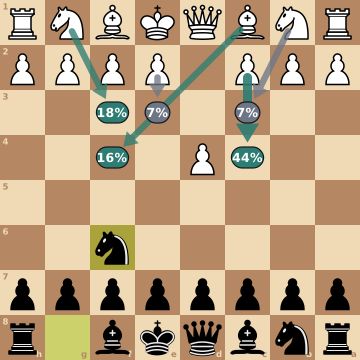
- 2. c4 (44%). c4 grabs more space and gets ready for Nc3 and e4.
Your answer: 2...g6. The King's Indian move: your bishop is heading for g7. - 2. Nf3 (18%). White develops Nf3 on move two.
Your answer: 2...g6. Your setup works against all of these. - 2. Bf4 (16%). White plans e3, Nf3 and c3 in almost every game.
Your answer: 2...g6. Your setup works against the London too. - 2. Nc3 (7%). White often follows with Bf4 or Bg5.
Your answer: 2...d5. Stop e4 right away. - 2. e3 (7%). It's solid but not very ambitious.
Your answer: 2...g6. Your usual setup.
After 1. d4 Nf6 2. c4 g6
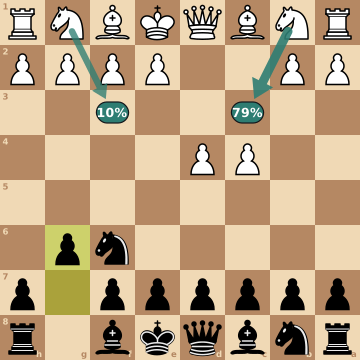
- 3. Nc3 (79%). The knight supports the e4 push that builds a big center.
Your answer: 3...Bg7. The fianchetto: your bishop sits on the long diagonal. - 3. Nf3 (10%). White might still play Nc3, or a g3 setup.
Your answer: 3...Bg7. Same fianchetto, same plan.
After 1. d4 Nf6 2. c4 g6 3. Nc3 Bg7
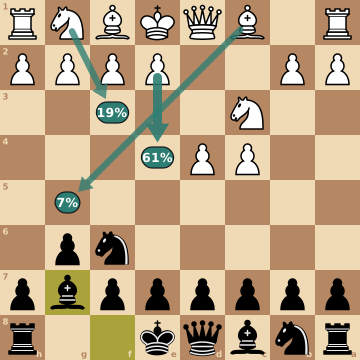
- 4. e4 (61%). White now has three pawns in the middle, which is exactly what the King's Indian invites.
Your answer: 4...d6. Controls e5 so White's pawn can't kick your knight. - 4. Nf3 (19%). White can still play e4 next, or choose a quieter setup.
Your answer: 4...d6. e5 and keep e4-e5 under control. - 4. Bg5 (7%). It isn't a pin yet, because your e7 pawn stands between the knight and your queen.
Your answer: 4...O-O. Castle first.
After 1. d4 Nf6 2. c4 g6 3. Nc3 Bg7 4. e4 d6
The key position. Castle next against every one of these moves, then choose your break: ...e5 against the calm Nf3, Be2 and h3 setups, ...c5 against f4, f3 and a bishop on g5. Against 5.Bd3 both breaks work, because the bishop cuts White's queen off from d4.
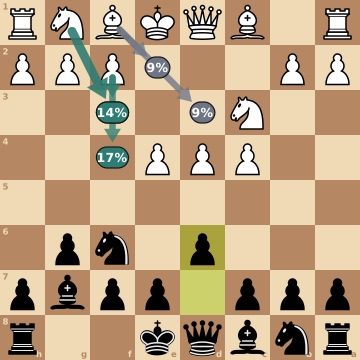
- 5. Nf3 (30%). White develops calmly and gets ready to castle.
Your answer: 5...O-O. Castle first, then hit the center. - 5. f4 (17%). It grabs a huge amount of space, but every pawn move is a move not spent developing, and the pawns can become targets.
Your answer: 5...O-O. Castle and let White's pawns come forward. - 5. f3 (14%). White often follows with Be3, Qd2 and a pawn storm with g4 and h4.
Your answer: 5...O-O. Castle, as usual. - 5. Bd3 (9%). White develops the bishop to d3, protecting e4.
Your answer: 5...O-O. Castle, then aim at the d4 pawn. - 5. Be2 (9%). It often leads to the Averbakh Variation with Bg5.
Your answer: 5...O-O. Castle, but watch out for Bg5 next. - 5. h3 (7%). Bg4, so White can play Be3 without it being chased. It also prepares g4 in some lines.
Your answer: 5...O-O. e5.
After 1. d4 Nf6 2. Nf3 g6
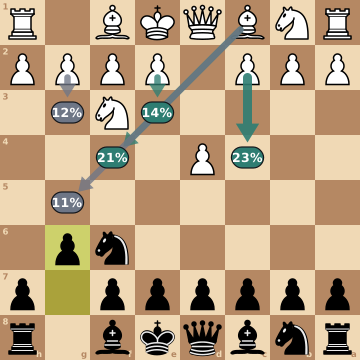
- 3. c4 (23%). White plays c4, heading for the main lines.
Your answer: 3...Bg7. Fianchetto, as always. - 3. Bf4 (21%). White builds a solid setup with e3, c3 and h3.
Your answer: 3...Bg7. Aim your bishop at d4 and b2. - 3. e3 (14%). White often aims for Bd3, O-O and a later e4.
Your answer: 3...Bg7. Complete the fianchetto. - 3. g3 (12%). White fianchettos too, with g3.
Your answer: 3...Bg7. Your bishop comes out first. - 3. Bg5 (11%). White plays Bg5, the Torre Attack.
Your answer: 3...Bg7. Keep developing, the bishop on g5 is no threat yet. - 3. Nc3 (9%). White plays Nc3, preparing e4.
Your answer: 3...Bg7. Develop and get ready to castle.
After 1. d4 Nf6 2. Bf4 g6
Against the London, the move to watch is 3.Nc3. White wants e4, Qd2 and Bh6, so answer it with 3...d5. Against the calm 3.e3 and 3.Nf3, finish your fianchetto.
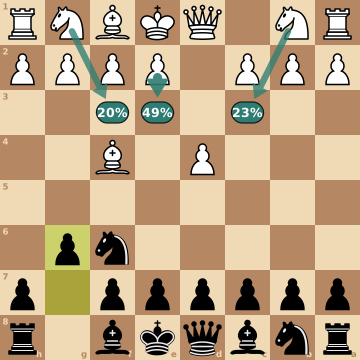
- 3. e3 (49%). White plays e3, the usual London move.
Your answer: 3...Bg7. Fianchetto. - 3. Nc3 (23%). White wants e4, Qd2 and Bh6 to trade off your g7 bishop.
Your answer: 3...d5. Stop e4 before White's attack gets going. - 3. Nf3 (20%). White develops Nf3.
Your answer: 3...Bg7. Fianchetto.
After 1. d4 Nf6 2. e3 g6
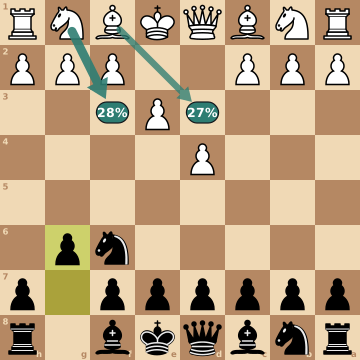
- 3. Nf3 (28%). White develops Nf3.
Your answer: 3...Bg7. Fianchetto and get ready to castle. - 3. Bd3 (27%). It's a little early, and Stockfish rates the position level, even a touch better for Black.
Your answer: 3...Bg7. Develop and keep an eye on d4.
Your plan after the opening
Against the Classical (5.Nf3 and 6.Be2): ...e5 and the kingside attack
Once you've castled, strike with 6...e5. After 7.O-O Nc6 8.d5 Ne7 the center is locked. From there both sides attack where their pawns point: White pushes b4 and c5 on the queenside, and you move the f6 knight (to e8 or d7) and play ...f5 to go after White's king.
If White trades queens with 7.dxe5 dxe5 8.Qxd8 Rxd8 9.Bg5, play 9...Re8 to step off the bishop's diagonal. Stockfish gives White about half a pawn in these lines, which is normal for this opening.
1. d4 Nf6 2. c4 g6 3. Nc3 Bg7 4. e4 d6 5. Nf3 O-O 6. Be2 e5 7. O-O Nc6 8. d5 Ne7
Against the Four Pawns Attack (5.f4): ...c5 and ...e6
White's pawns look scary, but White's king is still on e1 and most of White's pieces are at home. Castle, then hit the center from the side with ...c5. After 7.d5, chip away with 7...e6 and open the e-file toward White's king.
If White pushes 8.e5, play 8...dxe5 9.fxe5 Ng4, hitting the e5 pawn. Stockfish then prefers Black.
1. d4 Nf6 2. c4 g6 3. Nc3 Bg7 4. e4 d6 5. f4 O-O 6. Nf3 c5 7. d5 e6
Against 5.f3 (the Saemisch): ...c5 before White attacks
With f3, Be3 and Qd2, White plans g4, h4 and Bh6 against your king. The best answer to a flank attack is to open the center, so play ...c5 as soon as you've castled. At this level Black wins 44% of games after 5.f3, but 48% after 5.f3 O-O 6.Be3 c5. After 7.Nge2 Nc6 8.d5 your knight lands on e5, a strong central square.
1. d4 Nf6 2. c4 g6 3. Nc3 Bg7 4. e4 d6 5. f3 O-O 6. Be3 c5 7. Nge2 Nc6 8. d5 Ne5
Against the London, Colle and Torre: ...d6 and ...c5
These systems are solid but slow. Castle, play ...d6, then break with ...c5. With White's dark-squared bishop gone from c1, b2 has lost a defender, so ...Qb6 is often a real threat. Save ...e5 for later: against the London, White's bishop and knight both hit e5.
1. d4 Nf6 2. Nf3 g6 3. Bf4 Bg7 4. e3 O-O 5. Be2 c5 6. O-O d6 7. h3 Qb6
Traps and common mistakes
Playing ...e5 while White's bishop is on g5
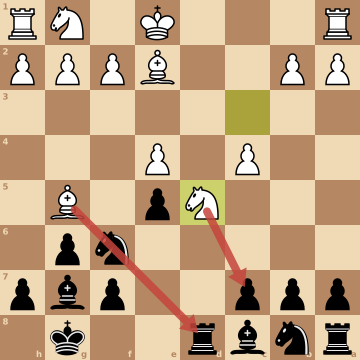
1. d4 Nf6 2. c4 g6 3. Nc3 Bg7 4. e4 d6 5. Be2 O-O 6. Bg5 e5? 7. dxe5 dxe5 8. Qxd8 Rxd8 9. Nd5
...e5 is the move you'll want to play in most lines, and that's why this one hurts. With the bishop on g5, White trades on e5 and then on d8, and 9.Nd5 hits both c7 and your pinned f6 knight. You lose the exchange (a rook for a minor piece), and Stockfish rates White about a pawn better.
Against 6.Bg5, play 6...c5 instead.
Letting the Nc3 London attack run
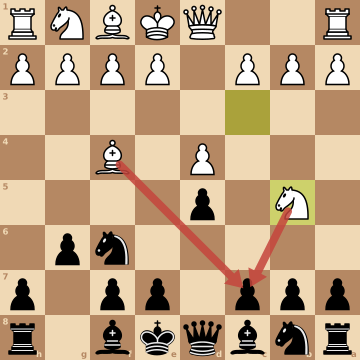
1. d4 Nf6 2. Bf4 g6 3. Nc3 d5 4. Nb5 Na6
After 2.Bf4 g6 3.Nc3, the natural 3...Bg7 lets White play 4.e4 and 5.Qd2 with a fast attack. 3...d5 stops e4 and keeps things calm.
Then watch c7. White's knight can jump to b5, and together with the f4 bishop it threatens Nxc7+, forking your king and the rook on a8. Cover c7 with ...Na6, which Stockfish rates level. Careless moves such as ...Nh5 lose material.
Pushing ...e5 too early against the London
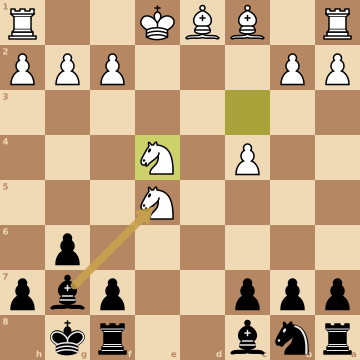
1. d4 Nf6 2. Nf3 g6 3. Bf4 Bg7 4. e3 O-O 5. Be2 d6 6. O-O e5? 7. dxe5
In the main lines ...e5 is your best friend. Against the London it's a problem, because the f4 bishop and the f3 knight both attack e5. After 7.dxe5 Stockfish rates White almost a pawn better. Use the ...c5 break instead, often with ...Qb6.
Missing the ...Nxe4 trick in the Classical
1. d4 Nf6 2. c4 g6 3. Nc3 Bg7 4. e4 d6 5. Nf3 O-O 6. Be2 e5 7. dxe5 dxe5 8. Nxe5 Qxd1+ 9. Bxd1 Nxe4 10. Nxe4 Bxe5
Some players hold back ...e5 because the pawn looks loose after 7.dxe5 dxe5. It isn't. If White grabs it with 8.Nxe5, trade queens and then take on e4. Your g7 bishop takes the knight on e5, the pawn is back, and Stockfish then prefers Black.
Frequently asked questions
Is the King's Indian Defense good for club players?
Yes, especially from about 1400 up. The setup is the same against almost everything, so there's less to memorize than in most 1.d4 defenses. You do need to know a few move-order tricks, like avoiding ...e5 when White's bishop is on g5.
What is the most common reply to 1...Nf6 at club level?
At 1400 to 2200 on Lichess, White's most common second moves are 2.c4 (44%), 2.Nf3 (18%) and 2.Bf4 (16%). After 2.c4 g6, 3.Nc3 is played in 79% of games, and after 3...Bg7, 4.e4 comes in 61%.
How do I play the King's Indian against the London System?
Fianchetto and castle as usual, then play ...d6 and break with ...c5, often with ...Qb6 hitting b2. Avoid an early ...e5, because the f4 bishop and f3 knight both control that square. If White plays an early Nc3 with the bishop on f4, switch to ...d5 to stop e4.
Should I play ...e5 or ...c5 in the King's Indian?
It depends on White's setup. Play ...e5 against the calm Classical lines with Nf3 and Be2. Play ...c5 against the Four Pawns Attack, the 5.f3 system, a bishop on g5, and quiet systems like the London and Colle.
What's the difference between the King's Indian and the Grünfeld?
Both start 1.d4 Nf6 2.c4 g6. In the King's Indian you let White build the center and attack it later with ...e5 or ...c5. In the Grünfeld you challenge it at once with 3...d5, and if White builds a big center anyway, you attack it with ...c5 and your pieces.
Keep learning
- All 36 opening guides: every opening on the site, grouped by what you play as White and Black.
- King's Indian vs Grünfeld: Two hypermodern defenses that start the same way and split on move three.
- How to counter the London System as Black: More anti-London plans, including a King's Indian setup and the ...Nh5 idea.
- The most reliable 1.d4 defenses for Black: How the King's Indian compares with eight other answers to 1.d4.
The Coach plays 1.d4 against you with the moves 1400 to 2200 players actually choose, from the Four Pawns Attack to the London, and explains every one of your moves in plain English. Progress tracking is free during the open beta.
Practice the King's Indian Defense free →