Should Beginners Memorize Chess Opening Lines or Learn Opening Principles?
TL;DR
Short answer Both, in that order. Learn principles first, then memorize a short list of lines for the openings you actually play, and learn why each move is played. Games behind this article About 264 million Lichess games: London System (35 million, 400 to 1400), Italian Game (131 million, 1000 to 1600) and Petroff Defense (98 million, 800 to 2400) Why one line isn't enough In the London, Black's answer to 1. d4 d5 2. Bf4 splits 2...Nc6 36.9%, 2...Nf6 19.7%, 2...e6 15.3%, 2...Bf5 12.7% Why principles aren't enough The Petroff has one move-order detail (3...d6 before ...Nxe4) that general rules won't find for you Size of a beginner repertoire London 20 lines (400 to 1400 Elo), Italian 20 lines (1000 to 1600 Elo) Typical line length The median line across our 613 lines is 9 plies, about five moves for White
The problem with memorizing first
Almost every beginner goes through a phase of learning ten moves of a sharp line, then losing because the opponent played something different on move four. That's not bad luck. It's what the data predicts.
Take the London System, the lowest-maintenance White opening we cover. Our trainer gets the bishop out straight away:
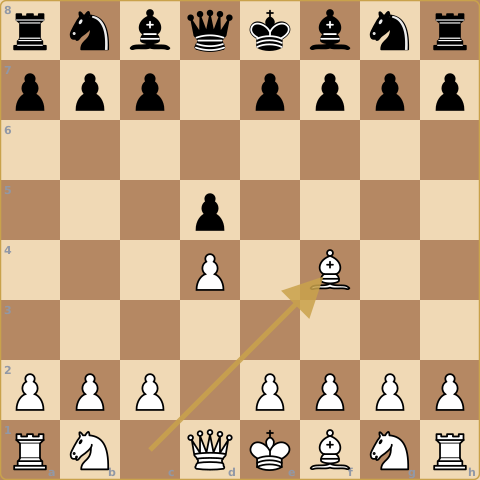
Among 400 to 1400 rated players on Lichess, Black's reply splits four ways: 2...Nc6 (36.9%), 2...Nf6 (19.7%), 2...e6 (15.3%) and 2...Bf5 (12.7%). If you memorized only the most common one, you'd be out of your prep in nearly two games out of three. That spread is the reason our London repertoire is 20 lines rather than one.
Memorized moves also break down when you don't know why they're played. If your opponent plays a slightly different move order, you won't know which of your moves still work and which don't.
The problem with principles only
So why not skip the lines and play on principles alone? Because some positions have one concrete detail that the general rules don't cover. The Petroff is the classic example:
Black wants to win back the pawn on e4, and principles say "recapture material, keep developing". But the move order matters. Black kicks the knight with 3...d6 first, and only then takes on e4. Take immediately and White has a nasty trick:
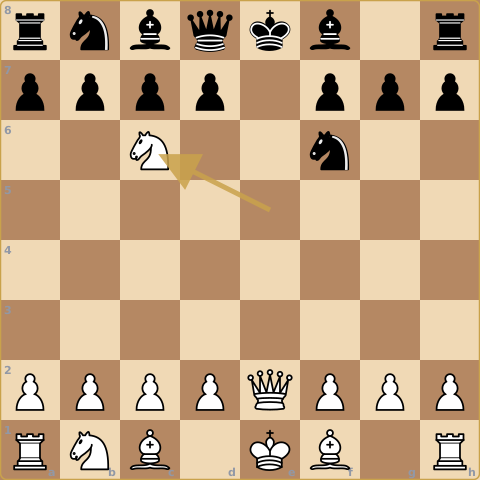
Nothing in "develop, castle, control the center" warns you about this. Our Petroff guide calls 3...d6 the single most important move-order detail in the whole opening, and yet only 26% of players at 800 to 2400 on Lichess play it after 3.Nxe5. A player who had drilled that one line would never fall for the trap.
What the right mix looks like
For most players under about 1500, we'd split the work like this:
- Principles: the core rules (center, development, castling, no early queen trips, no unchecked pawn grabs). These carry you through the moves after your prep ends and through every opening you haven't studied.
- A small repertoire: one opening as White, one answer to 1.e4, one answer to 1.d4. Learn the main lines to about move five to seven. The median line in our whole library is only 9 plies long, so that's further than most of our trainer lines go.
- The reasons behind the moves: for every move you memorize, know what it does. In the London, "Bf4 before e3" is a rule you can apply against any Black setup, not just the lines you studied.
- The traps: learn the few concrete spots in your openings where one wrong move loses material, like the Petroff trap above.
Why the Italian and London suit this approach
Two of our most beginner-friendly White openings, the Italian Game and the London System, are both built for this kind of learning. Their plans repeat, so each line you learn teaches you something about the others.
In the Italian, Black's most common answer to 3.Bc4 among 1000 to 1600 rated players is 3...Nf6 (31.7%), and our trainer meets it the quiet way:
It's easy to follow on principles: protect e4 with d3, castle, prepare d4 with c3, and play h3 so ...Bg4 never pins your knight. You still learn 20 lines, but many of them share this plan, so memorizing them doesn't feel like cramming 20 unrelated sequences.
Compare that with an opening like the Sicilian Najdorf. Our Najdorf trainer has to handle six different White second moves, and six different sixth moves after 5...a6, and its recommended range starts at 1600. That's a memorization project, not a principles project, and it can wait.
How to memorize lines so they stick
- Learn one branch at a time. Start with the most common reply (2...Nc6 in the London), then add the next.
- Say the reason out loud. "Bf4 before e3 so the bishop isn't locked in." If you can't give a reason, you haven't learned the move yet.
- Replay from the start, not from the middle. In a real game you always reach the position from move one.
- Check your games afterwards. Find where you left the book and whether it was you or your opponent who did it.
For the bigger picture on opening rules, go back to our guide to chess opening principles.
Frequently asked questions
Should beginners memorize chess openings?
A little, but not first. Learn the opening principles, then memorize the main lines of one or two openings to around move five to seven, along with the reason for each move. The median line in our 613-line library is only 9 plies, about five moves for White, which gives a sense of how short a practical repertoire can be.
Is it better to learn opening principles or opening theory?
Principles first, because they cover every position you haven't studied. Then add theory for the openings you actually play, especially the few spots where one wrong move loses material, like 3...Nxe4 instead of 3...d6 in the Petroff.
How many opening lines does a beginner need to know?
Fewer than you think. Our complete London System repertoire is 20 lines (built for 400 to 1400 Elo) and our Italian Game repertoire is also 20 (1000 to 1600 Elo). Most of those lines share the same plan, so they're much quicker to learn than the count suggests.
Why do I forget my opening lines during games?
Usually because the moves were memorized without their reasons, or because the opponent played a different reply. In the London, Black's answer to 1.d4 d5 2.Bf4 among 400 to 1400 rated players on Lichess splits four ways (2...Nc6 36.9%, 2...Nf6 19.7%, 2...e6 15.3%, 2...Bf5 12.7%), so knowing a single line leaves you out of your preparation in most games.
Copy the lines (PGN)
Every line in this article in standard PGN, ready to paste into Lichess, Chess.com or any chess database.
[Event "Should Beginners Memorize Chess Opening Lines or Learn Opening Principles?: London System, 2...Nc6"]
[Site "chesscoachacademy.com"]
[Result "*"]

1. d4 d5 2. Bf4 Nc6 3. e3 *

[Event "Should Beginners Memorize Chess Opening Lines or Learn Opening Principles?: Petroff, correct move order"]
[Site "chesscoachacademy.com"]
[Result "*"]

1. e4 e5 2. Nf3 Nf6 3. Nxe5 d6 4. Nf3 Nxe4 *

[Event "Should Beginners Memorize Chess Opening Lines or Learn Opening Principles?: Petroff trap, 3...Nxe4?"]
[Site "chesscoachacademy.com"]
[Result "*"]

1. e4 e5 2. Nf3 Nf6 3. Nxe5 Nxe4 4. Qe2 Nf6 5. Nc6+ *

[Event "Should Beginners Memorize Chess Opening Lines or Learn Opening Principles?: Italian Game, quiet setup against 3...Nf6"]
[Site "chesscoachacademy.com"]
[Result "*"]

1. e4 e5 2. Nf3 Nc6 3. Bc4 Nf6 4. d3 Bc5 5. O-O O-O 6. c3 d6 7. h3 *
Keep reading
- Chess Opening Principles for Beginners: The five core rules, when they bend, and the series this article belongs to.
Memorize the London the smart way
Our London System trainer is built for exactly this approach. You play the same setup against all of Black's main replies, one branch at a time, and every move comes with a plain-English reason so you learn the why along with the what. It covers 20 lines built from what 400 to 1400 rated players actually play on Lichess.
It's free during the open beta, and if you create an account your progress on every line is tracked for free, so you can see which branches you know and which need more work.
20 London System lines built from 35 million Lichess games. Free during the open beta, with free progress tracking.
Practice the London free →