What Is the Difference Between an Opening, a Defense, a Gambit and a System in Chess?
TL;DR
Short answer An opening is any named start to the game. A defense is an opening named from Black's side. A gambit gives up material, usually a pawn, for time or attack. A system is a setup you play against almost anything. Games behind this article About 298 million Lichess games, each opening at its own rating range: Italian Game (131 million), King's Gambit (78 million), Caro-Kann Advance (37 million), London System (35 million), Danish Gambit (17 million) Gambit accepted? King's Gambit: 2...exf4 44.7%, Falkbeer Countergambit 2...d5 9.3%. Danish: 3...dxc3 72.6% System in action London: Black answers 1.d4 with 1...d5 (54.9%), 1...Nf6 (10.0%) or 1...e6 (9.3%), and our trainer plays 2.Bf4 against all three Recommended ranges London 400 to 1400 Elo. Italian 1000 to 1600. Caro-Kann 800 to 2200. King's Gambit 900 to 2200. Danish 900 to 2000
Why the names matter
Chess opening names look random, but the last word usually tells you something useful. It hints at who's making the choice, whether material is on offer, and how much the plan changes from game to game. Once you know the vocabulary, a name like "Danish Gambit" or "London System" tells you what kind of game to expect before you've seen a move.
The naming isn't perfectly consistent (chess history is messy), so treat these as strong hints rather than strict definitions.
Opening: the umbrella term
"Opening" covers the first phase of any game and any named sequence in it. In names, it's most often used for White's choices. The Italian Game is a good example:
White decides the character of the game with 3.Bc4, aiming the bishop at f7. Openings that start 1.e4 e5 are often called a "Game" rather than an "Opening": the Italian Game, the Scotch Game, the Vienna Game. Other White openings keep the word itself, like the English Opening (1.c4) or the Reti Opening (1.Nf3).
Within an opening you'll also meet variations, which are branches inside it. The Caro-Kann Advance Variation, for instance, is the branch where White plays 3.e5.
Defense: named from Black's side
A defense is an opening where Black makes the defining choice, usually on move one or two in reply to 1.e4 or 1.d4. The Caro-Kann is a clear example:
Black prepares ...d5 with ...c6, so the d-pawn is already supported when it arrives. Our repertoire covers the Advance Variation (3.e5), where 64% of players at 800 to 2200 on Lichess answer with 3...Bf5. Other defenses in our library include the Petroff, the Scandinavian, the Slav and the King's Indian.
"Defense" doesn't mean passive. The Petroff meets 2.Nf3 with a counterattack on e4, and the King's Indian lets White build a big center so Black can hit it later.
Gambit: material for time
A gambit offers material, almost always a pawn, in return for faster development, open lines or an attack. The King's Gambit is the classic:
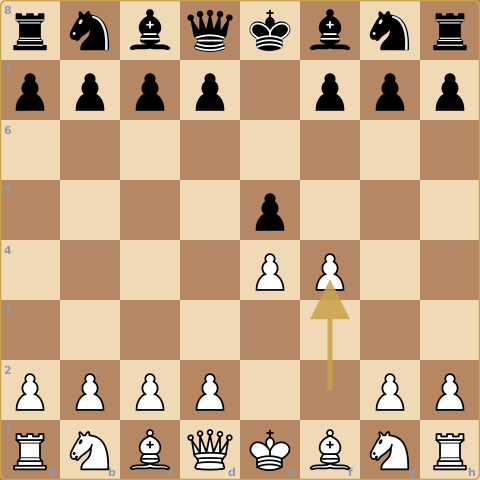
Among 900 to 2200 rated players on Lichess, Black takes the pawn with 2...exf4 in 44.7% of games. The rest mostly decline: 2...Nc6 (21.3%), 2...d6 (13.1%) and 2...d5 (9.3%).
That 2...d5 reply has its own name, the Falkbeer Countergambit, because Black answers a gambit by offering a pawn back. The same idea turns up in the Ponziani, where 3...f5 is called a countergambit too.
The Danish Gambit goes a step further and offers a second pawn:
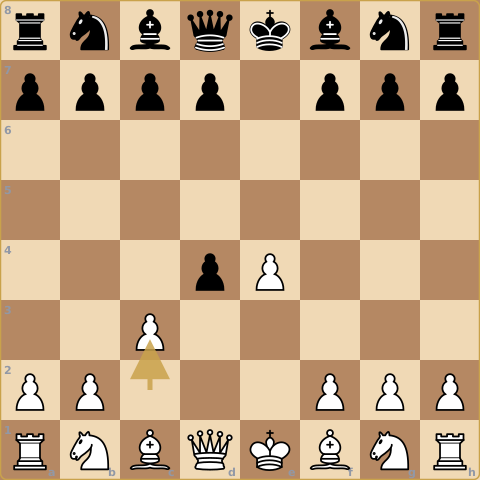
At 900 to 2000 on Lichess, 73% of players take the second pawn with 3...dxc3, and White wins 56% of those games at that level. Most players on the Black side, in other words, accept the gambit.
Black can gambit too. The Budapest Gambit and the Benko Gambit are both Black openings against 1.d4.
One famous name breaks the rule. In the Queen's Gambit (1.d4 d5 2.c4) White usually gets the pawn back, so it's rarely a true sacrifice. Our Queen's Gambit Accepted repertoire is built on exactly that idea: Black takes on c4, then gives the pawn back on good terms.
System: one setup against everything
A system is less about specific moves and more about a setup you aim for regardless of what your opponent does. The London System is the best-known example. White plays d4, Bf4, e3, Nf3 and c3 in some order against almost any Black setup.
Our London data shows why it works as a system. Among 400 to 1400 rated players on Lichess, Black answers 1.d4 with 1...d5 (54.9%), 1...Nf6 (10.0%) or 1...e6 (9.3%), and our trainer plays 2.Bf4 against all three. The Torre Attack, with its early Bg5, is another setup we'd put in this group.
"System" doesn't mean robotic, though. After 1.d4 d5 2.Bf4, Black's next move still splits between ...Nc6, ...Nf6, ...e6 and ...Bf5, and each one needs small adjustments. With a knight on c6 and a bishop on f5, for example, ...Nb4 can hit c2, so our guide has you watch that square.
Quick reference
| Opening | Any named start. Example: Italian Game, 1.e4 e5 2.Nf3 Nc6 3.Bc4 |
| Defense | Black's choice against 1.e4 or 1.d4. Example: Caro-Kann, 1.e4 c6 |
| Gambit | Material offered for time or attack. Examples: King's Gambit 2.f4, Danish Gambit 3.c3 |
| Countergambit | A gambit offered in reply to a gambit. Example: Falkbeer, 2...d5 |
| System | A setup played against almost anything. Example: London System |
| Variation | A branch inside an opening. Example: Caro-Kann Advance, 3.e5 |
If you're new, start with an opening or a system rather than a gambit. Our opening principles guide explains why.
Frequently asked questions
What is the difference between a chess opening and a defense?
Opening is the general term for any named start to a game, and in names it usually refers to White's choice, like the Italian Game or English Opening. A defense is an opening named from Black's side, where Black's reply sets the character of the game, like the Caro-Kann (1.e4 c6).
What is a gambit in chess?
A gambit offers material, usually a pawn, in exchange for faster development, open lines or attacking chances. In the King's Gambit (1.e4 e5 2.f4), Black accepts the pawn with 2...exf4 in 44.7% of games among 900 to 2200 rated players on Lichess.
What is a chess opening system?
A system is a setup you play against almost any reply, rather than a fixed sequence of moves. The London System (d4, Bf4, e3, Nf3, c3) is the best-known example. Among 400 to 1400 rated players on Lichess, Black answers 1.d4 with 1...d5 in 54.9% of games, 1...Nf6 in 10.0% and 1...e6 in 9.3%, and the same London setup handles all three.
Is the Queen's Gambit a real gambit?
Not in the usual sense. After 1.d4 d5 2.c4, White can normally win the c4 pawn back, so it's rarely a true sacrifice. That's why Black players who take it, in the Queen's Gambit Accepted, usually plan to give it back on good terms rather than hold on to it.
Copy the lines (PGN)
Every line in this article in standard PGN, ready to paste into Lichess, Chess.com or any chess database.
[Event "What Is the Difference Between an Opening, a Defense, a Gambit and a System in Chess?: Italian Game"]
[Site "chesscoachacademy.com"]
[Result "*"]

1. e4 e5 2. Nf3 Nc6 3. Bc4 *

[Event "What Is the Difference Between an Opening, a Defense, a Gambit and a System in Chess?: Caro-Kann Defense, Advance Variation"]
[Site "chesscoachacademy.com"]
[Result "*"]

1. e4 c6 2. d4 d5 3. e5 Bf5 *

[Event "What Is the Difference Between an Opening, a Defense, a Gambit and a System in Chess?: King's Gambit Accepted"]
[Site "chesscoachacademy.com"]
[Result "*"]

1. e4 e5 2. f4 exf4 *

[Event "What Is the Difference Between an Opening, a Defense, a Gambit and a System in Chess?: Falkbeer Countergambit"]
[Site "chesscoachacademy.com"]
[Result "*"]

1. e4 e5 2. f4 d5 *

[Event "What Is the Difference Between an Opening, a Defense, a Gambit and a System in Chess?: Danish Gambit"]
[Site "chesscoachacademy.com"]
[Result "*"]

1. e4 e5 2. d4 exd4 3. c3 *

[Event "What Is the Difference Between an Opening, a Defense, a Gambit and a System in Chess?: London System"]
[Site "chesscoachacademy.com"]
[Result "*"]

1. d4 d5 2. Bf4 Nf6 3. e3 *
Keep reading
- Chess Opening Principles for Beginners: The five core rules and the series this article belongs to.
Try one of each on our trainers
The quickest way to feel the difference is to play them. The London System trainer shows what a system is like: 20 lines built for 400 to 1400 Elo, one setup throughout. When you want to see how a gambit plays, the King's Gambit trainer covers 14 lines built from what 900 to 2200 rated players play on Lichess, and the Caro-Kann trainer gives you a solid defense from Black's side.
All of it is free during the open beta, and if you create an account your progress on every line is tracked for free.
Practice the London System →
Practice the King's Gambit →
Practice the Caro-Kann →
20 London System lines built from 35 million Lichess games. Free during the open beta, with free progress tracking.
Practice the London free →