Pirc vs Modern Defense: Which Should You Play Against 1.e4?
TL;DR
Short answer Pick the Pirc if you want the early ...Nf6 that makes White defend e4 at once, and easy wins against early e5 pushes. Pick the Modern if you like keeping the knight back and deciding your plan late. Many Modern lines end in the Pirc anyway, and both are fine choices below 1800. Games behind this article About 63 million Lichess games at 750 to 1800 (Pirc) and about 54 million at 900 to 1800 (Modern) Pirc, after 2.d4 Nf6 3.Nc3 65.4%, then after 3...g6: 4.Nf3 33.6%, 4.Bg5 18.6% Modern, after 2.d4 Bg7 3.Nf3 40.6%, 3.e5 23.2% Where they meet The Classical Nf3 setup and the Austrian Attack (f4) reach the exact same positions from either move order Lichess results Pirc, 750 to 1800 on Lichess: after 2.d4 Nf6 3.e5? dxe5 4.dxe5 Qxd1+ 5.Kxd1, Black wins 62% of games. Modern, 900 to 1800 on Lichess: after 2.Bc4 Bg7 3.Qf3 e6, Black wins 53% of games. Recommended range Pirc 750 to 1800 Elo, 17 lines. Modern 900 to 1800 Elo, 20 lines.
Same family, different first move
Both openings share one idea. Black lets White build a big pawn center, fianchettoes the dark-squared bishop on g7, and hits that center later with ...c5 or ...e5. The difference is the order Black plays the moves in.
That's the Pirc. Black commits to ...d6 and ...Nf6 right away and plays ...g6 on move three.
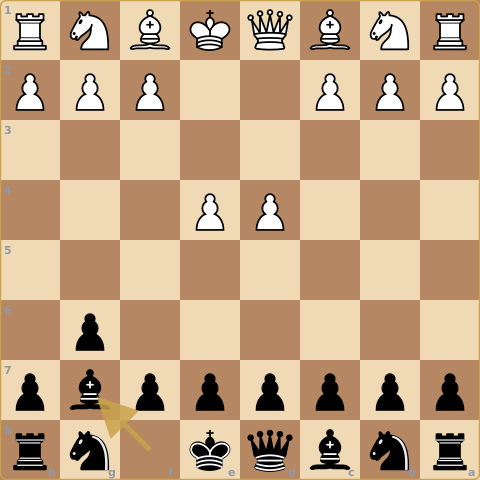
That's the Modern. The bishop goes to g7 at once, and Black waits to see White's setup before playing ...d6 and ...Nf6.
What the Pirc's ...Nf6 does to White
In the Pirc, 2...Nf6 attacks the e4 pawn, and at that moment nothing defends it. White has to deal with that straight away. At 750 to 1800 on Lichess, White answers with 3.Nc3 in 65.4% of games, 3.Bd3 in 13.0% and the pushy 3.e5 in 8.6%. After 3.Nc3 g6, White picks one of several systems:
- 4.Nf3 (33.6%), the Classical System, calm development and castling.
- 4.Bg5 (18.6%), the Byrne Variation, putting the bishop on the knight right away.
- 4.f4 (8.6%), the Austrian Attack, the most ambitious try with three pawns abreast on d4, e4 and f4.
- 4.Bc4 (6.4%) and 4.Be3 (6.1%), the second one being the 150 Attack with Qd2 and Bh6.
The practical upside for Black is that the early knight move forces White's hand, and at club level White often gets it wrong. The 3.e5 push looks aggressive but simply loses control of the center:
White recaptures 4.dxe5 in 86.3% of games, and after the queen trade the king is stuck on d1. The knight on g4 then hits both e5 and f2, and neither pawn has a defender. This is the line where Black wins 62% of games at this level on Lichess.
One more difference: against the quieter 2.Nf3 Nf6 3.Nc3, our Pirc lines switch to a solid ...e5 setup instead of the fianchetto.
What the Modern keeps open
In the Modern, nothing attacks e4 early, so White has more freedom. At 900 to 1800 on Lichess, 2.d4 comes in 38.2% of games, and after 2...Bg7 White spreads out: 3.Nf3 (40.6%), 3.e5 (23.2%), 3.c3 and 3.Nc3 (7.2% each), 3.Be3 (6.4%) and 3.c4 (5.5%).
This is the start of the Averbakh setup, with pawns on c4, d4 and e4. It's closer to a King's Indian structure and is a good example of what the Modern allows that the Pirc's early ...Nf6 makes harder.
The flip side is that without a knight on f6, the early 3.e5 push is much more common than in the Pirc, and it needs a specific answer:
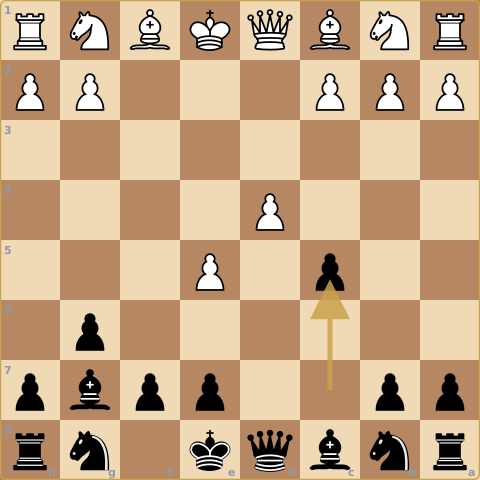
White props up e5 with 4.f4 in 34.5% of games and recaptures 5.fxe5 in 95.6%. Now only the d4 pawn defends e5, and the g7 bishop is already attacking it. 5...c5 goes after that defender. Watch the move order after 4.Nf3 (31.2%): 4...Nf6?? loses a piece to 5.exf6, so take on e5 first.
The Modern also has more early attacks on f7 to handle. After 2.Bc4 Bg7, White tries 3.Qf3 in 29.9% of games, threatening mate on f7. The answer is 3...e6, which blocks the bishop's line. 3...d6?? runs into 4.Qxf7+ Kd7 5.Qxg7 and Black loses a lot of material.
Where the two openings meet
A lot of the time, the choice matters less than it looks. Two of White's main systems lead to the same positions whichever first move Black picks.
The Classical System, reached from the Modern:
and from the Pirc:
Both give the identical position. In the Modern data, 4.Nc3 is White's top choice after 3...d6 (30.8%), and many of our Modern lines end right here with ...Nf6. In the Pirc data, White's most common next move is 5.Bc4 (18.8%), and Black simply castles so f7 is covered.
The Austrian Attack works the same way. 1.e4 g6 2.d4 Bg7 3.Nc3 d6 4.f4 Nf6 is the same position as the Pirc's 1.e4 d6 2.d4 Nf6 3.Nc3 g6 4.f4 Bg7. So whichever you choose, you'll need to know the Classical and Austrian structures. The real differences are in the early deviations.
Which one should you pick?
Choose the Pirc if you like a setup you can play the same way most games. The early ...Nf6 forces White's hand, lots of White players at this level push e5 too early or leave e4 hanging, and our range for it starts lower, at 750 Elo. It's a good first hypermodern defense.
Choose the Modern if you enjoy reacting to what your opponent does and don't mind a few more early tricks to learn, like 3.e5 and the Qf3 and Ng5 attacks on f7. You'll face a wider spread of White setups, including c4 structures, and our range starts at 900 Elo.
Both top out at 1800 in our library. Sharp systems like the 150 Attack and the Austrian reward exact knowledge whichever move order you use.
If you're still undecided, a practical approach is to start with the Pirc. Once you're comfortable with the Classical and Austrian structures, adding the Modern move order is a small step, since you already know half of it.
Frequently asked questions
What is the difference between the Pirc and the Modern Defense?
Move order. The Pirc starts 1.e4 d6 2.d4 Nf6 and plays ...g6 on move three. The Modern starts 1.e4 g6 and delays ...Nf6, so White has more freedom early on. Several main lines, including the Classical System and the Austrian Attack, reach the same positions from both.
Is the Pirc or the Modern better for beginners?
The Pirc is slightly easier. Its early ...Nf6 attacks e4 and forces White's hand, and at 750 to 1800 on Lichess White replies 3.Nc3 in 65.4% of games after 2.d4 Nf6. Our library recommends the Pirc from 750 Elo and the Modern from 900 Elo.
Can the Modern Defense transpose into the Pirc?
Yes. After 1.e4 g6 2.d4 Bg7 3.Nf3 d6 4.Nc3 Nf6 you have the Pirc's Classical System, and 3.Nc3 d6 4.f4 Nf6 gives the Pirc's Austrian Attack. That means you need to know those structures whichever one you play.
How should Black answer 3.e5 in the Modern Defense?
Hit the pawn with 3...d6. After 4.f4 dxe5 5.fxe5, play 5...c5 to attack d4, the only pawn defending e5. After 4.Nf3, take on e5 first, because 4...Nf6?? loses a piece to 5.exf6. At 900 to 1800 on Lichess, 3.e5 is White's second most common move after 2.d4 Bg7, at 23.2%.
Copy the lines (PGN)
Every line in this article in standard PGN, ready to paste into Lichess, Chess.com or any chess database.
[Event "Pirc vs Modern Defense: Which Should You Play Against 1.e4?: Pirc starting position"]
[Site "chesscoachacademy.com"]
[Result "*"]

1. e4 d6 2. d4 Nf6 3. Nc3 g6 *

[Event "Pirc vs Modern Defense: Which Should You Play Against 1.e4?: Pirc, punishing 3.e5"]
[Site "chesscoachacademy.com"]
[Result "*"]

1. e4 d6 2. d4 Nf6 3. e5 dxe5 4. dxe5 Qxd1+ 5. Kxd1 Ng4 *

[Event "Pirc vs Modern Defense: Which Should You Play Against 1.e4?: Pirc Classical"]
[Site "chesscoachacademy.com"]
[Result "*"]

1. e4 d6 2. d4 Nf6 3. Nc3 g6 4. Nf3 Bg7 5. Bc4 O-O *

[Event "Pirc vs Modern Defense: Which Should You Play Against 1.e4?: Modern into the Pirc Classical"]
[Site "chesscoachacademy.com"]
[Result "*"]

1. e4 g6 2. d4 Bg7 3. Nf3 d6 4. Nc3 Nf6 *

[Event "Pirc vs Modern Defense: Which Should You Play Against 1.e4?: Modern vs 3.e5 and 4.f4"]
[Site "chesscoachacademy.com"]
[Result "*"]

1. e4 g6 2. d4 Bg7 3. e5 d6 4. f4 dxe5 5. fxe5 c5 *

[Event "Pirc vs Modern Defense: Which Should You Play Against 1.e4?: Modern vs 3.Qf3"]
[Site "chesscoachacademy.com"]
[Result "*"]

1. e4 g6 2. Bc4 Bg7 3. Qf3 e6 *
Keep reading
- What Is the Best Defense Against 1.e4?: How the Pirc and Modern compare with the Caro-Kann, Scandinavian, Petroff, Sicilian and others.
Try both move orders on the trainer
The easiest way to decide is to play a few lines of each. Our Pirc trainer covers 17 lines built from about 63 million Lichess games at 750 to 1800, including the Classical System, 4.Bg5, the Austrian Attack, 4.Bc4, 4.Be3 and how to punish early e5 pushes. Our Modern trainer covers 20 lines from about 54 million games at 900 to 1800, including 3.e5, 3.c4 and the early attacks on f7. You play Black against the moves players really choose, with every one of your moves checked by Stockfish and a plain-English note on each one.
Both are free during the open beta, and once you sign up we track your progress on every line for free, so you can see which opening sticks.
17 Pirc lines and 20 Modern lines, built from real Lichess games. Free during the open beta, with free progress tracking.
Start with the Pirc free →