The Queen's Gambit Declined for White: The Classical Bg5 Plan at 1300 to 2200
TL;DR: the data
Built from 177 million Lichess games played by 1300 to 2200 rated players You play White, 14 practice lines, every move of yours checked by Stockfish Most common line 1. d4 d5 2. c4 e6 3. Nc3 Nf6 4. Bg5 Be7 5. e3 O-O 6. Nf3 Replies to 2.c4 2...e6 27% · 2...dxc4 24% · 2...c6 20% Worth knowing In the Englund Gambit, after 1.d4 e5 2.dxe5 Nc6 3.Nf3 Qe7, the most common move 4.Bf4 (34%) walks into the ...Qb4+ trap: White wins only 40% of games after it, compared with 53% after 4.Nc3.
In the Queen's Gambit you play 1.d4 and 2.c4, offering your c-pawn to pull Black's d5 pawn away from the center. When Black declines with 2...e6, you get the classical Queen's Gambit Declined: Nc3, a pin with Bg5, then e3 and Nf3. This page teaches that plan from White's side, and it's the most common single answer to 2.c4 at this level.
It's also far from the only one. This guide is built from 177 million Lichess games between 1300 and 2200 rated players, and the data says Black declines with 2...e6 in only 27% of games. Nearly as many take the pawn, a fifth play the Slav with 2...c6, and 15% answer with the inaccurate 2...Nf6. Plenty of players avoid 1...d5 altogether. So this repertoire covers what you'll actually meet: the main line, the Accepted, the Slav and Semi-Slav, 2...Nf6, and the 1...Nf6 setups, plus the Englund Gambit trap.
1. d4 d5 2. c4 e6 3. Nc3 Nf6 4. Bg5 Be7 5. e3 O-O 6. Nf3
Practice the Queen's Gambit Declined (Orthodox) free →Who it's for
Players rated roughly 1300 to 2200 who want a classical 1.d4 repertoire built on natural moves. Knight to c3, bishop to g5, e3, Nf3, castle: you can find most of it over the board, and several of Black's move orders lead back to the same main line.
It suits you if you're happy to win in the middlegame. Most main lines are level by Stockfish, so this is not a repertoire of quick traps. If you want sharp positions from move three, a gambit-heavy opening will feel more natural. If you want a sound position you understand, this is a very good choice.
Why it works at 1300 to 2200
- One setup covers a lot of ground. 1...e6 2.c4 d5 and 1...Nf6 2.c4 e6 3.Nc3 d5 both lead straight back to the main line, so learning it once pays off several times.
- Some of Black's common replies are small mistakes. Against 2...Nf6 you take on d5 and build a big center with e4, and against the Englund Gambit you're simply a pawn up if you avoid one trap.
- The pawn is never really lost. After 2...dxc4 you win it back with e3 and Bxc4, as long as you meet ...b5 with a4.
- The main lines are level. You get a healthy position with a small plus, not a won game, so you need to play good middlegames.
- There are a few traps you must know as White. The Elephant trap in the ...Nbd7 line and the ...Qb4+ trick in the Englund both catch natural-looking moves.
- Against the Nimzo-Indian and King's Indian setups, Bg5 is a quiet choice. You get easy development and a level game rather than an advantage.
What 1300 to 2200 players actually play
The chart shows how evenly Black's choices are spread after 2.c4. The classical 2...e6 leads at 27%, the Accepted 2...dxc4 is close behind at 24%, and the Slav 2...c6 takes 20%. That's why this page doesn't stop at the main line. The fourth reply, 2...Nf6 at 15%, is the one to enjoy: Black can't recapture on d5 with a pawn, and you get the center.
Three numbers from the data are worth remembering:
- After 1.d4 d5 2.c4, Black's most common replies at this rating range are 2...e6 (27%), 2...dxc4 (24%), 2...c6 (20%) and 2...Nf6 (15%).
- In the Englund Gambit, after 1.d4 e5 2.dxe5 Nc6 3.Nf3 Qe7, the most common move 4.Bf4 (34%) walks into the ...Qb4+ trap: White wins only 40% of games after it, compared with 53% after 4.Nc3.
- After 1.d4 d5 2.c4 Nf6 3.cxd5 Nxd5, 4.e4 is played in 69% of games, and White wins 58% of them.
How to play the Queen's Gambit Declined (Orthodox): move by move
Every position below comes from the practice lines. The arrows on each board show Black's most common replies at 1300 to 2200, labeled with how often each one is played in that exact position. Under each board you'll find why players choose the reply and the move you answer with.
After 1. d4
Fewer than half of Black players answer with 1...d5. You meet 1...d5, 1...Nf6 and 1...e6 with the same 2.c4. Only against 1...e5 do you do something different: take the pawn.
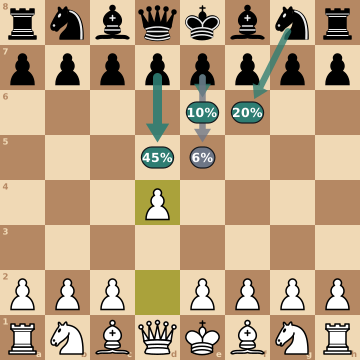
- 1...d5 (45%). d5 claims an equal share of the center.
Your answer: 2. c4. The Queen's Gambit: offer a pawn to pull Black's d5 pawn away from the center. - 1...Nf6 (20%). e6 and more.
Your answer: 2. c4. Grab more space on the queenside and the center. - 1...e6 (10%). Against your c4 plan it usually becomes a Queen's Gambit Declined.
Your answer: 2. c4. Stick to your Queen's Gambit setup. - 1...e5 (6%). e5? It's full of traps, so you need to know the right moves.
Your answer: 2. dxe5. Take the free pawn.
After 1. d4 d5 2. c4
The key position. Four replies each show up in at least 15% of games, and each one needs a different answer.
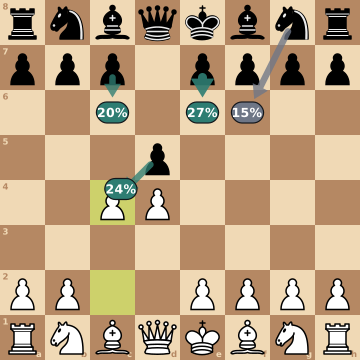
- 2...e6 (27%). e6 holds d5 with a second pawn, so Black never has to give up the center. The drawback: Black's c8 bishop is now shut in behind the e6 pawn.
Your answer: 3. Nc3. Develop and add a second attacker on d5. - 2...dxc4 (24%). dxc4 gives up the center for a pawn that Black usually can't keep.
Your answer: 3. Nf3. Develop first. You'll win the c4 pawn back with e3 and Bxc4. - 2...c6 (20%). e6 does, but it leaves the c8 bishop free to come out.
Your answer: 3. Nc3. Develop and add pressure on d5. - 2...Nf6 (15%). It looks natural, but now you can take on d5 and Black can't recapture with a pawn.
Your answer: 3. cxd5. Take, and Black's pieces will have to recapture.
After 1. d4 d5 2. c4 c6 3. Nc3
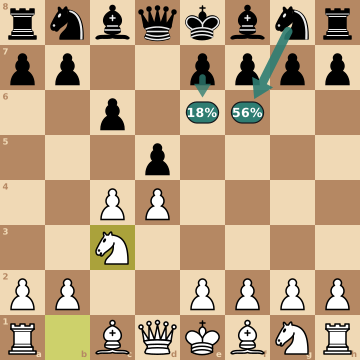
- 3...Nf6 (56%). It defends d5 a third time.
Your answer: 4. Nf3. Develop your other knight toward the center. - 3...e6 (18%). Black plays e6 before Nf6.
Your answer: 4. Nf3. Develop calmly and head for the same setup as the Semi-Slav.
After 1. d4 d5 2. c4 Nf6 3. cxd5 Nxd5 4. e4
Your pawns on d4 and e4 own the center. Black's knight splits almost evenly between f6 and b6, and you answer both with Nc3.
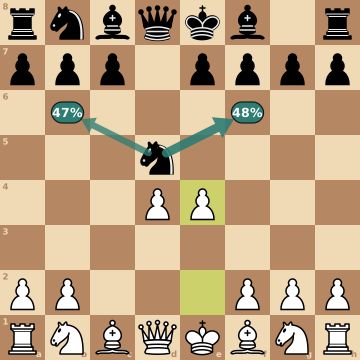
- 4...Nf6 (48%). Black retreats the knight to f6 and attacks e4.
Your answer: 5. Nc3. Protect e4 by developing a piece. - 4...Nb6 (47%). Black retreats the knight to b6.
Your answer: 5. Nc3. Develop and protect your center.
After 1. d4 Nf6 2. c4
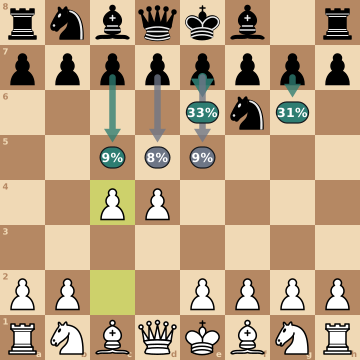
- 2...e6 (33%). Bb4 possible.
Your answer: 3. Nc3. Develop and prepare e4. - 2...g6 (31%). Bg7, so the bishop can aim at your center from a distance.
Your answer: 3. Nc3. Develop and support e4 and d5. - 2...c5 (9%). It often leads to the Benoni or the Benko Gambit.
Your answer: 3. d5. Push past, grab space and cramp Black's position. - 2...e5 (9%). Black plays e5, offering a pawn. This is the Budapest Gambit.
Your answer: 3. dxe5. Take the pawn. - 2...d5 (8%). c4 Nf6. Black's d5 pawn has no pawn support.
Your answer: 3. cxd5. Take, and Black can't recapture with a pawn.
After 1. d4 Nf6 2. c4 e6 3. Nc3
If Black plays 3...d5 you're back in the main line. Half of all players pin with 3...Bb4 instead, and you pin back with 4.Bg5.
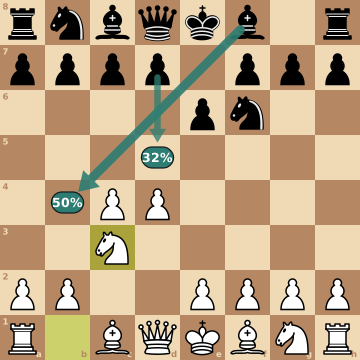
- 3...Bb4 (50%). Bb4 is played in half of all games here. The c3 knight can't move without exposing your king, so it can't really protect e4.
Your answer: 4. Bg5. Pin Black's knight in return. - 3...d5 (32%). Nc3 Nf6. Different move order, same position.
Your answer: 4. Bg5. The same pin as in the main line.
Your plan after the opening
In the main line: finish developing, then act
After 4...Be7 5.e3 O-O 6.Nf3, your plan is Rc1 and Bd3, then castle. Black's usual freeing idea is ...h6 and ...Ne4 to trade pieces. Keep your bishop with 7.Bh4 when it's kicked, and when the knight lands on e4, trade dark-squared bishops and carry on with Rc1. Don't start anything in the center until your king is safe.
1. d4 d5 2. c4 e6 3. Nc3 Nf6 4. Bg5 Be7 5. e3 O-O 6. Nf3 h6 7. Bh4 Ne4 8. Bxe7 Qxe7 9. Rc1
Against the Accepted: develop, then collect the pawn
Don't hurry to win back c4. Play 3.Nf3 to stop ...e5, then e3, and your f1 bishop takes on c4 with a developing move. If Black tries to keep the pawn with ...a6 and ...b5, strike with a4 at once to break up Black's queenside.
1. d4 d5 2. c4 dxc4 3. Nf3 a6 4. e3 Nf6 5. Bxc4 e6 6. O-O c5 7. a4
Against the Slav and Semi-Slav: the same pin
Develop with Nc3 and Nf3, then pin with Bg5 once Black has played ...e6. If Black asks the bishop with ...h6, the simple answer is to take on f6, play e3 and Bd3, and castle. If Black grabs the pawn with 5...dxc4, the sharp 6.e4 is the move that keeps your edge; slow moves throw it away.
1. d4 d5 2. c4 c6 3. Nc3 Nf6 4. Nf3 e6 5. Bg5 h6 6. Bxf6 Qxf6 7. e3
Against 1...Nf6: keep the same pieces, change the details
After 1...Nf6 2.c4 you still play Nc3 and usually Bg5. Against the Nimzo-Indian (3...Bb4) keep c3 protected with Qc2 or Qd3 and e3. Against the King's Indian setup, develop with Bg5, e3 and Nf3 and castle before doing anything sharp. Against 2...c5 push 3.d5 and use the space, and against the Budapest (2...e5) take the pawn and play Nc3 and e4 while Black spends time winning it back.
Traps and common mistakes
The Elephant trap: grabbing d5 when Black's knight is on d7
1. d4 d5 2. c4 e6 3. Nc3 Nf6 4. Bg5 Nbd7 5. cxd5 exd5 6. Nxd5?? Nxd5 7. Bxd8 Bb4+ 8. Qd2 Bxd2+ 9. Kxd2 Kxd8
The pin on f6 looks like it lets you win the d5 pawn. It doesn't when the knight is on d7. After 6.Nxd5?? Black ignores the queen and takes your knight. If you grab the queen with 7.Bxd8, the check 7...Bb4+ forces 8.Qd2, and Black takes that queen too. At the end Black is a piece for a pawn ahead.
Against 4...Nbd7, just keep developing with 5.e3 and Nf3.
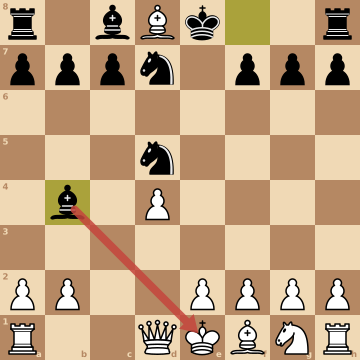
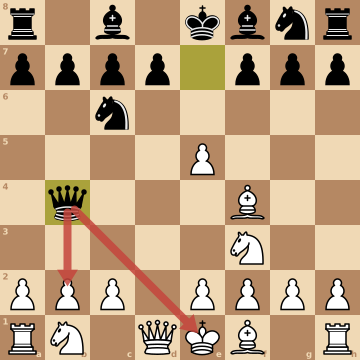
Falling for the Englund Gambit trap (4.Bf4?)
1. d4 e5 2. dxe5 Nc6 3. Nf3 Qe7 4. Bf4? Qb4+ 5. Bd2 Qxb2 6. Bc3 Bb4 7. Qd2 Bxc3 8. Qxc3 Qc1#
1...e5 is a real pawn sacrifice, and after 2.dxe5 Nc6 3.Nf3 Qe7 you're a pawn up. The natural 4.Bf4 is the most common move at this level (34%), but it walks into 4...Qb4+, hitting b2. White wins only 40% of games after 4.Bf4 at 1300 to 2200, against 53% after 4.Nc3.
Play 4.Nc3. The ...Qb4+ trick no longer works, and after 4...Nxe5 5.e4 you have the center and Stockfish rates you more than a pawn better.
Letting Black keep the c4 pawn
1. d4 d5 2. c4 dxc4 3. Nf3 a6 4. e3 b5 5. a4
In the Accepted, Black sometimes defends c4 with ...a6 and ...b5. Play 5.a4 straight away to attack the b5 pawn. The slow 5.Be2 lets Black hold on to the extra pawn.
Forgetting f2 after the queen trade in the 2...Nf6 line
1. d4 d5 2. c4 Nf6 3. cxd5 Nxd5 4. e4 Nf6 5. Nc3 e5 6. dxe5 Qxd1+ 7. Kxd1 Ng4 8. Ke1
After 4...Nf6 5.Nc3, Black's best try is 5...e5. Once the queens come off, 7...Ng4 attacks both e5 and f2. Step back with 8.Ke1 to cover f2. Black wins back the pawn, but your e4 pawn gives you more of the center and you keep a small edge.
Frequently asked questions
Is the Queen's Gambit Declined good for beginners as White?
Yes, if you're around 1300 or above. The moves are natural (Nc3, Bg5, e3, Nf3, castle) and several move orders reach the same position. Below that level, the number of different replies you have to know may feel like a lot at first.
What is the most common reply to the Queen's Gambit at club level?
At 1300 to 2200 on Lichess it's 2...e6, the Declined, in 27% of games. The Accepted 2...dxc4 follows at 24%, the Slav 2...c6 at 20% and 2...Nf6 at 15%.
Is the Queen's Gambit really a gambit?
Not really. If Black takes on c4, you win the pawn back with e3 and Bxc4 in almost every line. The only care needed is when Black defends it with ...b5: answer with a4 at once.
What should White play against 2...Nf6 in the Queen's Gambit?
Take with 3.cxd5. Black has to recapture with a piece, and after 3...Nxd5 you play 4.e4 to kick the knight and take the center. That's the most common choice at this level (69% of games), and White wins 58% of games after it.
Why is it called the Orthodox Queen's Gambit Declined?
"Orthodox" just describes Black's traditional, solid way of declining: supporting d5 with 2...e6 instead of taking the pawn. The main line in this guide, with 4.Bg5 and 4...Be7, is the classic example.
Keep learning
- All 36 opening guides: every opening on the site, grouped by what you play as White and Black.
- Should Black accept or decline the Queen's Gambit?: How the Accepted and the Declined differ, seen from the other side of the board.
- Slav vs Queen's Gambit Declined: Why 2...c6 and 2...e6 lead to such different games for Black's light-squared bishop.
- Five openings, one bishop: The shut-in c8 bishop, and why it shapes your plans in the main line.
The Coach plays Black against you with the moves 1300 to 2200 players actually choose, from the Declined and the Slav to the Englund Gambit, and explains every move in plain English. Progress tracking is free during the open beta.
Practice the Queen's Gambit Declined (Orthodox) free →