The Reti Opening: How 1000 to 2000 Players Answer 1.Nf3 d5 2.c4
TL;DR: the data
Built from 4.8 million Lichess games played by 1000 to 2000 rated players You play White, 19 practice lines, every move of yours checked by Stockfish Most common line 1. Nf3 d5 2. c4 dxc4 3. e3 b5 4. a4 c6 5. axb5 cxb5 6. Nc3 Replies to 2.c4 2...dxc4 35% · 2...d4 20% · 2...c6 14% Worth knowing After 2...dxc4 3.e3 b5 4.a4, 70% of players answer 4...c6, and White wins 65% of those games.
The Reti Opening starts 1.Nf3 d5 2.c4. You develop a knight first, then attack Black's d5 pawn from the side instead of meeting it head-on with d4. Against most replies you follow up with g3, Bg2 and castling, and your bishop presses on the center from long range.
This guide is built from 4.8 million Lichess games between 1000 and 2000 rated players, and the data holds a surprise. The most common answer to 2.c4 at this level isn't a solid defense of d5. It's 2...dxc4, grabbing the pawn, in 35% of games. So the most important thing to learn is the one line where you skip g3: play 3.e3 so your bishop can take back on c4, and punish Black if they try to keep the pawn with ...b5.
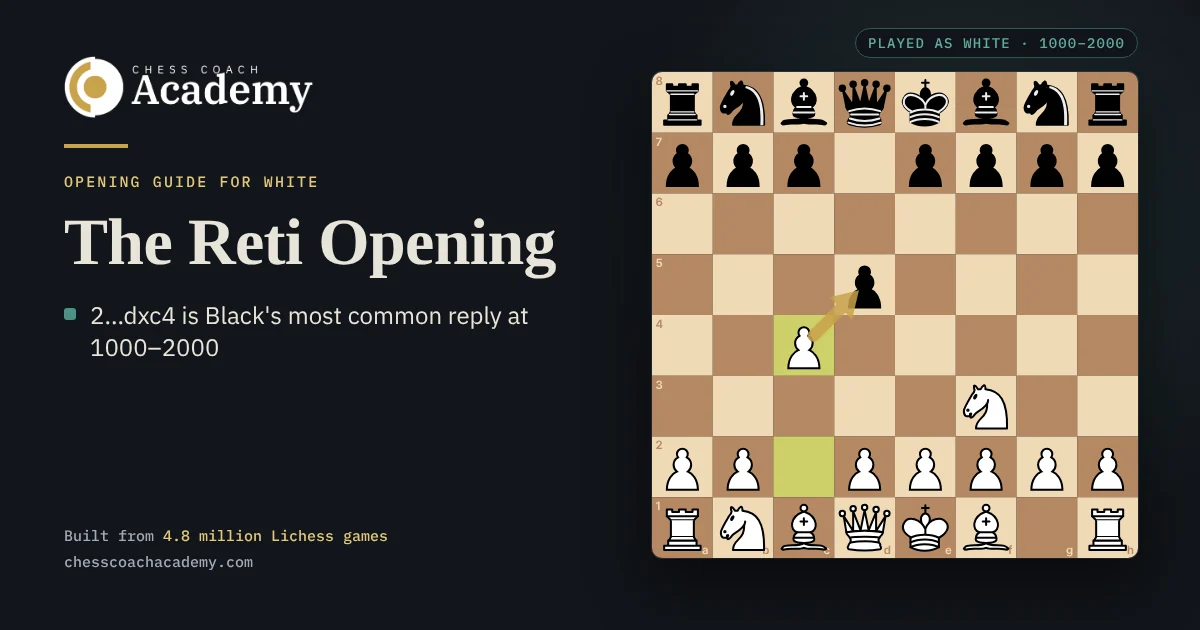
1. Nf3 d5 2. c4
Practice the Reti Opening free →Who it's for
Players rated roughly 1000 to 2000 who like calm, flexible positions and don't want to learn a lot of forcing theory. Against four of Black's five common replies you use the same g3, Bg2 and castle setup.
It suits patient players who enjoy pressure more than attacks. You don't grab the center with pawns early, so Black can take space, and you need to know how to hit back at it later. If you'd rather meet ...d5 with d4 and a classical center, the Queen's Gambit is more direct.
Why it works at 1000 to 2000
- Very little to memorize. Bishop to g2, castle, and choose a pawn break later.
- The most common reply is a chance for you. After 2...dxc4 3.e3, the pawn comes back quickly, and Black's most popular try to keep it runs into a clear refutation.
- Black's light-squared bishop often leaves c8 early, and your queen on b3 then hits b7. That idea comes up in several lines.
- Black can take space with 2...d4 and ...e5. You have to be comfortable with Black having more of the center for a while.
- Most lines end about level. You win in the middlegame, using breaks like e3, b4 and d4 against Black's center.
- The practice lines here start from 1...d5. At this level only 37% of players answer 1.Nf3 that way, so you need your own setup against the other replies.
What 1000 to 2000 players actually play
Five replies to 2.c4 all show up in more than a tenth of games. The pawn grab 2...dxc4 leads at 35%, the space-gaining 2...d4 follows at 20%, and then come the solid 2...c6 (14%), 2...e6 (12%) and 2...Nf6 (11%). Only the first and last of those change your plan: against 2...dxc4 you play 3.e3, and against 2...Nf6 you take on d5.
Three numbers from the data explain why 3.e3 is the key move to learn:
- At 1000-2000 on Lichess, 2...dxc4 is Black's most common reply to 1.Nf3 d5 2.c4 (35%), ahead of 2...d4 (20%), 2...c6 (14%), 2...e6 (12%) and 2...Nf6 (11%).
- After 2...dxc4, 3.e3 is White's most common move (39%), and White wins 58% of those games.
- After 2...dxc4 3.e3 b5 4.a4, 70% of players answer 4...c6, and White wins 65% of those games.
How to play the Reti Opening: move by move
Every position below comes from the practice lines. The arrows on each board show Black's most common replies at 1000 to 2000, labeled with how often each one is played in that exact position. Under each board you'll find why players choose the reply and the move you answer with.
After 1. Nf3 d5 2. c4
The key position. Against 2...dxc4 play 3.e3, against 2...Nf6 take on d5, and against the other three replies play 3.g3.
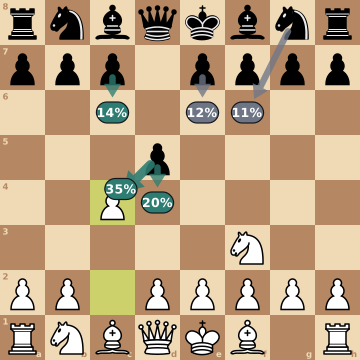
- 2...dxc4 (35%). You're a pawn down for now, but Black has given up the center pawn to get it.
Your answer: 3. e3. Open a path for your bishop to take back on c4. - 2...d4 (20%). It's an active, sound choice.
Your answer: 3. g3. Prepare Bg2 to pressure Black's center from a distance. - 2...c6 (14%). If you take on d5, Black recaptures with the c-pawn.
Your answer: 3. g3. Prepare your kingside fianchetto. - 2...e6 (12%). Black's c8 bishop is shut in for now.
Your answer: 3. g3. Head for a Catalan-style setup with Bg2. - 2...Nf6 (11%). You can take on d5 and Black has to recapture with a piece.
Your answer: 3. cxd5. Trade your side pawn for Black's center pawn.
After 1. Nf3 d5 2. c4 dxc4 3. e3
Your bishop is ready to take back on c4. Most replies let it, but a quarter of players defend the pawn with 3...b5, and one in eleven or so blocks with 3...Be6. Both need a specific answer.
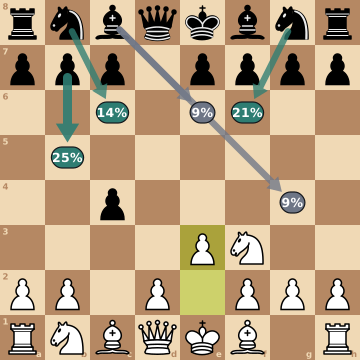
- 3...b5 (25%). b5 defends the c4 pawn with another pawn.
Your answer: 4. a4. Attack the pawn that's holding on to c4. - 3...Nf6 (21%). Black doesn't try to hold on to c4.
Your answer: 4. Bxc4. Material is level again, and your bishop is developed. - 3...Nc6 (14%). e5, but it doesn't stop you taking back on c4.
Your answer: 4. Bxc4. Pawn back, bishop out. - 3...Bg4 (9%). Black brings the bishop out to g4, eyeing your knight.
Your answer: 4. Bxc4. Win the pawn back, and now f7 and b7 are both targets. - 3...Be6 (9%). Bxc4??Bxc4 takes it and nothing can take back.
Your answer: 4. Na3. Add a second attacker on c4. - 3...e6 (8%). Black isn't trying to keep c4.
Your answer: 4. Bxc4. Pawn back, with a free, active bishop.
After 1. Nf3 d5 2. c4 dxc4 3. e3 Nf6 4. Bxc4
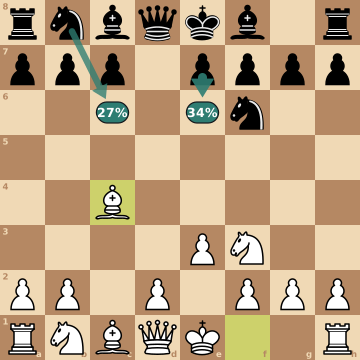
- 4...e6 (34%). e6 opens Black's dark-squared bishop and gets ready to castle.
Your answer: 5. O-O. King safe first, then decide on the center. - 4...Nc6 (27%). c5.
Your answer: 5. d4. c5.
After 1. Nf3 d5 2. c4 d4 3. g3
Black has a big pawn on d4. Don't attack it head-on. Fianchetto, castle, and play d3 so ...e4 just loses a pawn.
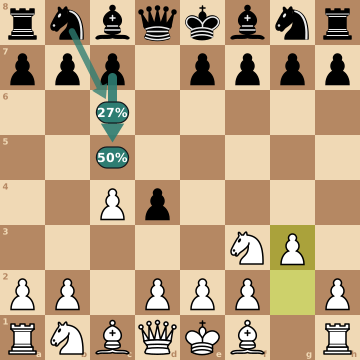
- 3...c5 (50%). It keeps the d4 pawn firmly in place.
Your answer: 4. Bg2. Complete the fianchetto. - 3...Nc6 (27%). e5.
Your answer: 4. Bg2. Fianchetto the bishop, same as always.
After 1. Nf3 d5 2. c4 c6 3. g3
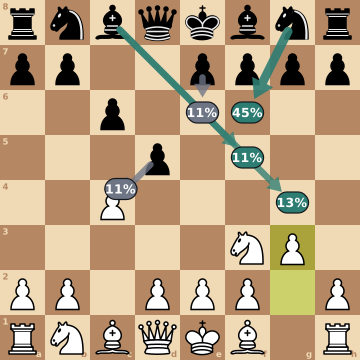
- 3...Nf6 (45%). Black develops Nf6, the most common reply.
Your answer: 4. Bg2. Complete the fianchetto. - 3...Bg4 (13%). Your e2 pawn stands between the bishop and your queen, so the knight isn't pinned.
Your answer: 4. Bg2. Keep developing and get ready to castle. - 3...Bf5 (11%). e6 shuts it in.
Your answer: 4. Bg2. Fianchetto first, then think about Qb3. - 3...e6 (11%). Black plays e6, making d5 very solid.
Your answer: 4. Bg2. Develop and prepare to castle. - 3...dxc4 (11%). Because you've played g3, not e3, your bishop can't take it back right away.
Your answer: 4. Bg2. Develop first. The pawn can wait.
After 1. Nf3 d5 2. c4 e6 3. g3
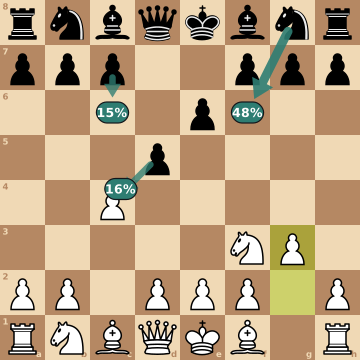
- 3...Nf6 (48%). Black develops Nf6, the most common reply.
Your answer: 4. Bg2. Your bishop is ready to aim down the long diagonal once the knight moves. - 3...dxc4 (16%). Black takes the c4 pawn.
Your answer: 4. Bg2. Develop, and the pawn will come back. - 3...c6 (15%). Black supports d5 with c6 as well.
Your answer: 4. Bg2. Develop your bishop and prepare to castle.
After 1. Nf3 d5 2. c4 Nf6 3. cxd5
Black has to take back with a piece. Against the knight, 4.e4 kicks it again. Against the queen, 4.Nc3 develops with gain of time.
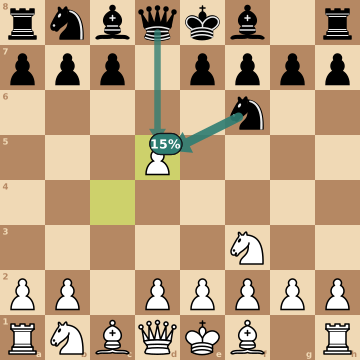
- 3...Nxd5 (78%). Black recaptures with the knight.
Your answer: 4. e4. Kick the knight and take the center. - 3...Qxd5 (15%). Black takes back with the queen.
Your answer: 4. Nc3. Develop and attack the queen at the same time.
Your plan after the opening
Against 2...dxc4: e3, Bxc4, then d4 or b3
Play 3.e3 and take back on c4 with the bishop. From there, castle and choose between d4 in the center or b3 and Bb2 to put your other bishop on the long diagonal. If Black has blocked the c-pawn with ...Nc6, go for d4 straight away, because Black can't answer with ...c5.
1. Nf3 d5 2. c4 dxc4 3. e3 Nf6 4. Bxc4 e6 5. O-O a6 6. d4 c5 7. b3
Against 2...d4: fianchetto, d3, then e3 or b4
Black grabs space with pawns on c5, d4 and often e5. Don't panic. Fianchetto and castle, then play d3 so that ...e4 simply drops a pawn to dxe4. Your plan after that is e3 to open the center (or b4 against the c5 pawn), with your rooks on whichever file opens.
1. Nf3 d5 2. c4 d4 3. g3 c5 4. Bg2 Nc6 5. O-O e5 6. d3 Bd6 7. e3
Against 2...c6 and 2...e6: fianchetto, castle, then Qb3 or d4
Against the Slav-style 2...c6, if Black develops the bishop to f5 or g4, b7 loses its defender. Castle and play Qb3 to hit it. Against 2...e6, you reach a Catalan-style game: castle, play d4, and if Black takes on c4, Qc2 wins the pawn back.
1. Nf3 d5 2. c4 c6 3. g3 Nf6 4. Bg2 Bf5 5. O-O e6 6. Qb3
Against 2...Nf6: take on d5 and grab the center
Take with 3.cxd5. Most players recapture with the knight, and 4.e4 kicks it again. After the usual 4...Nb6, play 5.d4 and you have two big center pawns. Develop with Nc3, a bishop move and castle. If the knight goes to f4 instead, 5.d4 keeps chasing it, and Stockfish rates you about two pawns up after 5...Ng6 6.h4.
1. Nf3 d5 2. c4 Nf6 3. cxd5 Nxd5 4. e4 Nb6 5. d4
Traps and common mistakes
Black trying to keep the pawn with ...b5 and ...c6
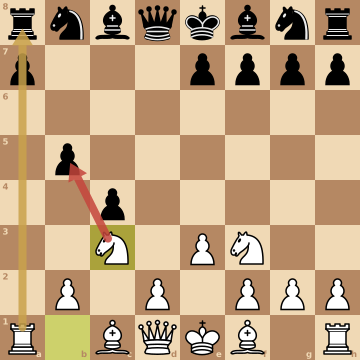
1. Nf3 d5 2. c4 dxc4 3. e3 b5 4. a4 c6 5. axb5 cxb5 6. Nc3
3...b5 is the most common reply to 3.e3 (25%). Hit the defending pawn with 4.a4. Now 70% of players prop it up with 4...c6, and White wins 65% of those games at this level. After the pawns trade on b5, the b5 pawn has no pawn left to protect it, and 6.Nc3 attacks it again.
If Black defends with ...a6, then Nxb5! works, because ...axb5 lets your rook take the rook on a8. Stockfish rates you almost two pawns better.
Taking on c4 with only one attacker
1. Nf3 d5 2. c4 dxc4 3. e3 Be6 4. Na3
After 3...Be6, the c4 pawn is defended by the bishop. If you take with 4.Bxc4??, Black simply takes back with ...Bxc4 and you've lost your bishop for a pawn.
Play 4.Na3 first. Now c4 is attacked twice and defended once, and you win the pawn back next move. Before taking anything, count attackers and defenders.
Missing the Bxf7+ trick against an early ...Bg4
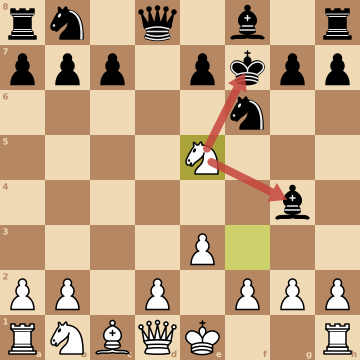
1. Nf3 d5 2. c4 dxc4 3. e3 Bg4 4. Bxc4 Nf6? 5. Bxf7+ Kxf7 6. Ne5+
When Black's bishop sits on g4 and you've taken back on c4, look at f7. After 4...Nf6?, 5.Bxf7+! Kxf7 6.Ne5+ gives check and attacks the g4 bishop at the same time. Next move you take the bishop, and you come out a pawn up.
If Black trades instead with 4...Bxf3, recapture with the queen. Your queen on f3 hits b7 and f7 at once, and Black can't cover both.
Forgetting about b7
Whenever Black's light-squared bishop leaves c8 early (to f5 or g4), b7 is defended only by the bishop that's no longer there. In the 2...c6 lines, castle and play Qb3. Black usually answers ...Qb6. If the queens are traded on b3, take back with the a-pawn so your rook gets a half-open a-file.
Frequently asked questions
Is the Reti Opening good for beginners?
It works well from about 1000 to 2000. The setup is simple and repeats across most lines, and the most common reply at this level, 2...dxc4, gives you a clear plan with 3.e3. It's less suited to players who want sharp attacking positions from the start.
What is the most common reply to the Reti Opening at club level?
At 1000 to 2000 on Lichess, after 1.Nf3 d5 2.c4, Black takes the pawn with 2...dxc4 in 35% of games. Next are 2...d4 (20%), 2...c6 (14%), 2...e6 (12%) and 2...Nf6 (11%).
What is the Reti Gambit, and do I get the pawn back?
It's the line 1.Nf3 d5 2.c4 dxc4, where Black takes your c-pawn. You get it back easily with 3.e3 and Bxc4. At this level 3.e3 is White's most common move (39%), and White wins 58% of those games.
What should I do if Black doesn't play 1...d5 against 1.Nf3?
At 1000 to 2000, only 37% of players answer 1.Nf3 with 1...d5, and the practice lines in this guide start from there. Against other replies the same idea of g3, Bg2 and castling is a sensible default, but you'll want to study those positions separately.
What's the difference between the Reti and the English?
The English starts 1.c4 and the Reti starts 1.Nf3, but both use c4, g3 and Bg2, and the two often reach the same positions. The Reti version waits to see Black's ...d5 before committing the c-pawn.
Keep learning
- All 36 opening guides: every opening on the site, grouped by what you play as White and Black.
- English vs Reti: 1.c4 or 1.Nf3: how the two flank openings compare and who each one suits.
- What is transposition in chess?: How different move orders reach the same position, with examples from our Reti data.
The Coach plays Black against you with the moves 1000 to 2000 players actually choose after 1.Nf3 d5 2.c4, including the ...b5 pawn grab, and explains every move in plain English. Progress tracking is free during the open beta.
Practice the Reti Opening free →