The Scandinavian Defense for 400 to 1400 Players: One Setup Against Everything
TL;DR: the data
Built from 94 million Lichess games played by 400 to 1400 rated players You play Black, 15 practice lines, every move of yours checked by Stockfish Most common line 1. e4 d5 2. exd5 Qxd5 3. Nc3 Qa5 4. Nf3 Nf6 5. d4 c6 6. Bd2 Bf5 Replies to 1...d5 2. exd5 51% · 2. e5 18% · 2. Nc3 9% Worth knowing After 3...Qa5 4.d4 Nf6 5.Bd2 c6 6.Ne4, about 2% of players take the knight with 6...Nxe4?? and lose the queen to 7.Bxa5. White wins 93% of those games.
The Scandinavian is the most direct answer to 1.e4 there is. You hit White's pawn with 1...d5 on the very first move, and when White takes, your queen takes back. From there you use the same handful of moves in almost every game: ...Qa5, ...Nf6, ...c6, ...Bf5, ...e6 and castle.
Most books teach this opening from games between masters, where White knows exactly how to chase your queen. This guide is built from 94 million Lichess games played at 400 to 1400, and your opponents at that level behave differently. Only about half of them take on d5. Almost one in five pushes 2.e5 instead, and a few play 2.Nf3 and simply leave a pawn hanging. You need an answer to each of those, and they are all below.
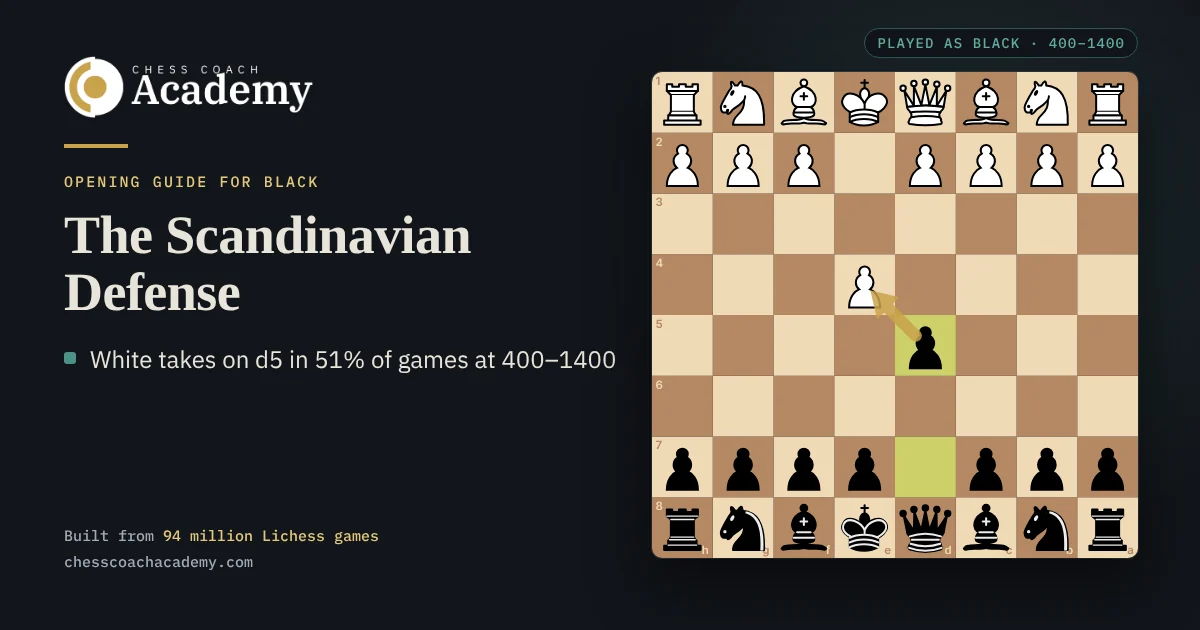
1. e4 d5 2. exd5 Qxd5 3. Nc3 Qa5
Practice the Scandinavian Defense free →Who it's for
Players rated roughly 400 to 1400 who want one clear plan against 1.e4 and don't want to learn a different structure every game. If you like knowing your first six or seven moves before the game starts, this is a good fit.
It suits players who are happy with a calm, solid position rather than a race of attacks. You won't get many early knockouts in the main line, but you will rarely get blown off the board either, as long as you remember one rule about your queen (covered in the traps section).
Why it works at 400 to 1400
- One setup covers almost everything. Against 4.Nf3, 4.d4, 4.d3 and 4.Bc4 you answer 4...Nf6 every time, then ...c6 and ...Bf5.
- You decide the shape of the game on move one. White can't set up a big pawn center with d4 and e4 side by side.
- Some common replies at this level are real mistakes. 2.Nf3 just drops a pawn, and 2.Nc3 lets you gain space with 2...d4 and chase the knight around.
- Your queen comes out early, so White gains a little time by attacking it. In the main line Stockfish rates White slightly better, which is normal for Black.
- You must know the discovered attack. With White's bishop on d2 and your queen on a5, any knight move from c3 can uncover an attack on your queen.
- Not everyone takes on d5. 2.e5 shows up in 18% of games at this level and leads to a different kind of position, so learn the short answer to it.
What 400 to 1400 players actually play
Here is what White does after 1.e4 d5 at 400 to 1400. Taking the pawn with 2.exd5 is the most common choice at 51%, and that's where the main line starts. The surprise is 2.e5 at 18%: many players at this level push past your pawn instead of taking it. 2.Nc3 (9%) defends e4 but lets you kick the knight with 2...d4, and 2.Nf3 (6%) doesn't defend e4 at all, so you win a pawn on move two.
The numbers to keep in your head:
- At this rating range, 1...d5 is played in about 10% of games after 1.e4.
- White's most common replies to 1...d5 are 2.exd5 (51%), 2.e5 (18%), 2.Nc3 (9%) and 2.Nf3 (6%).
- After 3...Qa5 4.d4 Nf6 5.Bd2 c6 6.Ne4, about 2% of players take the knight with 6...Nxe4?? and lose the queen to 7.Bxa5. White wins 93% of those games.
How to play the Scandinavian Defense: move by move
Each board below is a position from the practice lines, shown from your side. The arrows are White's most common replies at 400 to 1400, labeled with how often each one is played in that exact position. Under each board you'll see why White plays the move and the answer the Coach teaches you.
After 1. e4 d5
Your first decision is already made. Now White has to choose, and four different replies are common enough to prepare for.
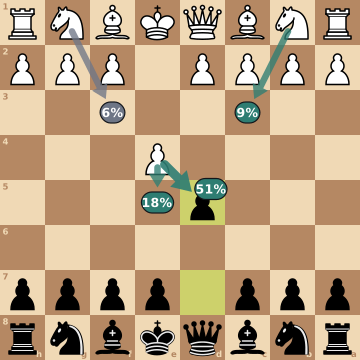
- 2. exd5 (51%). Don't worry: you take the pawn straight back.
Your answer: 2...Qxd5. Take the pawn back with your queen. - 2. e5 (18%). White grabs space instead of taking on d5.
Your answer: 2...c5. Attack the d4 square before White builds a pawn chain. - 2. Nc3 (9%). It's not a big mistake, but it lets you gain space by chasing the knight.
Your answer: 2...d4. Push past and kick the knight. - 2. Nf3 (6%). Nf3? doesn't protect the e4 pawn.
Your answer: 2...dxe4. Win a pawn and attack the knight.
After 1. e4 d5 2. exd5 Qxd5
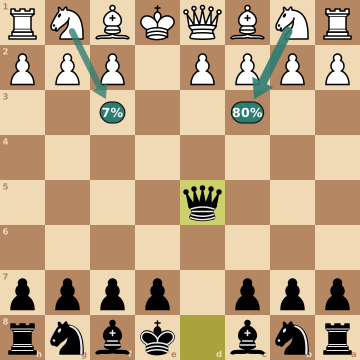
- 3. Nc3 (80%). It brings out a piece and gains time by chasing your queen.
Your answer: 3...Qa5. Move your queen to a safe square on the side. - 3. Nf3 (7%). White doesn't chase your queen right away.
Your answer: 3...Bg4. Develop your bishop and pin the knight to White's queen.
After 1. e4 d5 2. exd5 Qxd5 3. Nc3 Qa5
This is home base. Whatever White plays next, your answer is 4...Nf6. The only thing that changes is how quickly White lines up a bishop against your queen.
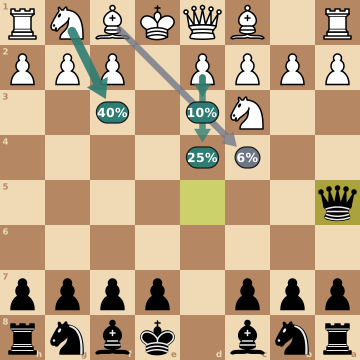
- 4. Nf3 (40%). White simply brings out pieces and gets ready to castle.
Your answer: 4...Nf6. Develop your knight to its best square. - 4. d4 (25%). White builds a center before bringing out the knight.
Your answer: 4...Nf6. Develop your knight. - 4. d3 (10%). It opens the c1 bishop but doesn't take much of the center.
Your answer: 4...Nf6. Develop your knight. - 4. Bc4 (6%). The bishop points at f7, the weakest square near your king.
Your answer: 4...Nf6. Develop, and guard the h5 square against White's queen.
After 1. e4 d5 2. exd5 Qxd5 3. Nc3 Qa5 4. Nf3 Nf6
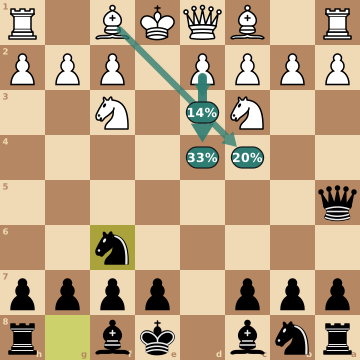
- 5. d4 (33%). White now has a pawn in the middle, and the c1 bishop can come out.
Your answer: 5...c6. Make a safe spot for your queen and guard d5 and b5. - 5. Bc4 (20%). The bishop looks at f7, a weak square that only your king protects.
Your answer: 5...c6. Give your queen a way back to c7 and guard d5 and b5. - 5. d3 (14%). White plays d3, a quiet move that opens the c1 bishop.
Your answer: 5...c6. Your usual move: a safe square for the queen.
After 1. e4 d5 2. exd5 Qxd5 3. Nc3 Qa5 4. d4 Nf6
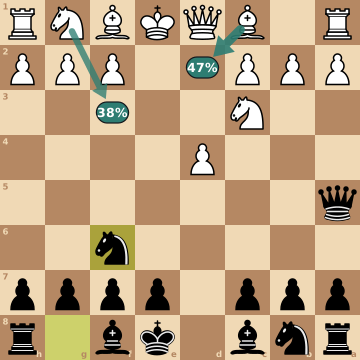
- 5. Bd2 (47%). The c3 knight is now the only thing between White's bishop and your queen.
Your answer: 5...c6. Take d5 and b5 away from the knight and free c7 for your queen. - 5. Nf3 (38%). White develops and keeps the d4 pawn strong.
Your answer: 5...c6. Free c7 for your queen and guard d5 and b5.
After 1. e4 d5 2. exd5 Qxd5 3. Nc3 Qa5 4. d4 Nf6 5. Bd2 c6
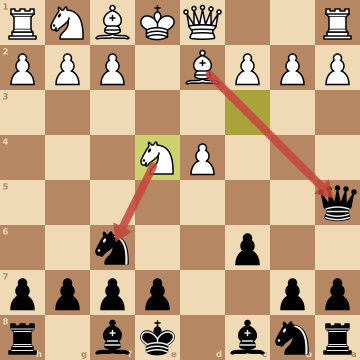
The most important moment in the opening. White's knight on c3 is the only thing between the d2 bishop and your queen. If it moves, your queen moves first.
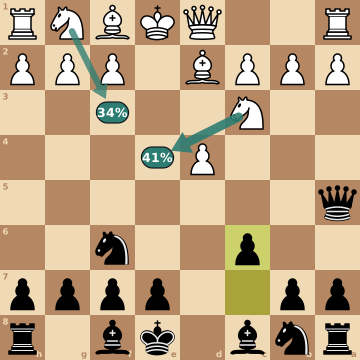
- 6. Ne4 (41%). When the knight moves, the d2 bishop attacks your queen. The knight also attacks your f6 knight. Move your queen first!
Your answer: 6...Qc7. Move your queen to safety. - 6. Nf3 (34%). Nf3 main line, reached in a different order.
Your answer: 6...Bf5. Bishop out before e6.
After 1. e4 d5 2. Nc3 d4
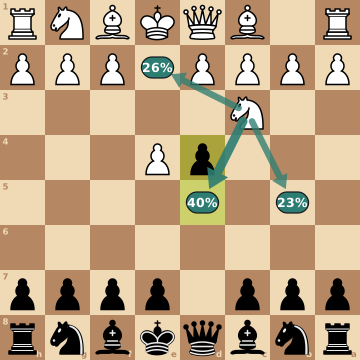
- 3. Nd5 (40%). The knight looks active, but it can be chased away.
Your answer: 3...c6. Chase the knight away again. - 3. Nce2 (26%). The knight can go to g3 later, but it blocks White's f1 bishop for now.
Your answer: 3...e5. Support your d4 pawn and take more of the center. - 3. Nb5 (23%). The knight eyes c7 and your d4 pawn, but your queen protects both.
Your answer: 3...e5. Protect d4 with a pawn and take the center.
After 1. e4 d5 2. Nf3 dxe4
You're a pawn up already. White's knight has to move again, and both common squares for it come with a simple answer.
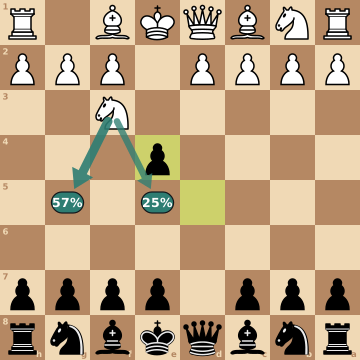
- 3. Ng5 (57%). The knight hits e4 and also looks at f7 and h7.
Your answer: 3...Bf5. Protect your extra pawn and develop. - 3. Ne5 (25%). The knight is centralized and eyes f7.
Your answer: 3...Nf6. Develop and protect your e4 pawn.
Your plan after the opening
The main line: queen to a5, then build the same setup
After 3...Qa5 your next moves are ...Nf6, ...c6 and ...Bf5, then ...e6, ...Nbd7 and castling. The pawn on c6 gives your queen a safe square on c7 and keeps White's knight off d5 and b5. The bishop goes to f5 before ...e6, so it stays outside your pawn chain instead of being stuck behind it.
Once you've castled, the usual plan is to put a rook on d8, facing White's d4 pawn, and look for ...c5 or ...e5 to challenge the center.
1. e4 d5 2. exd5 Qxd5 3. Nc3 Qa5 4. Nf3 Nf6 5. d4 c6 6. Bd2 Bf5
Against 2.e5: hit d4 with ...c5
When White pushes past your pawn, the fight is about the d4 square. Play 2...c5 so White can't easily build a chain with d4. White's pawn on e5 takes f6 away from your knight, so develop with ...Nc6 and bring your light-squared bishop to f5 or g4 before you play ...e6. If White checks with Bb5+, block with ...Nc6 or ...Bd7. Stockfish rates this position level.
1. e4 d5 2. e5 c5 3. c3 Bf5 4. Bb5+ Nc6 5. d4 e6
Against 2.Nc3: push and take space
2...d4 kicks the knight, and every retreat costs White more time. If it jumps to d5, chase it again with 3...c6. If it goes to e2 or b5, support your d4 pawn with 3...e5. In all three lines Stockfish rates you slightly better, and you have a big pawn center to build on with ...Nf6 and ...Nc6.
1. e4 d5 2. Nc3 d4 3. Nd5 c6 4. Nf4 e5 5. Nfe2 Nf6
Against 3.Nf3: pin the knight
If White develops the knight instead of hitting your queen (7% of games), pin it with 3...Bg4. Follow up with ...Nc6 and ...Nf6, and you can even castle queenside. When White finally plays Nc3, move your queen before you do anything else.
Traps and common mistakes
Taking the knight when it uncovers an attack on your queen
1. e4 d5 2. exd5 Qxd5 3. Nc3 Qa5 4. d4 Nf6 5. Bd2 c6 6. Ne4 Nxe4?? 7. Bxa5
This is the one trap every Scandinavian player has to know. 6.Ne4 is White's most common move here (41%). The knight attacks your f6 knight, and at the same time the bishop on d2 now attacks your queen. If you grab the knight, 7.Bxa5 wins your queen. About 2% of players at 400 to 1400 fall for it, and White wins 93% of those games.
The fix is a habit: when the c3 knight moves and your queen is on a5, move the queen first. Here 6...Qc7 is the Coach's answer. After 7.Nxf6+ exf6 your bishop on f8 is free and you castle quickly.
Playing ...e6 before ...Bf5
Your light-squared bishop needs to get out before you play ...e6, or it spends the whole game behind your own pawns on e6 and c6. The order is always ...Nf6, ...c6, ...Bf5 (or ...Bg4), and only then ...e6. It's a small thing that decides how good your position feels ten moves later.
Missing the free pawn after 2.Nf3
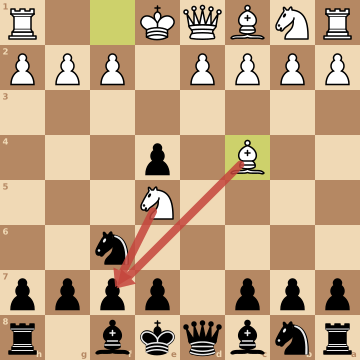
1. e4 d5 2. Nf3 dxe4 3. Ne5 Nf6 4. Bc4 e6
2.Nf3 doesn't protect e4, so take it: 2...dxe4 wins a pawn and attacks the knight. Stockfish rates you about a pawn better in both main replies.
The one danger comes after 3.Ne5 Nf6 4.Bc4. The knight and bishop both aim at f7. If you play a careless move, Nxf7 forks your queen and your rook on h8. Play 4...e6 at once, which blocks the bishop so f7 is safe.
Taking on f3 too early against 3.Nf3
1. e4 d5 2. exd5 Qxd5 3. Nf3 Bg4 4. Nc3 Bxf3? 5. Nxd5 Bxd1 6. Nxc7+
After 3.Nf3 Bg4 4.Nc3 your queen is attacked. If you take on f3 first, White takes your queen with 5.Nxd5. You take White's queen back with 5...Bxd1, but then the knight checks from c7 and forks your king and rook, and Stockfish rates White about a pawn ahead. Move the queen first (4...Qe6+ or 4...Qf5 are the best squares), and keep the pin for later.
Frequently asked questions
Is the Scandinavian Defense good for beginners?
Yes, it's one of the easiest defenses to 1.e4 to learn. You play the same setup in almost every line, and at 400 to 1400 several common White replies are outright mistakes. The one thing you must learn is to move your queen first whenever White's c3 knight uncovers an attack on it.
What is the most common reply to the Scandinavian at club level?
At 400 to 1400 on Lichess, 2.exd5 is White's most common reply (51%), followed by 2.e5 (18%), 2.Nc3 (9%) and 2.Nf3 (6%). After 2.exd5 Qxd5, White attacks your queen with 3.Nc3 in 80% of games.
Is 3...Qa5 or 3...Qd6 better in the Scandinavian?
Both are played, but this guide and the Coach use 3...Qa5. On a5 the queen is out of the way and hard to hit again, and after ...c6 it can always drop back to c7. It also lets you use the same setup against 4.Nf3, 4.d4, 4.d3 and 4.Bc4.
What should Black do against 2.e5 in the Scandinavian?
Play 2...c5 and fight for the d4 square before White can support e5 with a pawn chain. Develop with ...Nc6 and get your light-squared bishop out to f5 or g4 before ...e6. Stockfish rates the position level.
What if White plays 2.Nf3 against the Scandinavian?
Take the pawn with 2...dxe4. White's e4 pawn isn't protected, and your pawn now attacks the knight too. It happens in 6% of games at 400 to 1400, and in both main follow-ups Stockfish rates you about a pawn ahead.
Keep learning
- All 36 opening guides: every opening on the site, grouped by what you play as White and Black.
- Is the Scandinavian Defense Sound?: How it holds up once your opponents get stronger.
- Which Chess Openings Require the Least Memorization?: Where the Scandinavian ranks among the low-theory openings.
- What Is the Best Defense Against 1.e4?: How the Scandinavian compares with six other defenses.
The Coach plays White against your Scandinavian with the moves 400 to 1400 players actually choose, including 2.e5 and the 6.Ne4 trick, and explains every move in plain English. Progress tracking is free during the open beta.
Practice the Scandinavian Defense free →