
Why the Sicilian Najdorf Isn't Recommended Under 1500 Elo (And What to Play Instead)
TL;DR
Recommended range The Najdorf course is built for 1600 to 2400 Elo, from about 17 million Lichess games at that level Why not under 1500 White gets three separate choices between five or more common systems: six second moves, five third moves and six sixth moves. No other 1.e4 defense in our library has more than two Open Sicilian share Only 57% of White players at 1600 to 2400 even play 2.Nf3. The rest choose anti-Sicilians White's 6th move after 5...a6 6.Bg5 24% · 6.Be3 19% · 6.Bc4 14% · 6.Be2 12% · 6.f3 8% · 6.Bd3 7.5% Play instead under 1500 Scandinavian (400+), Pirc (750+), Caro-Kann (800+), Petroff (800+) or Modern Defense (900+)
What "Not Recommended" Actually Means Here
This site assigns every opening an Elo range based on how sharp the resulting positions are and how much precise preparation they demand, not a vague sense of "this is hard." The Sicilian Najdorf's range starts at 1600, the highest floor of any 1.e4 defense on this site, and that number reflects something you can check in its own data.
A note on the numbers: our trainers were rebuilt from Lichess games at each opening's own rating range. Most figures below are move frequencies. The few results we quote come straight from our data, with the rating band attached. None of this says the Najdorf is unsound. It says it asks more of you.
The Real Complexity, By the Numbers
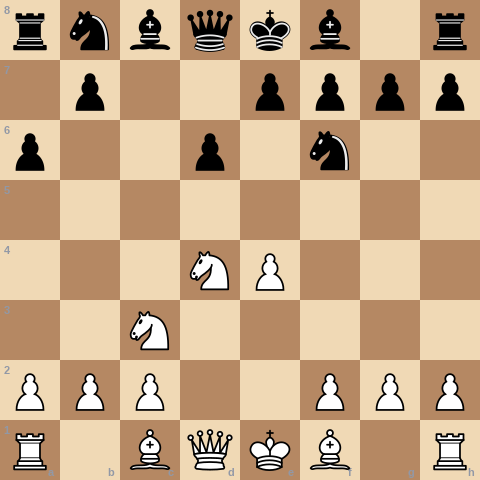
That's the Najdorf's defining sequence. Black's pawn push to a6 keeps White's pieces off b5 and prepares queenside play without committing to a structure yet. What happens next is what makes the difference.
At 1600 to 2400 on Lichess, White's sixth move spreads across six common systems: 6.Bg5 (24%), 6.Be3 (19%), 6.Bc4 (14%), 6.Be2 (12%), 6.f3 (8%) and 6.Bd3 (7.5%). Our Najdorf trainer covers all six. And that's only the Open Sicilian. Before you ever reach 5...a6, White has already had two other wide choices:
- Move two: 2.Nf3 (57%), 2.Nc3 (9%), 2.Bc4 (8%), 2.d4 (7%, usually the Smith-Morra with 3.c3), 2.c3 (6%) and 2.f4 (5%).
- Move three, after 2.Nf3 d6: 3.d4 (57%), 3.Bc4 (14%), 3.c3 (9%), 3.Bb5+ (7%) and 3.Nc3 (6%).
- Move six, after 5...a6: the six systems above.
Compare that to the other 1.e4 defenses on this site. The Pirc, the Caro-Kann and the Petroff each have two decision points where White has five or more common moves, and the Scandinavian has none. The Najdorf has three, spread across completely different kinds of position: quiet sidelines, gambits and the sharp Open Sicilian.
The anti-Sicilians also punish natural moves. In the Smith-Morra after 5.Nf3 Nf6 6.Bc4, Black scores 43% with 6...e6 but only 35% with 6...g6, which allows White's e5 and Bxf7+ trick. Those figures are from 1600 to 2400 on Lichess, where players already know the main lines.
So the 1600 floor isn't a judgment on the opening. The Najdorf is the most respected Sicilian system in chess, played at every level up to world championship matches. It's a judgment on the preparation it takes to handle all of those branches well, which most players haven't built yet below that range.
What to Play Instead Under 1500
This site covers six other 1.e4 defenses, and five of them carry a recommended floor well below 1500:
Caro-Kann Advance (800+ Elo, about 37 million Lichess games): solid and positional. After 1. e4 c6 2. d4 d5 3. e5, you play 3...Bf5, developing the bishop before ...e6 boxes it in, just like 64% of players at 800 to 2200.
Scandinavian Defense (400+ Elo, about 94 million Lichess games): the most accessible option here by a wide margin. After 1. e4 d5, White takes with 2. exd5 in 51% of games at 400 to 1400, you recapture with 2...Qxd5, and you use the same few moves against almost everything after that.
Pirc Defense (750+ Elo, about 63 million Lichess games): flexible, with the same ...Nf6, ...g6 and ...Bg7 setup against 2.d4, which White plays in 41% of games at 750 to 1800.
Modern Defense (900+ Elo, about 54 million Lichess games): closely related to the Pirc. White answers 1...g6 with 2.d4 in 38% of games and 2.Nf3 in 29%, and you meet both with ...Bg7 and ...d6.
Petroff Defense (800+ Elo, about 98 million Lichess games): a direct, symmetrical counter-attack with 1. e4 e5 2. Nf3 Nf6. White's third move splits 3.Nc3 (33%), 3.Nxe5 (32%) and 3.Bc4 (18%), and after 3.Nxe5 only 26% of players at 800 to 2400 find the correct 3...d6, so one well-learned move puts you ahead.
None of these asks you to handle three wide decision points at once, which is why they carry a lower recommended floor. They aren't worse openings. They just ask less of you while your opening intuition is still developing.
Read the full breakdown of all seven 1.e4 defenses →
Frequently asked questions
Is the Sicilian Najdorf good for beginners?
Not as a first defense. Our Najdorf course is built for 1600 to 2400, because White has three separate points where five or more common systems are possible, and each one needs its own answers. Below 1500, a simpler defense gets you playable positions far sooner.
What rating should you be to play the Najdorf?
Our recommended range starts at 1600 Elo, the highest floor of any 1.e4 defense on this site. That reflects the preparation it takes, not a flaw in the opening. The Najdorf is played at every level up to world championship matches.
What should I play against 1.e4 under 1500?
The Scandinavian (from 400), the Pirc (from 750), the Caro-Kann (from 800), the Petroff (from 800) or the Modern Defense (from 900). Each has fewer wide decision points for White, so one well-learned plan covers most of your games.
Is the Sicilian Najdorf unsound?
No. It is one of the most respected defenses in chess. The 1600 floor is about how much it asks of you, not about whether it works.
Keep reading
For both colors and the full 1200 to 1800 range:
- The Best Chess Openings for Intermediate Players (1200 to 1800): White and Black repertoires for club players, backed by our move data.
Try Any of These for Free
The Sicilian Najdorf and all five alternatives above are fully interactive on this site, with lines built from Lichess games at each opening's rating range and move-by-move coaching. All 38 openings are free to try, no card and no account needed to start, with your progress tracked for free if you create one.
The Caro-Kann course covers 800 to 2200, built from the moves players really choose on Lichess and checked by Stockfish. Track your progress free with an account.
Practice the Caro-Kann free →