Why the Sicilian Najdorf Isn't Recommended Under 1500 Elo (And What to Play Instead)
TL;DR
- The Sicilian Najdorf's recommended range on this site is 1600 to 2400 Elo, starting above the 1500 mark. Its trainer is built from what 1600 to 2400 rated players actually play on Lichess, about 17 million games.
- White gets three separate chances to pick between five or more common systems in our Najdorf repertoire: six second moves after 1.e4 c5, five third moves after 2.Nf3 d6, and six sixth moves after 5...a6. No other 1.e4 defense in our library has more than two decision points that wide.
- Only 57% of White players at 1600 to 2400 on Lichess even play 2.Nf3. The rest choose sidelines, so a Najdorf player needs answers to the Open Sicilian and to a handful of anti-Sicilians.
- Five lower-recommended alternatives on this site suit a player under 1500 facing 1.e4: the Caro-Kann (800+), Scandinavian (400+), Pirc (750+), Modern Defense (900+) and Petroff (800+).
What "Not Recommended" Actually Means Here
This site assigns every opening an Elo range based on how sharp the resulting positions are and how much precise preparation they demand, not a vague sense of "this is hard." The Sicilian Najdorf's range starts at 1600, the highest floor of any 1.e4 defense on this site, and that number reflects something you can check in its own data.
A note on the numbers: our trainers were rebuilt from Lichess games at each opening's own rating range. Most figures below are move frequencies. The few results we quote come straight from our data, with the rating band attached. None of this says the Najdorf is unsound. It says it asks more of you.
The Real Complexity, By the Numbers
1. e4 c5 2. Nf3 d6 3. d4 cxd4 4. Nxd4 Nf6 5. Nc3 a6
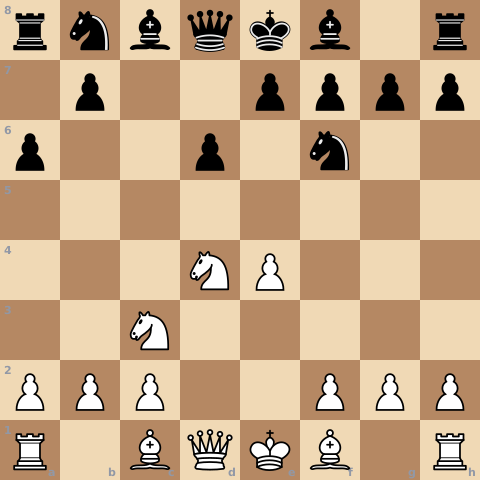
That's the Najdorf's defining sequence. Black's pawn push to a6 keeps White's pieces off b5 and prepares queenside play without committing to a structure yet. What happens next is what makes the difference.
At 1600 to 2400 on Lichess, White's sixth move spreads across six common systems: 6.Bg5 (24%), 6.Be3 (19%), 6.Bc4 (14%), 6.Be2 (12%), 6.f3 (8%) and 6.Bd3 (7.5%). Our Najdorf trainer covers all six. And that's only the Open Sicilian. Before you ever reach 5...a6, White has already had two other wide choices:
- Move two: 2.Nf3 (57%), 2.Nc3 (9%), 2.Bc4 (8%), 2.d4 (7%, usually the Smith-Morra with 3.c3), 2.c3 (6%) and 2.f4 (5%).
- Move three, after 2.Nf3 d6: 3.d4 (57%), 3.Bc4 (14%), 3.c3 (9%), 3.Bb5+ (7%) and 3.Nc3 (6%).
- Move six, after 5...a6: the six systems above.
Compare that to the other 1.e4 defenses on this site. The Pirc, the Caro-Kann and the Petroff each have two decision points where White has five or more common moves, and the Scandinavian has none. The Najdorf has three, spread across completely different kinds of position: quiet sidelines, gambits and the sharp Open Sicilian.
The anti-Sicilians also punish natural moves. In the Smith-Morra after 5.Nf3 Nf6 6.Bc4, Black scores 43% with 6...e6 but only 35% with 6...g6, which allows White's e5 and Bxf7+ trick. Those figures are from 1600 to 2400 on Lichess, where players already know the main lines.
So the 1600 floor isn't a judgment on the opening. The Najdorf is the most respected Sicilian system in chess, played at every level up to world championship matches. It's a judgment on the preparation it takes to handle all of those branches well, which most players haven't built yet below that range.
What to Play Instead Under 1500
This site covers six other 1.e4 defenses, and five of them carry a recommended floor well below 1500:
Caro-Kann Advance (800+ Elo, about 37 million Lichess games): solid and positional. After 1. e4 c6 2. d4 d5 3. e5, you play 3...Bf5, developing the bishop before ...e6 boxes it in, just like 64% of players at 800 to 2200.
Scandinavian Defense (400+ Elo, about 94 million Lichess games): the most accessible option here by a wide margin. After 1. e4 d5, White takes with 2. exd5 in 51% of games at 400 to 1400, you recapture with 2...Qxd5, and you use the same few moves against almost everything after that.
Pirc Defense (750+ Elo, about 63 million Lichess games): flexible, with the same ...Nf6, ...g6 and ...Bg7 setup against 2.d4, which White plays in 41% of games at 750 to 1800.
Modern Defense (900+ Elo, about 54 million Lichess games): closely related to the Pirc. White answers 1...g6 with 2.d4 in 38% of games and 2.Nf3 in 29%, and you meet both with ...Bg7 and ...d6.
Petroff Defense (800+ Elo, about 98 million Lichess games): a direct, symmetrical counter-attack with 1. e4 e5 2. Nf3 Nf6. White's third move splits 3.Nc3 (33%), 3.Nxe5 (32%) and 3.Bc4 (18%), and after 3.Nxe5 only 26% of players at 800 to 2400 find the correct 3...d6, so one well-learned move puts you ahead.
None of these asks you to handle three wide decision points at once, which is why they carry a lower recommended floor. They aren't worse openings. They just ask less of you while your opening intuition is still developing.
Read the full breakdown of all seven 1.e4 defenses →
Keep reading
For both colors and the full 1200 to 1800 range:
- The Best Chess Openings for Intermediate Players (1200 to 1800): White and Black repertoires for club players, backed by our move data.
Try Any of These for Free
The Sicilian Najdorf and all five alternatives above are fully interactive on this site, with lines built from Lichess games at each opening's rating range and move-by-move coaching. All 36 openings are completely unlocked during this site's open beta, no card, no limit, no account required to start, with your progress tracked for free if you create one.
Every line checked the same way, against real game data, not against what sounds right.
Browse all 36 openings free →