The Slav Defense: One Solid Setup Against 1.d4 for 700 to 1700 Players
TL;DR: the data
Built from 26 million Lichess games played by 700 to 1700 rated players You play Black, 18 practice lines, every move of yours checked by Stockfish Most common line 1. d4 d5 2. c4 c6 3. Nc3 Nf6 4. Nf3 e6 Replies to 2...c6 3. Nc3 51% · 3. Nf3 16% · 3. e3 12% Worth knowing After 1.d4 d5, only 34% of players rated around 700-1700 play 2.c4. 2.Bf4 (21%), 2.Nf3 (15%), 2.e3 (12%) and 2.Nc3 (9%) are all common, which is why this course covers them.
The Slav Defense is the calm way to meet 1.d4. You answer 1.d4 with 1...d5, and when White attacks that pawn with 2.c4, you protect it with another pawn: 2...c6. Nothing gets blocked. Your c8 bishop still has a clear road to f5 or g4, which is the problem that makes the Queen's Gambit Declined hard work.
This guide is built from 26 million Lichess games played by 700 to 1700 rated players, so it covers what White actually does at that level, not what a textbook expects. The biggest surprise is how often White never plays the Queen's Gambit at all. Only 34% of players push 2.c4 after 1.d4 d5. The rest choose the London with 2.Bf4, or 2.Nf3, 2.e3 or 2.Nc3. The good news is that the same few Slav moves work against all of them.
1. d4 d5 2. c4 c6
Practice the Slav Defense free →Who it's for
Players rated roughly 700 to 1700 who want one reliable answer to 1.d4 and would rather understand a setup than memorize long lines. You play ...d5, ...c6, ...Nf6 and then either ...Bf5 or ...e6, and that covers almost every game.
It fits especially well if you already play the Caro-Kann against 1.e4, because the pawn shapes and plans are very similar. If you want early tactics and quick knockouts, look elsewhere: the Slav wins by being the more comfortable side in the middlegame.
Why it works at 700 to 1700
- One setup for almost everything. ...c6, ...Nf6 and then ...Bf5 or ...e6 works against 2.c4, the London, 2.Nf3, 2.e3 and 2.Nc3.
- Your light-squared bishop gets out. In most lines it lands on f5 or g4 before you play ...e6, instead of sitting behind your own pawns all game.
- Many opponents don't know it well. After 2.c4, only 16% of players at this level choose 2...c6, so White players meet it less often than the other replies.
- It rarely wins in the opening. Stockfish rates most of these lines about level, so you have to outplay your opponent later.
- You must watch the b7 pawn. Once your bishop leaves c8, a queen on b3 can attack b7, which is why the main line uses ...e6 instead of ...Bf5.
- Two thirds of opponents skip 2.c4. You need to know how the setup changes against the London and the quiet e3 systems (both covered below).
What 700 to 1700 players actually play
Once you have played 2...c6, about half of White players develop with 3.Nc3 (51%), putting a second attacker on d5. The rest split between 3.Nf3 (16%), the quiet 3.e3 (12%) and the Exchange Variation 3.cxd5 (12%). Your answer to the first three is the same move, 3...Nf6. Against 3.cxd5 you take back with the c-pawn.
Three numbers from the data shape this whole repertoire:
- After 1.d4 d5, only 34% of players rated around 700-1700 play 2.c4. 2.Bf4 (21%), 2.Nf3 (15%), 2.e3 (12%) and 2.Nc3 (9%) are all common, which is why this course covers them.
- After 1.d4 d5 2.c4, only 16% of players at this level choose 2...c6. 2...dxc4 (31%) and 2...e6 (23%) are both more popular, so many opponents rarely face the Slav.
- After 1.d4 d5 2.e3 c6 3.Bd3, the 2% of players who answer 3...Bf5? lose 70% of their games, because Bxf5 simply wins the bishop.
How to play the Slav Defense: move by move
Each board below is a position from the practice lines, shown from your side. The arrows are White's most common replies at 700 to 1700, labeled with how often each one is played in that exact position. Under every board you'll find why White plays the move and the answer you give.
After 1. d4 d5
Your first real decision comes after White's second move. Against 2.c4, 2.Nf3, 2.e3 and 2.Nc3 you play ...c6. Against the London (2.Bf4) you develop with ...Nf6 first and add ...c6 later.
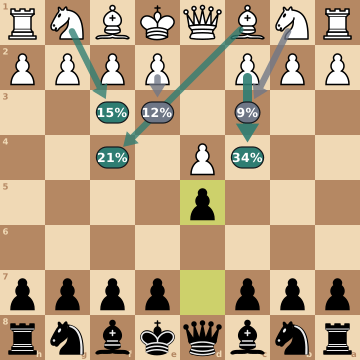
- 2. c4 (34%). c4 attacks your d5 pawn and asks whether you'll defend it or take on c4.
Your answer: 2...c6. The Slav Defense: protect d5 with a pawn. - 2. Bf4 (21%). White skips c4 and develops the bishop before playing e3.
Your answer: 2...Nf6. Develop first. The Slav setup still works here. - 2. Nf3 (15%). White might play c4 later, or go for a London or Colle setup.
Your answer: 2...c6. Play the Slav setup anyway. - 2. e3 (12%). It supports d4 but shuts in White's c1 bishop.
Your answer: 2...c6. Your Slav setup again. - 2. Nc3 (9%). Nc3 blocks White's c-pawn and prepares e4.
Your answer: 2...c6. The Slav setup again.
After 1. d4 d5 2. c4 c6
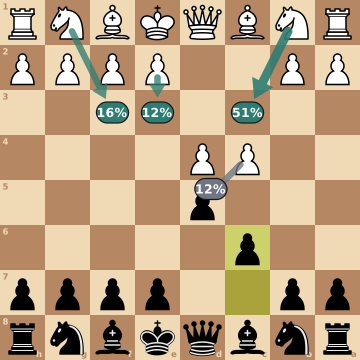
- 3. Nc3 (51%). d5 is now attacked by the c4 pawn and the knight.
Your answer: 3...Nf6. Develop and defend d5 once more. - 3. Nf3 (16%). It keeps options open between Nc3, e3 and other setups.
Your answer: 3...Nf6. Same move as always: develop and cover d5. - 3. e3 (12%). e3 is solid but a bit passive: White's dark-squared bishop is now shut in behind the e3 pawn.
Your answer: 3...Nf6. Develop and defend d5, then bring the bishop out. - 3. cxd5 (12%). cxd5 simplifies the position right away.
Your answer: 3...cxd5. Recapture with the c-pawn and keep your pawn in the center.
After 1. d4 d5 2. c4 c6 3. Nc3 Nf6
This is where the Slav splits. Against 4.Nf3 you play ...e6. Against 4.Bg5 and 4.Bf4 you take the c4 pawn, because nothing defends it. Against 4.e3 your bishop comes out to f5.
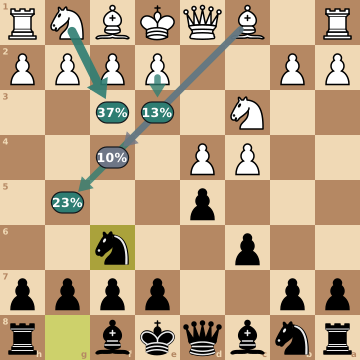
- 4. Nf3 (37%). This position is called the Three Knights Variation.
Your answer: 4...e6. Build a rock-solid pawn chain. This is the Semi-Slav. - 4. Bg5 (23%). It develops and puts pressure on your f6 knight, but it does nothing to defend the c4 pawn.
Your answer: 4...dxc4. Take the pawn: White hasn't played e3, so nothing defends c4. - 4. e3 (13%). e3 protects c4 and prepares Bd3, but White's dark-squared bishop is now stuck behind its own pawns.
Your answer: 4...Bf5. e6. - 4. Bf4 (10%). The bishop is active on f4, but it no longer guards b2 and it does nothing to defend c4.
Your answer: 4...dxc4. Take the pawn, just like against Bg5.
After 1. d4 d5 2. Nf3 c6
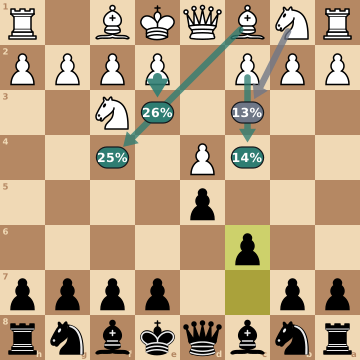
- 3. e3 (26%). It's solid, but White's c1 bishop is now shut in behind the pawns.
Your answer: 3...Nf6. Develop, and keep your options open. - 3. Bf4 (25%). The bishop comes out before e3 so it doesn't get shut in.
Your answer: 3...Nf6. Develop the knight first. - 3. c4 (14%). c4 turns the game into a normal Slav, just by a different move order.
Your answer: 3...Nf6. The usual Slav move. - 3. Nc3 (13%). Nc3 blocks White's c-pawn, so c4 won't come soon.
Your answer: 3...Nf6. Develop and control e4.
After 1. d4 d5 2. e3 c6
Look at where White's bishop is going. If it lands on d3, the f5 square is covered, and ...Bf5 simply hangs the bishop. Play ...Nf6 first.
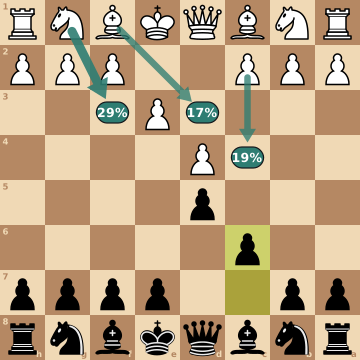
- 3. Nf3 (29%). White develops the knight to f3.
Your answer: 3...Nf6. Develop the knight and control e4. - 3. c4 (19%). c4 reaches a Slav with e3 already played.
Your answer: 3...Nf6. Develop and defend d5. - 3. Bd3 (17%). The bishop aims at h7 and covers f5, the square your own bishop wants.
Your answer: 3...Nf6. Develop, and don't put your bishop on f5 yet.
After 1. d4 d5 2. Nc3 c6
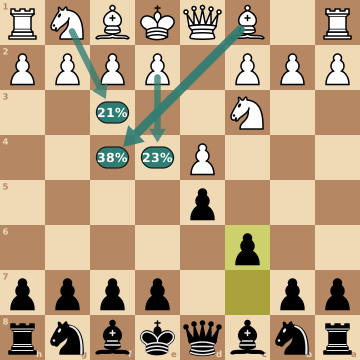
- 3. Bf4 (38%). White is heading for a London-style setup with the knight on c3.
Your answer: 3...Nf6. Develop and control e4. - 3. e4 (23%). e4.
Your answer: 3...dxe4. Take the pawn. - 3. Nf3 (21%). Nc3 line.
Your answer: 3...Nf6. Develop and control e4.
Your plan after the opening
Against 3.Nc3 and 4.Nf3: build the Semi-Slav with ...e6
Here you don't play ...Bf5, because 4...Bf5 5.cxd5 cxd5 6.Qb3 leaves b7 hanging (see the mistakes below). Play 4...e6, then ...Nbd7, a bishop to e7 or d6, and castle. Your c8 bishop still gets out: once White's bishop leaves f1, take on c4, gain time with ...b5 and put the bishop on b7. Stockfish rates it about level.
1. d4 d5 2. c4 c6 3. Nc3 Nf6 4. Nf3 e6 5. e3 Nbd7 6. Bd3 dxc4 7. Bxc4 b5 8. Bd3 b4
Against 4.Bg5 and 4.Bf4: take c4 and keep it with ...b5
Both bishop moves develop a piece but leave c4 without a defender. Take it with 4...dxc4, and hold it with ...b5: your c6 pawn is what makes that possible. If White hits b5 with a4, support it with ...Qb6, then finish with ...e6, ...Nbd7 and ...Bb7. Stockfish rates you slightly better. After 4.Bf4 dxc4 5.e3, don't play 5...Nd5 6.Bxc4, which just hands the pawn back.
1. d4 d5 2. c4 c6 3. Nc3 Nf6 4. Bg5 dxc4 5. e3 b5 6. a4 Qb6 7. Be2 e6
Against e3 and the London: bishop out first, then ...e6
When White plays e3 early, White's own c1 bishop is shut in, so you're in no hurry. Put your bishop on f5 before you play ...e6, then ...Nbd7 and castle.
Against the London (Bf4 and e3), remember that White's bishop has left c1, so the b2 pawn has lost a defender. ...Qb6 attacking b2 is often annoying for White. If White ignores it, you can take the pawn.
1. d4 d5 2. Nf3 c6 3. Bf4 Nf6 4. e3 Bf5 5. c4 Qb6 6. Qc1
Against the Exchange (3.cxd5): develop fast and watch b7
The pawns are symmetrical, so the side that develops better is better. Play ...Nf6, ...Nc6, ...Bf5 and ...e6, then castle. If White's queen comes to b3 to attack b7, ...Na5 attacks the queen and gains time.
1. d4 d5 2. c4 c6 3. cxd5 cxd5 4. Nc3 Nf6 5. Bf4 Nc6 6. e3 Bf5 7. Qb3 Na5
Traps and common mistakes
Putting the bishop on f5 when White's bishop is on d3
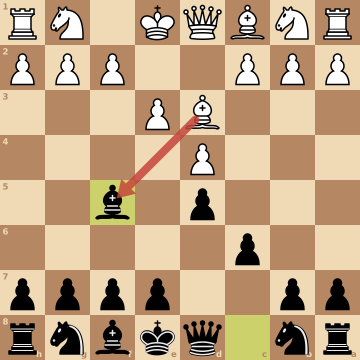
1. d4 d5 2. e3 c6 3. Bd3 Bf5? 4. Bxf5
This is the most expensive mistake in the data. After 2.e3 c6 3.Bd3, nothing of yours defends f5. Only 2% of players at this level play 3...Bf5?, but they lose 70% of their games, because Bxf5 simply wins the bishop.
3...Bg4?? is no better, because the queen takes it: the e-pawn has moved, so the road from d1 to g4 is open. Play 3...Nf6 first. Then your knight covers g4, and the bishop can go there safely. If you want the bishop on f5, play ...e6 first so it is protected.
Forgetting about b7 after ...Bf5
1. d4 d5 2. c4 c6 3. Nc3 Nf6 4. Nf3 Bf5 5. cxd5 cxd5 6. Qb3
The whole Slav is built around getting the bishop out, but timing matters. In the main line with 3.Nc3 and 4.Nf3, the bishop leaves c8, White trades on d5 and the queen jumps to b3. Now b7 is attacked and has no defender.
That's why the Coach plays 4...e6 in this position. In lines where ...Bf5 is right, you can meet an early Qb3 with ...Qb6 while the c-pawns are still on the board.
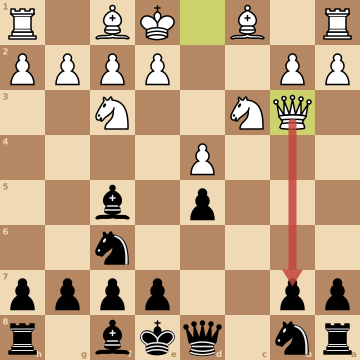
Answering Qb3 with ...Qb6 after the c-pawns are gone
1. d4 d5 2. c4 c6 3. Nc3 Nf6 4. e3 Bf5 5. cxd5 cxd5 6. Qb3 Qb6? 7. Nxd5
...Qb6 is a fine answer to Qb3 while your c6 pawn still guards d5. Once the pawns have been traded, your queen leaves d8 and d5 loses a defender. White's knight takes it, and it hits your queen at the same time. After the queen trade you're simply a pawn down.
Play 6...Bc8, which guards b7 again, or 6...Nc6. Those are the two answers the Coach gives. 6...Nc6 doesn't guard b7: it offers the pawn for time. If White grabs it with 7.Qxb7, play 7...Bd7 and ...Rb8 to chase the queen, and Stockfish still rates the game about level.
Letting White trap your bishop on the kingside
In the 2.Nc3 c6 3.Bf4 Nf6 4.e3 Bf5 line, White often throws the f, g and h pawns forward to chase your bishop. Drop it back to g6, and when White plays h4, answer with ...h5 or ...h6. If you ignore it, h4-h5 traps the bishop.
Frequently asked questions
Is the Slav Defense good for beginners?
Yes, especially from about 700 to 1700. The same few moves work against almost everything White plays, your pieces all get good squares, and there are only a couple of traps to learn (mostly about your light-squared bishop). It won't win you many games in the opening, but it gives you a solid position to play from.
What is the most common reply to the Slav Defense at club level?
At 700 to 1700 on Lichess, 3.Nc3 is played in 51% of games after 1.d4 d5 2.c4 c6. Next come 3.Nf3 (16%), 3.e3 (12%) and the Exchange Variation 3.cxd5 (12%). Against the first three, 3...Nf6 is your answer.
What is the difference between the Slav and the Semi-Slav?
The Slav is 1.d4 d5 2.c4 c6. The Semi-Slav is the version where you also play ...e6 early, usually after 3.Nc3 Nf6 4.Nf3 e6. In this repertoire you play the Semi-Slav setup against 4.Nf3, because 4...Bf5 runs into cxd5 and Qb3 against b7.
What's the difference between the Slav and the Queen's Gambit Declined?
Both protect d5 against 2.c4. The Declined uses 2...e6, which shuts in your c8 bishop, while the Slav uses 2...c6 and keeps the bishop's road open. One small cost: the c6 pawn takes your queen's knight's natural square, so that knight usually goes to d7 instead.
What if White doesn't play 2.c4?
That's the normal case at this level: only 34% of players play 2.c4, and 2.Bf4 (21%), 2.Nf3 (15%), 2.e3 (12%) and 2.Nc3 (9%) are all common. You keep the same setup: ...c6, ...Nf6, ...Bf5 or ...Bg4, then ...e6. Against the London, ...Qb6 hitting b2 is a useful extra idea.
Keep learning
- All 36 opening guides: every opening on the site, grouped by what you play as White and Black.
- Slav vs Queen's Gambit Declined: 2...c6 or 2...e6, and what each choice does for your light-squared bishop.
- Five Openings, One Bishop: Why the Slav's free bishop matters, compared with four other openings.
- How to counter the London System as Black: More ideas against 2.Bf4, the second most common reply to 1...d5.
The Coach plays 1.d4 against you with the moves 700 to 1700 players actually choose, from 2.c4 to the London, and explains every one of your moves in plain English. Progress tracking is free during the open beta.
Practice the Slav Defense free →