The Trompowsky Attack: A Low-Theory 1.d4 Plan for 900 to 1800 Players
TL;DR: the data
Built from 4.2 million Lichess games played by 900 to 1800 rated players You play White, 20 practice lines, every move of yours checked by Stockfish Most common line 1. d4 Nf6 2. Bg5 e6 3. e4 Be7 4. e5 Nd5 5. Bxe7 Qxe7 6. c4 Nb6 7. Nc3 Replies to 2.Bg5 2...e6 29% · 2...d5 18% · 2...g6 17% Worth knowing After 2...e6 3.e4 Be7 4.e5 Ne4 5.Bxe7 Qxe7 6.Bd3, the most common reply is 6...Ng5? (33%), which loses the knight to 7.h4.
The Trompowsky Attack starts 1.d4 Nf6 2.Bg5. Instead of the usual 2.c4 or 2.Nf3, your dark-squared bishop comes out on move two and threatens to take the f6 knight. If it does, Black has to recapture with a pawn or the queen, and either way Black's position changes shape before the opening has really started.
This guide is built from 4.2 million Lichess games between 900 and 1800 rated players, not from master games. Only about 4% of players at this level choose 2.Bg5, so most of your opponents have never studied it, and the data shows exactly how they react. The plan that comes out of it is short: against 2...e6 grab the center with e4, against 2...Ne4 drop the bishop back to f4, and against almost everything else take on f6 and play e3 and c4.
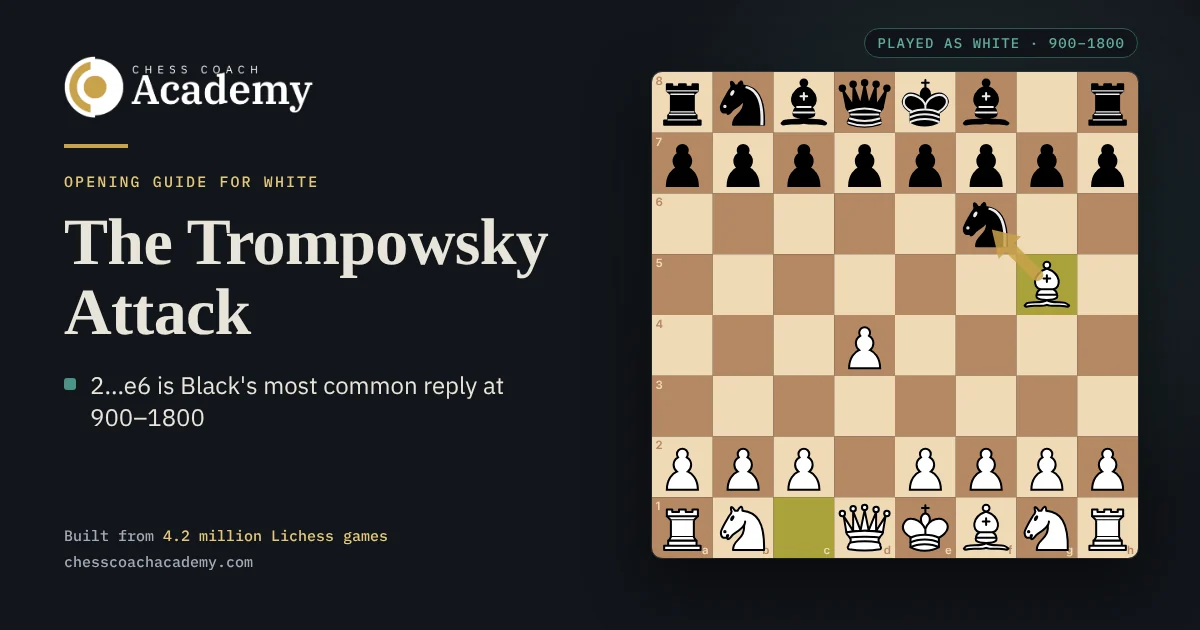
1. d4 Nf6 2. Bg5
Practice the Trompowsky Attack free →Who it's for
Players rated roughly 900 to 1800 who open with 1.d4 but don't want to learn the big Queen's Gambit and Indian Defense systems. You reach your own kind of position on move two, and the same few ideas repeat in every line.
It suits you if you're happy to swap a bishop for a knight in return for better pawns and a clear plan. If you want a setup you can play without looking at your opponent's moves, the London is simpler. The Trompowsky asks you to make one decision early (take on f6 or not), and this guide tells you when.
Why it works at 900 to 1800
- Your opponents are rarely ready for it. Very few players at this level play 2.Bg5, so Black is usually thinking for themselves from move two.
- The plans repeat. Take on f6, play e3 and c4, develop and castle. Against 2...e6 you get a big center with e4 and e5 instead.
- It comes with real traps. The pin on f6 catches players who grab e4 too early, and the 6...Ng5? line in the 4...Ne4 branch loses a knight to one pawn move.
- Taking on f6 hands Black the two bishops. Most of those lines are level, so you win with the better pawn structure in the middlegame, not in the opening.
- Your c1 bishop leaves home early, so b2 is loose. Moves like ...Qb6 and ...Qb4+ come up often, and you need to know how to meet them.
- 2...Ne4 hits your bishop at once, and 3...g5 chases it again. It isn't dangerous if you know the retreats, but it's the least comfortable line.
What 900 to 1800 players actually play
Black's answers to 2.Bg5 are spread out. 2...e6 leads at 29%, and it's the one reply where you don't take on f6: Black could recapture with the queen and keep good pawns, so you play 3.e4 instead. Next come 2...d5 at 18% and 2...g6 at 17%, and in both of those you do take. The sharpest reply, 2...Ne4, shows up in roughly one game in eight, and 2...h6 in 10%. Each of these gets its own board below.
Three numbers from the data explain why this opening works at club level:
- After 1.d4 Nf6, only about 4% of 900-1800 rated players on Lichess choose 2.Bg5.
- Against 2.Bg5, Black's most common replies are 2...e6 (29%), 2...d5 (18%), 2...g6 (17%) and 2...Ne4 (12%).
- After 2...e6 3.e4 Be7 4.e5 Ne4 5.Bxe7 Qxe7 6.Bd3, the most common reply is 6...Ng5? (33%), which loses the knight to 7.h4.
How to play the Trompowsky Attack: move by move
Every position below comes from the practice lines. The arrows on each board show Black's most common replies at 900 to 1800, labeled with how often each one is played in that exact position. Under each board you'll find why players choose the reply and the move you answer with.
After 1. d4 Nf6 2. Bg5
Six different replies each show up in at least 5% of games. The rule of thumb: against 2...e6 play 3.e4, against 2...Ne4 play 3.Bf4, and against the rest take on f6.
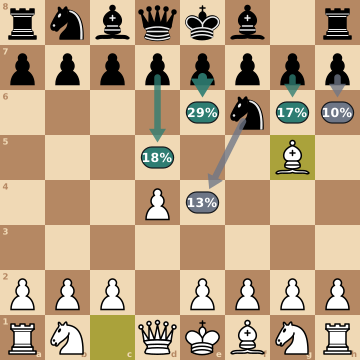
- 2...e6 (29%). e6 means that if you take on f6, Black can recapture with the queen and keep a healthy pawn structure.
Your answer: 3. e4. Take the whole center. The f6 knight is pinned, so it can't take. - 2...d5 (18%). Black doesn't worry about doubled pawns.
Your answer: 3. Bxf6. Trade and give Black doubled pawns. - 2...g6 (17%). O-O.
Your answer: 3. Bxf6. Take now, before Black gets set up. - 2...Ne4 (13%). Black attacks your bishop with Ne4.
Your answer: 3. Bf4. Keep the bishop active on a safe square. - 2...h6 (10%). Ne4, so taking is simpler.
Your answer: 3. Bxf6. Take and give Black doubled pawns. - 2...d6 (5%). Nbd7. It doesn't bother your bishop at all.
Your answer: 3. Bxf6. Trade and double Black's pawns.
After 1. d4 Nf6 2. Bg5 e6 3. e4
The knight on f6 is pinned to Black's queen, so it can't take on e4. Most players break the pin with 3...Be7, and almost a quarter kick your bishop with 3...h6.
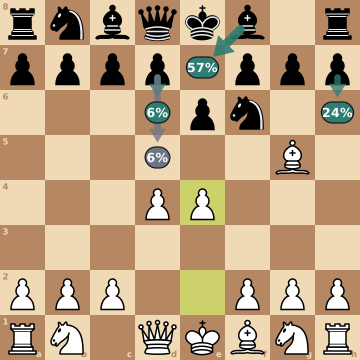
- 3...Be7 (57%). Be7 puts a piece between your bishop and Black's queen, so the knight is free to move again.
Your answer: 4. e5. Gain space and chase the f6 knight. - 3...h6 (24%). e5?hxg5 takes your bishop and Stockfish rates Black more than three pawns better.
Your answer: 4. Bxf6. Take the knight before it can take e4. - 3...d6 (6%). Black plays the quiet d6.
Your answer: 4. Nc3. Develop and protect your e4 pawn. - 3...d5 (6%). But the f6 knight is still pinned to Black's queen, which gives you a strong answer.
Your answer: 4. e5. Attack the pinned knight.
After 1. d4 Nf6 2. Bg5 e6 3. e4 Be7 4. e5
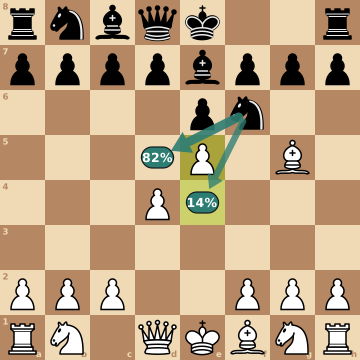
- 4...Nd5 (82%). Now Black's bishop on e7 attacks your bishop on g5, which has no defender.
Your answer: 5. Bxe7. Trade bishops instead of leaving yours hanging. - 4...Ne4 (14%). The knight looks active, but no pawn protects it on e4.
Your answer: 5. Bxe7. Trade before your bishop is lost.
After 1. d4 Nf6 2. Bg5 e6 3. e4 Be7 4. e5 Nd5 5. Bxe7
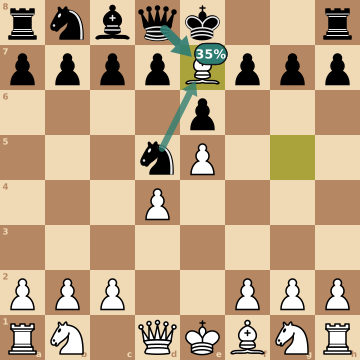
- 5...Qxe7 (65%). The knight on d5 looks strong, but it can be chased with a pawn.
Your answer: 6. c4. Kick the knight off its central square. - 5...Nxe7 (35%). The knight will often look for the f5 square next.
Your answer: 6. Bd3. Develop and take the f5 square away from Black's knight.
After 1. d4 Nf6 2. Bg5 e6 3. e4 Be7 4. e5 Nd5 5. Bxe7 Qxe7 6. c4
Your c-pawn has kicked the knight. Watch for 6...Qb4+, which checks and hits b2 at the same moment.
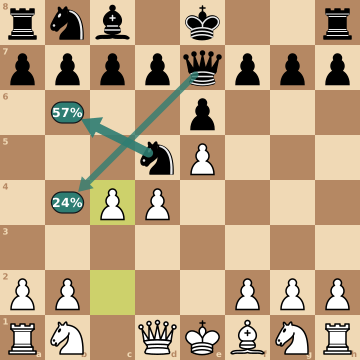
- 6...Nb6 (57%). The knight is safe there, but it's far from the center and Black's kingside.
Your answer: 7. Nc3. Develop and take control of d5 and e4. - 6...Qb4+ (24%). It gets out of the way with check and eyes b2, but Black's knight on d5 is still attacked by your c4 pawn.
Your answer: 7. Nd2. Block the check and keep the queens on.
After 1. d4 Nf6 2. Bg5 d5 3. Bxf6
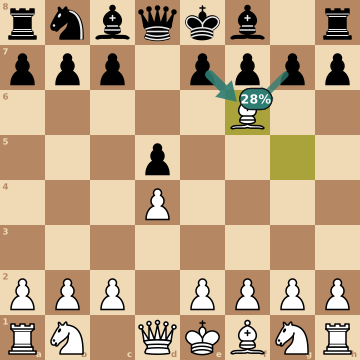
- 3...exf6 (72%). Black recaptures toward the center with exf6.
Your answer: 4. e3. Open your f1 bishop and keep d4 solid. - 3...gxf6 (28%). Black recaptures with gxf6.
Your answer: 4. e3. Solid, and it opens your f1 bishop.
After 1. d4 Nf6 2. Bg5 d5 3. Bxf6 exf6 4. e3
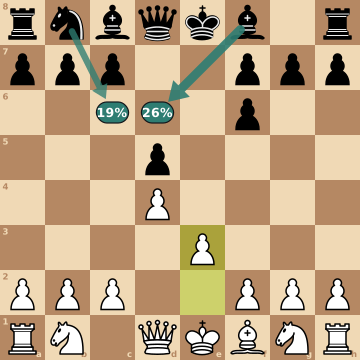
- 4...Bd6 (26%). The bishop aims at your kingside, toward h2.
Your answer: 5. c4. Attack Black's d5 pawn. - 4...Nc6 (19%). Black develops the knight to c6.
Your answer: 5. c4. The same idea: hit d5 at once.
After 1. d4 Nf6 2. Bg5 g6 3. Bxf6 exf6 4. e3 Bg7 5. g3
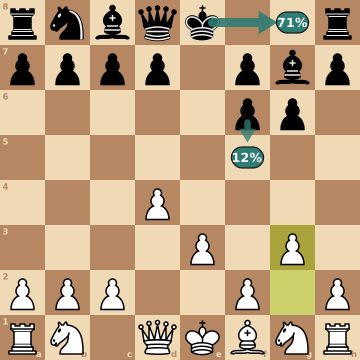
- 5...O-O (71%). Black's king is safe, and the game is about good squares now.
Your answer: 6. Bg2. Your bishop takes over the long diagonal. - 5...f5 (12%). Black plays f5 to free the g7 bishop.
Your answer: 6. Bg2. Your bishop on its best diagonal, aiming at b7.
After 1. d4 Nf6 2. Bg5 g6 3. Bxf6 exf6 4. e3 Bg7 5. g3 O-O 6. Bg2
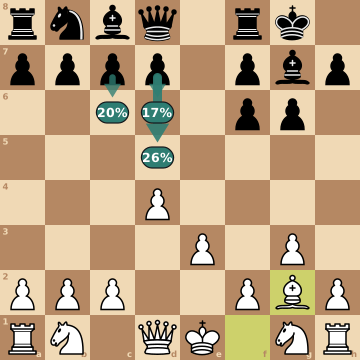
- 6...d5 (26%). Black puts a pawn on d5.
Your answer: 7. Ne2. Develop the knight without blocking your bishop. - 6...c6 (20%). d5.
Your answer: 7. c4. d5 in. - 6...d6 (17%). Black plays the quiet d6.
Your answer: 7. Ne2. Develop without blocking your g2 bishop.
After 1. d4 Nf6 2. Bg5 Ne4 3. Bf4
Black's knight is active but has no pawn behind it yet. Your plan is e3, then challenge the knight with Bd3 or Nd2.
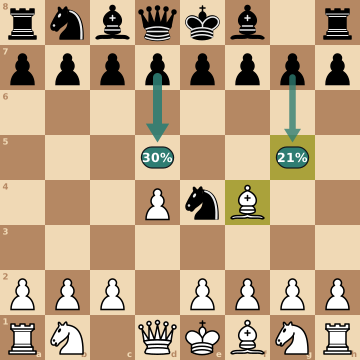
- 3...d5 (30%). Black supports the knight with d5.
Your answer: 4. e3. Protect your bishop and open the way for your other bishop. - 3...g5 (21%). It's aggressive, but that g5 pawn can become a target.
Your answer: 4. Bc1. Back home, where the bishop is completely safe.
After 1. d4 Nf6 2. Bg5 h6 3. Bxf6
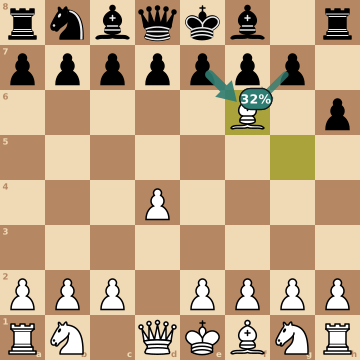
- 3...exf6 (68%). d5 lines.
Your answer: 4. e3. Solid, and it opens your f1 bishop. - 3...gxf6 (32%). h6 has weakened them further.
Your answer: 4. e3. Calm development. Black's broken pawns aren't going anywhere.
After 1. d4 Nf6 2. Bg5 d6 3. Bxf6
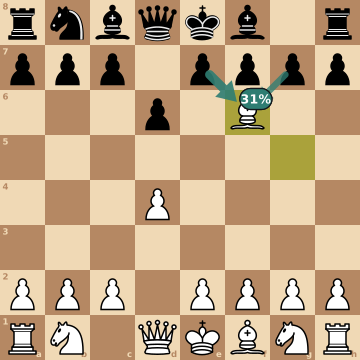
- 3...exf6 (68%). Black recaptures with the e-pawn.
Your answer: 4. e3. The usual solid setup. - 3...gxf6 (31%). Black recaptures with the g-pawn.
Your answer: 4. e3. Calm and solid.
Your plan after the opening
Against 2...e6: take space with e4 and e5
Play 3.e4 while the f6 knight is pinned. After 3...Be7 4.e5 the knight has to jump, and 82% of players choose 4...Nd5. Trade bishops with 5.Bxe7, then kick the knight again with c4. Your pawns on c4, d4 and e5 give you lots of space. Then just develop: Nc3, Nf3, a bishop move and castle. When Black hits back with ...d6 or ...c5, keep c4 and d4 protected before starting anything else.
1. d4 Nf6 2. Bg5 e6 3. e4 Be7 4. e5 Nd5 5. Bxe7 Qxe7 6. c4 Nb6 7. Nc3
Against 2...d5, 2...h6 and 2...d6: double the pawns, then hit d5
Take on f6. Most players recapture with the e-pawn (72% after 2...d5), which leaves a doubled f-pawn. Now e3 supports d4 and frees your other bishop, and c4 attacks d5, Black's only center pawn, which the doubled f-pawns can't help defend. Black's bishop on d6 often points at h2, so castle before you get ambitious. Your trump is the pawn structure, and it counts for more with every trade.
1. d4 Nf6 2. Bg5 d5 3. Bxf6 exf6 4. e3 Bd6 5. c4 dxc4 6. Bxc4 Nd7 7. Nc3
Against 2...g6: take, then fianchetto your own bishop
After 3.Bxf6 exf6 (98% of games), Black's pawn on f6 blocks the bishop that wants to go to g7. You put your bishop on the long diagonal with g3 and Bg2, where nothing blocks it. Develop the king's knight to e2 rather than f3 so it doesn't stand in front of that bishop, castle, and push c4.
1. d4 Nf6 2. Bg5 g6 3. Bxf6 exf6 4. e3 Bg7 5. g3 O-O 6. Bg2 d5 7. Ne2
Against 2...Ne4: retreat and then go after the knight
Step back with 3.Bf4. If Black supports the knight with 3...d5, play e3, then challenge the knight with Bd3 or Nd2. If Black chases the bishop again with 3...g5, go all the way home with 4.Bc1. The bishop is safe there, and the g5 pawn becomes a target: kick the knight with f3, develop, and pick up the pawn. Stockfish rates you more than half a pawn better in that line.
1. d4 Nf6 2. Bg5 Ne4 3. Bf4 g5 4. Bc1 d5 5. f3 Nd6 6. Nc3 Bg7 7. Bxg5
Traps and common mistakes
Black grabbing e4 while the knight is pinned
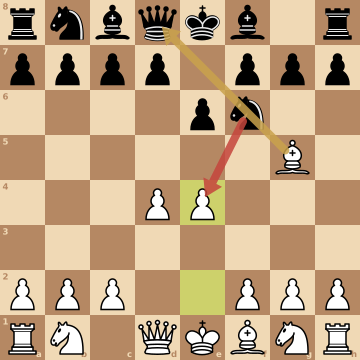
1. d4 Nf6 2. Bg5 e6 3. e4 Nxe4?? 4. Bxd8
After 2...e6 the e7 pawn has moved, so your bishop on g5 looks straight through to Black's queen on d8. The knight on f6 can't move without losing the queen. That's why 3.e4 works even though e4 looks unprotected.
The same idea comes back after 3...d5 4.e5. The knight is attacked, but 4...Ne4?? loses the queen to 5.Bxd8. Black's best is 4...h6, and then retreat with 5.Be3.
Pushing 4.e5? when your bishop is attacked
1. d4 Nf6 2. Bg5 e6 3. e4 h6 4. e5? hxg5
After 3...h6 (24% of games) your bishop is under attack, so 4.e5 simply loses it: Black takes on g5 and Stockfish rates Black more than three pawns better.
Take first with 4.Bxf6. Retreating to f4 or e3 releases the pin so the knight can grab e4, and 4.Bh4 lets Black break the pin with ...g5.
The 6...Ng5? knight trap
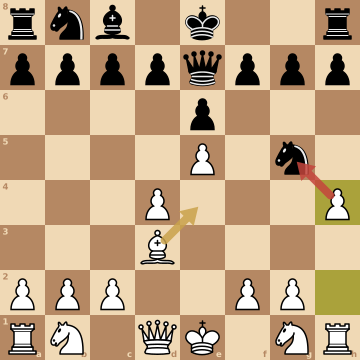
1. d4 Nf6 2. Bg5 e6 3. e4 Be7 4. e5 Ne4 5. Bxe7 Qxe7 6. Bd3 Ng5? 7. h4!
When Black answers 4.e5 with 4...Ne4, trade bishops and play 6.Bd3. The knight on e4 has no pawn behind it, so Black has to move it or prop it up with ...f5. The most common retreat at this level is 6...Ng5?, played in 33% of games, and it loses the knight to 7.h4!
Look at the knight's squares: e4 is covered by your bishop, f3 and h3 by your g2 pawn, and f7, h7 and e6 hold Black's own pawns. After the calmer 6...f5, you're still better by about three quarters of a pawn.
Forgetting about b2 after ...Qb4+
1. d4 Nf6 2. Bg5 e6 3. e4 Be7 4. e5 Nd5 5. Bxe7 Qxe7 6. c4 Qb4+ 7. Nd2
6...Qb4+ is played in 24% of games once you kick the knight with 6.c4. It checks and attacks b2 at once. Most players block with 7.Qd2, which lets Black trade queens. Block with 7.Nd2 instead.
Now the d5 knight is still attacked by your c-pawn, so 7...Qxb2? runs into 8.Rb1, hitting the queen, with cxd5 to follow. Against the usual 7...Nb6 or 7...Nf4, play 8.Qc2 to cover both c4 and b2.
Frequently asked questions
Is the Trompowsky Attack good for beginners?
It's a good fit for players from about 900 to 1800. There's very little theory, the plans repeat from line to line, and few opponents at this level have prepared for it. You do need to remember one rule: against 2...e6 you play 3.e4 instead of taking on f6.
What is the most common reply to the Trompowsky at club level?
At 900 to 1800 on Lichess it's 2...e6, in 29% of games. Next are 2...d5 at 18% and 2...g6 at 17%. The sharp 2...Ne4 comes up in about one game in eight, and the direct 2...h6 in 10%.
Should I always take on f6 in the Trompowsky?
No. Take against 2...d5, 2...g6, 2...h6 and 2...d6, because Black has to recapture with a pawn. Against 2...e6 the queen could recapture, so you play 3.e4 and use the pin instead. Against 2...Ne4 the knight has already left f6, so your bishop goes to f4.
How do I play against 2...Ne4 in the Trompowsky?
Retreat with 3.Bf4. If Black plays 3...d5, continue with e3 and then Bd3 or Nd2 to challenge the knight. If Black plays 3...g5, drop back to 4.Bc1, then kick the knight with f3 and go after the weak g5 pawn.
Does giving up the bishop for the knight make the Trompowsky bad?
Not at this level. Black gets the two bishops, but you get the healthier pawns and easy development, and Stockfish rates most of those lines as level. Your winning chances come from the doubled f-pawns, which become more of a problem for Black as pieces get traded.
Keep learning
- All 36 opening guides: every opening on the site, grouped by what you play as White and Black.
- London vs Torre vs Trompowsky: How the three low-theory 1.d4 systems compare, and who each one suits.
- Which White openings are right for 1200 to 1500: Five White openings whose rating range covers the middle of the club ladder.
The Coach plays Black against you with the moves 900 to 1800 players actually choose after 2.Bg5, from 2...e6 to 2...Ne4, and explains every move in plain English. Progress tracking is free during the open beta.
Practice the Trompowsky Attack free →