What Is Zugzwang in Chess? Meaning and Examples
TL;DR
In one sentence Zugzwang is when any move you make worsens your position, but you have to move. Meaning German for "compulsion to move". Say it "TSOOK-tsvahng". Where it happens Mostly in endgames, above all king and pawn endgames Mutual zugzwang Whoever has to move is the one who loses Not the same as Stalemate, where you have no legal moves at all
What zugzwang means
In chess you can't pass. Most of the time that doesn't matter, because there's always something useful to do. But sometimes a position is perfectly fine for you, and the only problem is that it's your turn. Whatever you play, you give something up: a square, a pawn, or the game. That's zugzwang.
All the positions on this page were checked with an endgame tablebase, a database that knows the perfect result of every position with seven pieces or fewer.
Example 1: the kings face off
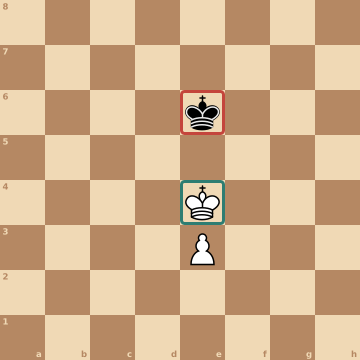
The two kings stand face to face with one square between them. This standoff is called the opposition, and the side that does not have to move "has" it.
- Black to move loses. The king must step aside, for example 1...Kd6, and White's king walks forward with 2.Kf5. Then the white king leads the pawn up the board and it promotes.
- White to move draws. Now White is the one who has to step aside. After 1.Kd4 Kd6 (or 1.Kf4 Kf6), Black keeps the opposition, and White can't make progress.
Same position, same pieces. The only difference is whose turn it is, and it changes the result. That's the whole idea of zugzwang.
Example 2: mutual zugzwang
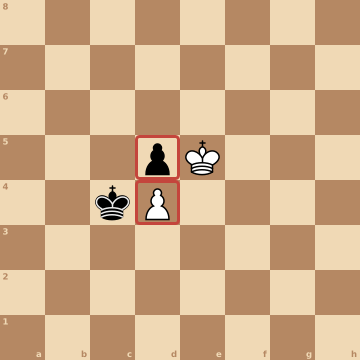
Each king attacks the enemy pawn and defends its own. If White moves, the king has to let go of d4, Black takes it with ...Kxd4, and Black wins. If Black moves, White takes on d5 and wins instead. This position has a name: the trébuchet.
Why zugzwang matters in the endgame
In the opening and middlegame there is almost always a harmless move available, like a pawn push or a rook shuffle, so zugzwang is rare. In the endgame there are only a few pieces left, every move counts, and running out of safe moves becomes a real problem. That's why these ideas show up again and again:
- The opposition (Example 1) decides most king and pawn endgames.
- Spare pawn moves are gold. A pawn that can still move one square lets you "pass" and hand the move to your opponent.
- Triangulation is a king maneuver over three squares that loses a move on purpose, so the opponent ends up being the one to move.
Zugzwang in the middlegame
It does happen, just rarely. The most famous example is Sämisch against Nimzowitsch, Copenhagen 1923, often called "the Immortal Zugzwang Game". White still had all his pieces, but every one of his moves lost material, so he resigned. For club players, the lesson is simpler: when your opponent has very few safe moves, look for a quiet move that takes away the last one.
How to use zugzwang
- Ask "what if it were their move?" If your opponent would be in trouble having to move, find a way to give them the move: a waiting move, a spare pawn move, or a king triangle.
- Save your spare pawn moves. Don't push pawns in the endgame without a reason; you might need that tempo later.
- Learn the opposition. It's the single most useful endgame idea for beginners, and it's pure zugzwang.
Practice it
Try our zugzwang puzzles, taken from real games, or the full endgame puzzle set. Zugzwang's close cousin is stalemate, which is when the player to move has no legal moves at all. For more words like this, see our chess terms glossary.
FAQ
What does zugzwang mean?
Zugzwang is a German word meaning "compulsion to move". In chess, it's a position where the player to move would be fine if they could pass, but every legal move makes their position worse.
How do you pronounce zugzwang?
Roughly "TSOOK-tsvahng". In English it's often said "ZUG-zwang", and people will understand either.
What is mutual zugzwang?
A position where whoever has to move is worse off. If it's White's turn, White suffers; if it's Black's turn, Black does. Strong players call it a reciprocal zugzwang.
Is zugzwang the same as stalemate?
No. In zugzwang you do have legal moves, they're just all bad. In stalemate you have no legal moves at all and you're not in check, so the game is a draw.
Where does zugzwang happen most?
In endgames, especially king and pawn endgames, where there are few pieces left and no spare moves to waste. In the middlegame it's rare, because there's almost always a harmless move to play.
These puzzles come from real Lichess games where putting the opponent in zugzwang was the only way to win.
Try the zugzwang puzzles →