Why Is the Caro-Kann Defense (1.e4 c6) Considered So Solid?
TL;DR
Why it's solid Black supports d5 with a pawn, develops the light-squared bishop before playing ...e6, and ends up with no obvious weaknesses. Games behind this article About 37 million Lichess games at 800 to 2200 Black's reply to 3.e5 3...Bf5 in 64% of games White's 4th move vs 3...Bf5 4.Nf3 28.0% · 4.Bd3 22.4% · 4.h4 8.4% · 4.f4 8.3% · 4.Nc3 7.9% · 4.g4 6.4% Lichess result After 4.h4, 16% of players reply 4...e6?, and White wins 69% of those games (800 to 2200) Recommended range 800 to 2200 Elo, 14 lines in our trainer Solid doesn't mean passive or drawish. It means Black's position is hard to damage, which is a different thing.
The idea in two moves
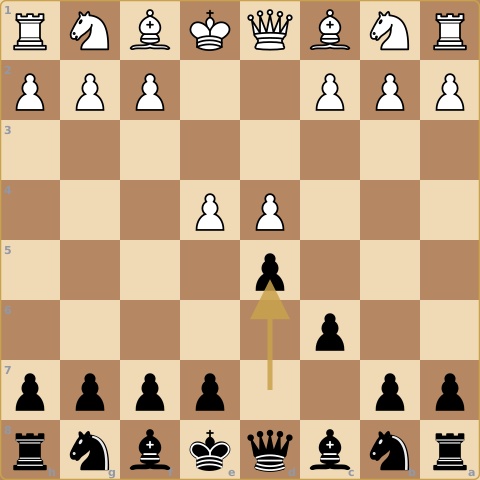
Black prepares ...d5 with ...c6, so when the d-pawn arrives it's already protected. That small detail explains most of what makes the Caro-Kann solid. If White takes on d5, Black takes back with a pawn and keeps a pawn in the center. If White pushes past with e5, the d5 pawn is still firmly supported.
Reason 1: the bishop gets out first
Compare it with the French, 1.e4 e6. In the French, Black also plays ...d5, but the pawn on e6 locks the c8 bishop in. French players spend a lot of energy fixing that problem.
In the Caro-Kann, Black waits with ...e6 until the bishop is already outside the pawn chain. Look at the most common line against the Advance Variation:
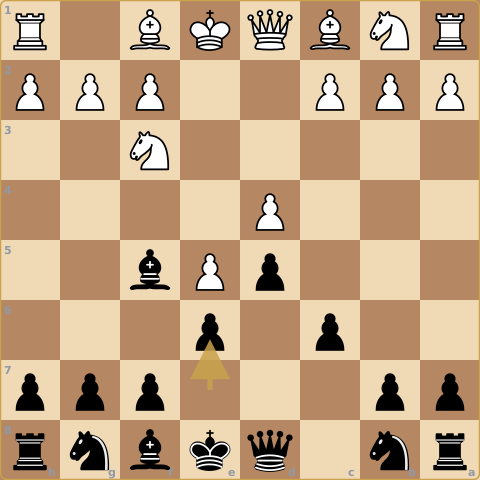
At 800 to 2200 on Lichess, 64% of Black players answer 3.e5 with 3...Bf5, and against 4.Nf3, White's most common reply (28.0%), our trainer follows up with 4...e6. The order matters: bishop out first, then the pawn chain. Black gets the French pawn structure without the French problem bishop.
Reason 2: no holes, no loose pawns
After ...c6, ...d5 and ...e6, Black's pawns cover each other and the key squares in front of them. There are no weak squares White can easily occupy, no backward pawns and nothing hanging. Black's king usually castles short into a position with all its pawns still at home.
That's why many Caro-Kann games reach endgames where Black is the one with fewer problems. White often has more space, but space can turn into overextended pawns once pieces come off.
Reason 3: White has to take risks to get an edge
Because Black's position has no obvious target, White usually has to do something committal to make progress. Our data shows White spreading across six tries against 3...Bf5:
- 4.Nf3 (28.0%), the Short Variation. Calm development, often with Bd3 or Be2 and castling.
- 4.Bd3 (22.4%). Offers a bishop trade. Black takes with 4...Bxd3 and the solid structure stays intact.
- 4.h4 (8.4%), the Tal Variation. Chase the bishop with h-pawn threats.
- 4.f4 (8.3%). Extra support for e5, though the f4 pawn shuts in White's dark-squared bishop.
- 4.Nc3 (7.9%). Quick development, with sharp g4 ideas in the background.
- 4.g4 (6.4%). An immediate bishop hunt with kingside pawns.
The sharp tries (h4, g4) show what White has to do to cause problems: push kingside pawns and accept some weaknesses of its own. Against 4.h4, Black's standard answer is simply 4...h5, stopping the pawn and keeping the bishop on its best square. The natural-looking 4...e6? is a real mistake: 16% of players at this level play it, 5.g4 chases the bishop until it's trapped, and White wins 69% of those games on Lichess.
The same story in the Classical Variation
The main alternative to the Advance is 3.Nc3 or 3.Nd2, where Black takes on e4 and again gets the bishop out before ...e6:
Same pattern: light-squared bishop out, then a solid ...e6 and ...Ngf6 setup, and a pawn structure without weaknesses. Our trainer covers the Advance in depth, since it's White's most common third move at 800 to 2200 (42.3%). The Classical isn't in our data yet, but the ideas carry over.
What Black gives up
Nothing's free. The Caro-Kann's safety comes with some costs:
- Less space. Especially in the Advance, White gets a big pawn on e5 and more room for the pieces.
- A slower counterattack. Black's main break is ...c5, and because the c-pawn already moved to c6, playing ...c5 costs an extra tempo.
- Fewer early winning chances. Against a careful White player, the game can stay balanced for a long time. You win Caro-Kann games in the middlegame and endgame, not in the opening.
If you want sharp, unbalanced positions from move two, the Sicilian or the Alekhine will suit you better. If you want a position that holds together when you're tired, short on time, or facing someone stronger, the Caro-Kann is hard to beat.
Is the Caro-Kann good for beginners?
Yes. Our recommended range starts at 800 Elo and runs to 2200. Early on, the main benefit is that it's hard to fall for a quick trap: the d5 pawn is protected, the bishop is active, and the king is safe. As you improve, White's six different fourth moves give you plenty to study. And from the White side, see how to beat the Caro-Kann for the plans you'll be facing.
Frequently asked questions
Why is the Caro-Kann so solid?
Because Black supports d5 with the c-pawn, develops the light-squared bishop before closing the pawn chain with ...e6, and ends up with a pawn structure that has no obvious weaknesses. At 800 to 2200 on Lichess, 64% of Black players answer the Advance with 3...Bf5, and ...e6 comes only after the bishop is out.
Is the Caro-Kann drawish?
It has a reputation for being safe, not for being drawish. White has several sharp systems (4.h4 and 4.g4 among them), and the positions stay rich. Black wins by outplaying White later rather than in the opening.
What is the difference between the Caro-Kann and the French?
Both put a pawn on d5. The French plays ...e6 first, which locks Black's light-squared bishop behind the pawns. The Caro-Kann plays ...c6 first, so the bishop can come out to f5 or g4 before ...e6.
What is White's most common answer to the Caro-Kann Advance?
In our data from about 37 million Lichess games at 800 to 2200, after 3.e5 Bf5 White's most common move is 4.Nf3 (28.0%), followed by 4.Bd3 (22.4%), 4.h4 (8.4%), 4.f4 (8.3%), 4.Nc3 (7.9%) and 4.g4 (6.4%).
Copy the lines (PGN)
Every line in this article in standard PGN, ready to paste into Lichess, Chess.com or any chess database.
[Event "Why Is the Caro-Kann Defense (1.e4 c6) Considered So Solid?: Caro-Kann Advance, Short Variation"]
[Site "chesscoachacademy.com"]
[Result "*"]

1. e4 c6 2. d4 d5 3. e5 Bf5 4. Nf3 e6 5. Be2 *

[Event "Why Is the Caro-Kann Defense (1.e4 c6) Considered So Solid?: Caro-Kann Advance, main line"]
[Site "chesscoachacademy.com"]
[Result "*"]

1. e4 c6 2. d4 d5 3. e5 Bf5 4. Nf3 e6 5. Bd3 Bxd3 6. Qxd3 c5 7. c3 Nc6 8. O-O Nge7 *

[Event "Why Is the Caro-Kann Defense (1.e4 c6) Considered So Solid?: Caro-Kann Advance, Tal Variation"]
[Site "chesscoachacademy.com"]
[Result "*"]

1. e4 c6 2. d4 d5 3. e5 Bf5 4. h4 h5 5. Bd3 Bxd3 6. Qxd3 e6 7. Nf3 c5 *

[Event "Why Is the Caro-Kann Defense (1.e4 c6) Considered So Solid?: Caro-Kann Classical"]
[Site "chesscoachacademy.com"]
[Result "*"]

1. e4 c6 2. d4 d5 3. Nc3 dxe4 4. Nxe4 Bf5 5. Ng3 Bg6 6. h4 h6 7. Nf3 Nd7 8. h5 Bh7 9. Bd3 Bxd3 10. Qxd3 *
Keep reading
- How to Beat the Caro-Kann as White: The White plans that cause the Caro-Kann the most trouble.
- What Is the Best Defense Against 1.e4?: How the Caro-Kann compares with Black's other answers to 1.e4.
Practice the Caro-Kann against every White try
Our Caro-Kann trainer covers 14 lines built from what 800 to 2200 rated players actually play on Lichess, including the Short Variation, 4.Bd3, the Tal Variation with 4.h4, 4.f4, 4.Nc3 and the 4.g4 bishop hunt. You play Black, the trainer plays White's real moves, and every move comes with a plain-English explanation.
It's free during the open beta, and your progress on every line is tracked for free once you create an account.
14 Caro-Kann lines from 37 million Lichess games. Free during the open beta, with free progress tracking.
Practice the Caro-Kann free →