How to Counter the French Defense (1.e4 e6) as White
TL;DR
Short answer Play the Advance Variation, 3. e5. Grab space, support d4 with c3, Nf3 and Be2, and let Black's bad light-squared bishop do the rest. Games behind this article About 30 million Lichess games at 900 to 1800 How often 3.e5 is played 47% of White players at this level choose it after 1.e4 e6 2.d4 d5 Black's reply to 3.e5 3...c5 70.5% · 3...Nc6 11.7% After 4.c3 4...Nc6 60.1% · 4...cxd4 13.7% · 4...Qb6 12.5% · 4...c4 5.2% White's key idea Hold d4. Be2 keeps your queen guarding it, Nc3 answers ...Bb4+, and Na3-c2 adds a defender when Black piles up. Lichess result 900 to 1800: after 6.Be2 cxd4 7.cxd4 Bb4+, White wins 52% of games with 8.Nc3 but only 42% with 8.Bd2 Recommended range 900 to 1800 Elo, 15 lines in our trainer
What the French is trying to do
The French is a counterattacking defense disguised as a passive one. Black lets White have the center for now, then hits it from the side with ...c5 and sometimes ...f6. The price is Black's light-squared bishop on c8, which is shut in behind the pawn on e6. French players spend half their lives trying to free that bishop.
On move three, White has four serious options:
- 3.e5, the Advance Variation. Grab space, lock the center.
- 3.Nc3, the main line. Leads to the Winawer (3...Bb4) and Classical (3...Nf6), both very theoretical.
- 3.Nd2, the Tarrasch. Avoids the Winawer pin and keeps things flexible.
- 3.exd5, the Exchange Variation. Very safe, but it frees Black's bishop and often leads to a symmetrical, drawish game.
For most club players, the Advance is the best practical choice. You decide the structure, the plans are clear, and you don't need to know the Winawer.
The Advance Variation: the plan in one line
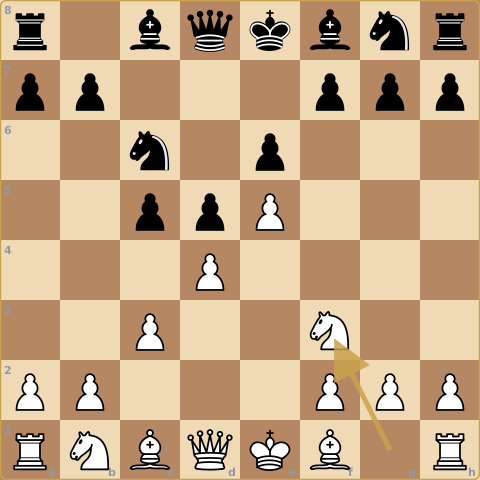
After 3.e5, Black wants to hit the base of White's pawn chain right away, and at 900 to 1800 on Lichess 70.5% of Black players do it with 3...c5. The next most common reply, 3...Nc6 (11.7%), is also covered by our trainer.
White's whole early game is about the d4 pawn. Black lines up against it with ...c5, ...Nc6, ...Qb6 and often ...Nge7-f5. White answers each attacker with a defender: c3, Nf3, Be2 and, when needed, a knight coming to c2 via a3. As long as d4 holds, White keeps the space, and Black's bishop stays stuck behind e6.
After 4.c3, Black's main choice is 4...Nc6 (60.1%), followed by 4...cxd4 (13.7%) and 4...Qb6 (12.5%). 4...Qb6 usually transposes after 5.Nf3 Nc6, so you only need one plan.
Meeting the queen on b6
This is the main line of our trainer, and 5...Qb6 is Black's choice in 49.4% of games at this level. The queen on b6 hits b2 and adds to the pressure on d4. The modest 6.Be2 keeps the d-file clear, so your queen still guards d4, and gets you ready to castle.
The most common reply is 6...cxd4 (35.9%) 7.cxd4, and then Black has two main tries. The check 7...Bb4+ (40.6%) is met by 8.Nc3, developing a new piece and leaving Black's bishop loose on b4. At 900 to 1800 on Lichess, White wins 52% of games after 8.Nc3, but only 42% after 8.Bd2.
Against 7...Nge7 (37.2%), the knight is heading for f5 to hit d4 a third time. Castling here is the natural mistake: 63% of White players do it, 8...Nf5 wins the d4 pawn, and White wins only 40% of those games. With 8.Na3 and Nc2, White wins 49%. And sometimes the answer is to change the structure: in the 6...Nh6 line (13.4%), 7.O-O Nf5 8.dxc5 Bxc5 9.b4 gains queenside space.
A trap every French Advance player should know
Many White players develop the bishop to d3 instead of playing 6.a3. That leads to a famous trap:
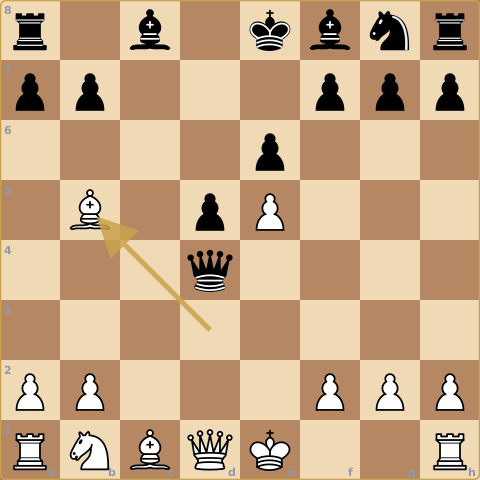
Black grabbed the d4 pawn twice, but once the bishop leaves d3 with check, White's queen on d1 attacks Black's queen on d4. Black has to deal with the check, and White takes the queen. Well-prepared Black players avoid this with 7...Bd7 first, which leads to the Milner-Barry Gambit, a sharp pawn sacrifice for White. 6.Be2, the move our trainer uses, keeps the queen's line to d4 open and avoids the whole question.
Mistakes to avoid as White
- Letting d4 fall. Count attackers and defenders on d4 before you castle, every move until the tension is resolved.
- Letting Black swap off your good bishop. With pawns on d4 and e5, your light-squared bishop is the good one and Black's c8 bishop is the bad one. Black would love to trade them with ...Bd7 and ...Bb5, so don't make it easy.
- Ignoring ...f6. When Black hits e5 with ...f6, be ready to support it or to take on f6 and use the open lines. Castle first if you can.
- Moving the c1 bishop too soon. It's the piece guarding b2. After 5...Qb6 6.Be3?, 6...Qxb2 leaves Black clearly better, and White wins only 38% of those games at this level.
For the full list of Black's counterattacking ideas from the other side of the board, read our guide to the key pawn breaks for Black in the French Advance. Knowing what Black wants is the fastest way to stop it.
What about 3.Nc3 and 3.Nd2?
Both are excellent, and at the top level 3.Nc3 is the most challenging try. But they come with a lot more theory, especially the Winawer after 3.Nc3 Bb4, where Black gives up the bishop pair to damage White's pawns and the main lines involve pawn sacrifices on both sides. We don't have trainer data for those lines, though at 900 to 1800 on Lichess 3.e5 is already the choice of 47% of White players. If you're building a first answer to the French, the Advance gets you playable, understandable positions far sooner.
Frequently asked questions
What is the best way to play against the French Defense?
For most players, the Advance Variation (3.e5) is the most practical. It gains space, keeps Black's light-squared bishop locked in, and needs far less theory than 3.Nc3. At 900 to 1800 on Lichess, 70.5% of Black players answer 3.e5 with 3...c5, so the plans are very predictable.
How do you punish the French Defense?
You don't punish it, because it's a sound defense. You make it uncomfortable. Keep a firm grip on d4 and e5, don't let Black trade off your good light-squared bishop, and look for the Bb5+ trap if Black grabs on d4 too early in lines with Bd3.
What is the Milner-Barry Gambit?
It's a sharp line in the French Advance: 1.e4 e6 2.d4 d5 3.e5 c5 4.c3 Nc6 5.Nf3 Qb6 6.Bd3 cxd4 7.cxd4 Bd7 8.O-O Nxd4 9.Nxd4 Qxd4 10.Nc3, where White gives up the d4 pawn for fast development.
Is the French Exchange Variation good for White?
It's safe, but it frees Black's problem bishop and usually leads to symmetrical positions. It's a fine choice if you want a quiet game, but it gives Black an easier time than the Advance.
Copy the lines (PGN)
Every line in this article in standard PGN, ready to paste into Lichess, Chess.com or any chess database.
[Event "How to Counter the French Defense (1.e4 e6) as White: French Advance main line"]
[Site "chesscoachacademy.com"]
[Result "*"]

1. e4 e6 2. d4 d5 3. e5 c5 4. c3 Nc6 5. Nf3 Qb6 6. Be2 cxd4 7. cxd4 Nge7 8. Na3 *

[Event "How to Counter the French Defense (1.e4 e6) as White: French Advance, 7...Bb4+"]
[Site "chesscoachacademy.com"]
[Result "*"]

1. e4 e6 2. d4 d5 3. e5 c5 4. c3 Nc6 5. Nf3 Qb6 6. Be2 cxd4 7. cxd4 Bb4+ 8. Nc3 Nge7 9. O-O *

[Event "How to Counter the French Defense (1.e4 e6) as White: French Advance, 6...Nh6"]
[Site "chesscoachacademy.com"]
[Result "*"]

1. e4 e6 2. d4 d5 3. e5 c5 4. c3 Nc6 5. Nf3 Qb6 6. Be2 Nh6 7. O-O Nf5 8. dxc5 Bxc5 9. b4 *

[Event "How to Counter the French Defense (1.e4 e6) as White: French Advance, the Bb5+ trap"]
[Site "chesscoachacademy.com"]
[Result "*"]

1. e4 e6 2. d4 d5 3. e5 c5 4. c3 Nc6 5. Nf3 Qb6 6. Bd3 cxd4 7. cxd4 Nxd4 8. Nxd4 Qxd4 9. Bb5+ *

[Event "How to Counter the French Defense (1.e4 e6) as White: Milner-Barry Gambit"]
[Site "chesscoachacademy.com"]
[Result "*"]

1. e4 e6 2. d4 d5 3. e5 c5 4. c3 Nc6 5. Nf3 Qb6 6. Bd3 cxd4 7. cxd4 Bd7 8. O-O Nxd4 9. Nxd4 Qxd4 10. Nc3 *
Keep reading
- Key Pawn Breaks for Black in the French Advance: Every counterattacking idea Black has, and how White should react.
- What Is the Best Defense Against 1.e4?: How the French compares with Black's other answers to 1.e4.
Drill the French Advance until d4 never falls
Our French Advance trainer covers 15 lines built from what 900 to 1800 rated players actually play on Lichess, including 4...Nc6, 4...cxd4, 4...Qb6 and 4...c4, the early 3...Nc6 with ...f6, and the Na3-c2 plan when Black piles up on d4. Every move has a short explanation, so you learn why you're playing it.
It's free during the open beta, and you can track your progress on every line for free with an account.
15 lines from 30 million Lichess games. Free during the open beta, with free progress tracking.
Practice the French Advance free →