Open Sicilian vs Alapin (2.c3): What's the Difference?
TL;DR
The split Open Sicilian: 2. Nf3 then 3. d4, recapturing on d4 with the knight. Alapin: 2. c3 then d4, recapturing with the c-pawn. Key difference The Open Sicilian trades a center pawn for fast development. The Alapin keeps (or rebuilds) a pawn center and avoids Black's prepared systems. Theory load Alapin: 16 lines cover Black's six most common replies in our trainer. Najdorf alone: 20 lines, with six main White systems after 5...a6 plus the anti-Sicilians. Black's replies to 2.c3 2...Nc6 32.4% · 2...d6 17.5% · 2...d5 14.5% · 2...e6 14.3% · 2...Nf6 9.1% (about 27 million Lichess games at 900 to 2200) Results We only quote Lichess results for specific positions, never an overall score for either choice. See "Winning chances" below. Best for Alapin: 900 to 2200 Elo, low study time. Open Sicilian (Yugoslav Attack): 1700 to 2400 Elo, sharp players.
The one-move difference that changes everything
Both approaches want the same thing: a pawn on d4. The difference is what happens after Black takes it.
In the Open Sicilian, White takes back with the knight. White now has a lead in development and more space, but Black has two center pawns (d6 and e7) against White's one (e4), plus a half-open c-file. That's the trade Sicilian players want.
In the Alapin, the c3 pawn is there to take back on d4 so White keeps a pawn in the center. Black never gets the classic Sicilian pawn trade, and a lot of what Black studied for the Open Sicilian no longer applies.
Structure: what the positions look like
Open Sicilian
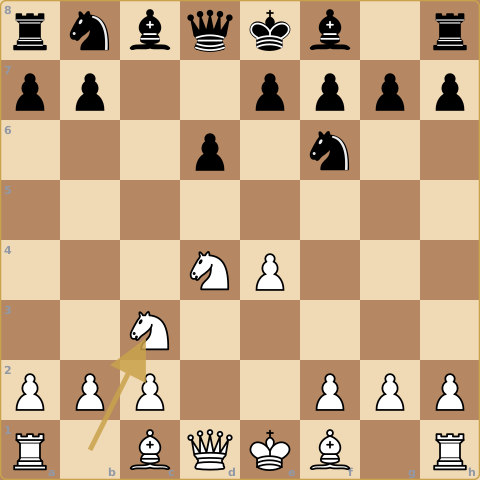
White's pieces come out fast and often aim at Black's king. Black counterattacks on the queenside along the c-file, frequently with ...b5. Opposite-side castling is common, and so are exchange sacrifices on c3. Positions stay unbalanced and double-edged.
Alapin
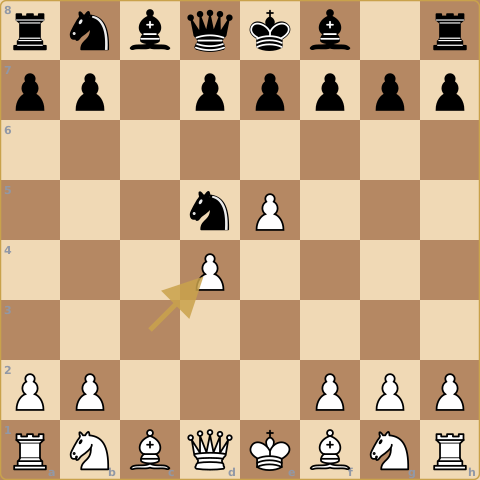
Against 2...Nf6, White pushes 3.e5 and gains space with tempo on the knight. In many lines White ends up with an isolated pawn on d4 after recapturing with the c-pawn. That pawn can become a target later, but in return White gets open files for the rooks, a good square on e5 and active bishops. You play for the initiative, not a mating attack.
Against 2...d5, Black's queen comes to d5 early. Normally White would kick it with Nc3, but the c3 pawn is in the way, so White plays 4.d4 and develops calmly with Nf3. Once the c-pawns are traded, c3 is free again and Nc3 comes with tempo on the queen.
Against 2...Nc6 (32.4%, Black's most common reply in our data), White plays 3.d4 cxd4 4.cxd4 and keeps two pawns in the center.
How much you need to learn
This is the biggest practical difference and the reason most club players end up choosing the Alapin.
- Alapin: our full trainer is 16 lines across Black's six most common replies. The plans overlap a lot (push d4, take back with the pawn, develop and castle), so knowing one line helps with the next.
- Open Sicilian: you need a system against every major Sicilian. Our Najdorf trainer alone has 20 lines, and after 5...a6 players at 1600 to 2400 on Lichess spread over six main White systems (6.Bg5 24.2%, 6.Be3 19.1%, 6.Bc4 13.8%, 6.Be2 12.4%, 6.f3 7.8%, 6.Bd3 7.5%). Against the Dragon, the Yugoslav Attack has two main ninth moves for White (9.O-O-O in 61% of games at 1700 to 2400 and 9.Bc4 in 20%), each with its own theory.
There's also the question of who has done more homework. A dedicated Sicilian player has usually studied their own system far more deeply than you have studied your answer to it. The Alapin moves the game onto ground where that preparation matters less.
Winning chances
Our data doesn't give an overall win percentage for either choice. It does show results after some specific positions, and they tell the same story: accuracy matters more than the opening. In the Yugoslav Attack, White wins 62% of games after the slow 9...a6 at 1700 to 2400 on Lichess. In the Alapin, after 2...Nc6 3.d4 cxd4 4.cxd4 g6 5.d5, 54% of players at 900 to 2200 answer 5...Ne5?, which runs into 6.f4, and White wins 63% of games after 5...Ne5 on Lichess.
The Open Sicilian gives both sides more chances. If you know the lines and like to attack, it produces the kind of positions where one well-timed sacrifice ends the game. If you don't know the lines, the same sharpness works against you.
The Alapin gives White a steady, modest edge in space and development and asks Black to prove equality. It's rarely a quick knockout, and a well-prepared opponent can reach a level position. It still has plenty of bite, which is why it has held its place at every level since the 1970s.
A simple way to decide
- If you're under about 1800, or you have an hour a week for openings, not ten, choose the Alapin.
- If you're 1800 or higher, you enjoy calculating, and you want to learn the classic Sicilian attacking patterns, choose the Open Sicilian and learn it one Black system at a time.
- If you already play the London System or another system opening, the Alapin will feel familiar: same idea of building a setup you understand rather than memorizing forcing lines.
Plenty of strong players use both, picking the Alapin against opponents who are known Sicilian experts and the Open Sicilian when they want a sharp game.
Frequently asked questions
Is the Alapin better than the Open Sicilian?
Neither is objectively better. The Open Sicilian is more ambitious and far more theoretical. The Alapin is sound, needs much less memorization, and gives White a steady edge in space. For most players under about 1800 the Alapin is the more practical choice.
Why don't strong players always play the Open Sicilian?
Because Sicilian specialists prepare their own systems very deeply. Playing 2.c3 takes the game away from that preparation. Deep Blue used the Alapin against Kasparov in 1996 for exactly this reason.
Does the Alapin lead to an isolated queen's pawn?
Often, yes. After lines like 2...Nf6 3.e5 Nd5 4.d4 cxd4 5.cxd4, White has recaptured on d4 with the c-pawn, and once White's e5 pawn is traded off, the d4 pawn is often left isolated. The isolated pawn comes with active pieces and open files, which is a well-known and fully playable trade.
What is Black's most common reply to the Alapin?
In our data from about 27 million Lichess games at 900 to 2200, 2...Nc6 is the most common reply (32.4%), followed by 2...d6 (17.5%), 2...d5 (14.5%), 2...e6 (14.3%), 2...Nf6 (9.1%) and 2...e5 (5.2%).
Copy the lines (PGN)
Every line in this article in standard PGN, ready to paste into Lichess, Chess.com or any chess database.
[Event "Open Sicilian vs Alapin (2.c3): What's the Difference?: Open Sicilian after 5.Nc3"]
[Site "chesscoachacademy.com"]
[Result "*"]

1. e4 c5 2. Nf3 d6 3. d4 cxd4 4. Nxd4 Nf6 5. Nc3 *

[Event "Open Sicilian vs Alapin (2.c3): What's the Difference?: Alapin, 2...Nc6"]
[Site "chesscoachacademy.com"]
[Result "*"]

1. e4 c5 2. c3 Nc6 3. d4 cxd4 4. cxd4 d5 5. exd5 Qxd5 6. Nf3 *

[Event "Open Sicilian vs Alapin (2.c3): What's the Difference?: Alapin, 2...Nf6"]
[Site "chesscoachacademy.com"]
[Result "*"]

1. e4 c5 2. c3 Nf6 3. e5 Nd5 4. d4 cxd4 5. cxd4 *

[Event "Open Sicilian vs Alapin (2.c3): What's the Difference?: Alapin, 2...d5"]
[Site "chesscoachacademy.com"]
[Result "*"]

1. e4 c5 2. c3 d5 3. exd5 Qxd5 4. d4 Nf6 5. Nf3 *
Keep reading
- How to Play Against the Sicilian Defense: The full overview of White's options against 1...c5.
- What Is the Best Defense Against 1.e4?: Every 1.e4 defense we cover, compared from Black's side.
Try the Alapin before you decide
The easiest way to choose is to play both kinds of position. Our Alapin trainer takes you through all 16 lines against 2...Nc6, 2...d6, 2...d5, 2...e6, 2...Nf6 and 2...e5, and the Yugoslav Attack trainer gives you a taste of the Open Sicilian at its sharpest.
Both are free during the open beta, and your progress on every line is tracked for free when you sign up.
Practice the Alapin Variation →
Practice the Yugoslav Attack →
Lines built from what players at your level play on Lichess, with a plain-English note on every move. Free during the open beta.
Practice the Alapin free →